
Visa Is Making Digital Assets Spendable at 175 Million Merchants. Could African Bitcoin Users Benefit?
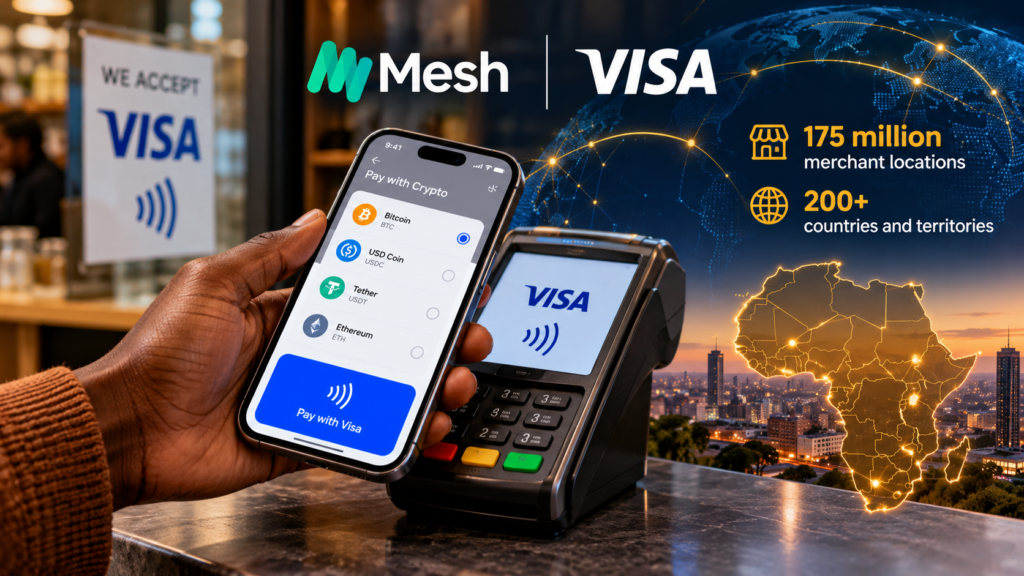
On October 19, 2026, Mesh, a crypto payments network, announced a strategic partnership with Visa to make cryptocurrency and stablecoin balances spendable across Visa’s global acceptance network. The announcement covers 175 million merchant locations across more than 200 countries and territories. It is the largest infrastructure move in crypto payments in years. Furthermore, it raises a direct question for African Bitcoin users: does this change anything for them?
The short answer is: possibly, but not in the way the headline suggests.
What the Mesh-Visa partnership actually does
The core mechanic is straightforward. Mesh acts as an intermediary layer between a user’s existing crypto or stablecoin wallet and Visa’s payment rails. Specifically, when a user wants to pay at a merchant, a Visa credential is provisioned in the background. The merchant receives a standard Visa payment in local currency. The user’s crypto or stablecoin balance is converted at the point of transaction.
In other words, the user never moves funds in advance. They do not cash out to a bank account and wait. They do not sign up for a separate card tied to a single platform. Instead, they tap at a contactless terminal or check out online from a wallet they already use. The merchant sees nothing different. The Mesh infrastructure handles everything in between.
Mesh CEO Bam Azizi described the problem the product solves directly. “Crypto never had a spending problem — it has a last-mile problem, and until now, closing it meant getting a separate card,” he said. “Mesh handles the funding and conversion, so a balance becomes purchasing power at the moment of payment, with nothing for the user to move and nothing for the merchant to change.”
Visa’s Global Head of Growth Rubail Birwadker added that the partnership is designed to expand how digital asset balances connect to the payment experiences consumers and merchants rely on every day.
What assets this covers
Here is where the Bitcoin-only framing matters. The Mesh-Visa partnership is primarily positioned around stablecoins and broader crypto balances, not Bitcoin specifically. Mesh already participated in Paxos’s Global Dollar Network and has positioned itself around stablecoin spending infrastructure.
Bitcoin is technically included under the broader “crypto balances” umbrella. However, the product’s natural home is stablecoin spending. Specifically, the use case Mesh describes most clearly is a user holding USDT or USDC in a wallet app who wants to spend it at a physical merchant without first cashing out to a bank account.
For a Bitcoin holder who values self-custody and the Lightning Network, this partnership does not change much in the near term. Lightning already solves the last-mile problem more elegantly for Bitcoin specifically: instant settlement, sub-cent fees, and no custodian holding your funds between transactions. Furthermore, Tando already connects Lightning wallets to M-Pesa in Kenya, and MoneyBadger already connects Bitcoin to Visa and Mastercard merchant infrastructure in South Africa.
Therefore, for African users already in the Bitcoin ecosystem, the Mesh-Visa announcement is primarily a signal about where the broader market is heading, not an immediate practical upgrade.
Why it still matters for Africa
However, the announcement is worth paying attention to for three specific reasons relevant to the African Bitcoin ecosystem.
First, it expands the merchant acceptance surface for digital assets broadly. 175 million Visa merchants accepting crypto spending means that any African user holding Bitcoin, stablecoins, or other digital assets has a much wider spending surface available to them when they travel, transact cross-border, or use platforms that integrate with Mesh.
Second, it validates the infrastructure model that African Bitcoin companies have already built. MoneyBadger in South Africa, Tando in Kenya, and Félix Pago (one of Mesh’s named enterprise partners) in Latin America are all building the same thing: a bridge between digital asset balances and existing payment infrastructure. The Mesh-Visa announcement is global validation of that model. Furthermore, it could accelerate similar integrations across Africa as more global payment infrastructure providers recognise the demand.
Third, it puts stablecoins and Bitcoin on the same spending rail. For African users who currently hold a mix of Bitcoin and dollar-pegged stablecoins, a single integration that makes both spendable through Visa is genuinely useful. It reduces the number of conversions and intermediaries in their spending workflow.
The custody question
The most important thing to understand about the Mesh-Visa model from a Bitcoin perspective is the custody implication. Mesh acts as the program manager, handling user onboarding and KYC. A Visa credential is provisioned behind the scenes. The conversion from crypto to fiat happens at the point of payment.
That means, for the duration of the transaction, Mesh is in the middle. The user is not transacting peer-to-peer. They are not holding their own keys at the moment of spending. This is fundamentally different from the Lightning Network model, where the payer and payee transact directly with no intermediary processing the conversion.
For everyday spending of small amounts, that distinction may not matter much to most users. However, for African users in countries with capital controls, unstable banking systems, or governments that have previously frozen accounts, the question of who processes your transactions and what data they retain about them is not abstract. It is the reason Bitcoin and Lightning exist in the first place.
The comparison to what already works in Africa
South Africa’s MoneyBadger already processes Bitcoin payments at merchant locations through Peach Payments, Ozow, and Scan to Pay, settling in rand on the next business day. Merchants receive local currency. Users spend Bitcoin. The model has been live for years and processed millions of rands in volume.
Kenya’s Tando already makes approximately 40 million M-Pesa phone numbers Lightning-addressable. A user sends sats. The merchant receives shillings. Settlement happens in seconds.
In both cases, the infrastructure is already built, locally, by African companies, for African use cases. The Mesh-Visa announcement is a global version of the same idea. Furthermore, it may eventually partner with or incorporate African payment rails as the rollout extends beyond initial markets.
What African users and developers should watch
The rollout details for the Mesh-Visa partnership have not been fully announced yet. Specifically, initial availability, supported devices, and participating platforms are still to be confirmed. Africa’s inclusion in the rollout will depend on which Mesh enterprise partners operate in African markets and which Visa corridors the product activates first.
For African Bitcoin developers building payment infrastructure, the Mesh-Visa announcement is worth studying as a reference architecture. Specifically, the model of provisioning a Visa credential in the background while the user pays from an existing balance is exactly the abstraction layer that makes crypto payments seamless for users who do not want to manage multiple accounts. That is a UX pattern worth understanding and potentially building toward in African-specific integrations.
For African Bitcoin users, the headline is less dramatic than it appears. What you have through Lightning, MoneyBadger, and Tando is already better for Bitcoin specifically than what Mesh-Visa offers today. However, the direction of global payment infrastructure is clearly moving toward making digital asset balances directly spendable. Africa is already ahead of that curve in several meaningful ways.
The last-mile problem Mesh is trying to solve globally is one that African Bitcoin builders started working on years ago. That work is not finished. However, it is further along than most of the world realises.
Sources
- Mesh press release — Mesh and Visa Partner to Make Stablecoin and Crypto Balances Spendable Across 175 Million Merchants — https://www.prnewswire.com/news-releases/mesh-and-visa-partner-to-make-stablecoin-and-crypto-balances-spendable-across-175-million-merchants-302912148.html
- Mesh — https://www.meshpay.com/
- MoneyBadger — https://www.moneybadger.co.za/
- Tando — https://tando.me/