
African Bitcoin builders unite SeD, ABSL and Pontmore
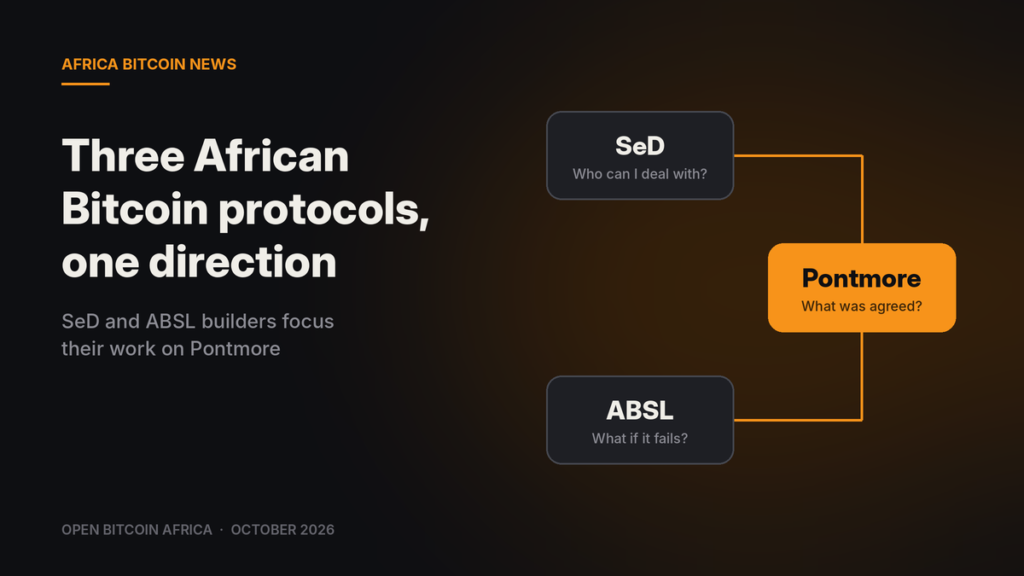
Three open-source Bitcoin protocol projects started by African developers are joining forces. In a proposal on the Open Bitcoin Africa forum, the builders behind SeD, ABSL and Pontmore agreed to focus their collaboration on Pontmore, an open protocol built on Nostr.
The goal is simple to state: help a wallet or app find a trustworthy provider, agree on terms, carry out a Bitcoin trade, and know what protection exists if something goes wrong.
Three projects, three questions
Each project started by answering a different question about the same kind of trade, such as swapping Bitcoin for local currency.
- SeD (service discovery) asks: who can I deal with, and who vouches for them? It lets providers publish where they operate, which currencies and payment rails they support, such as M-Pesa or bank transfers, and builds reputation from records of past trades.
- Pontmore asks: what was agreed, what happened, and in what order? It gives each participant a portable Nostr identity and a shared record of every step in a trade.
- ABSL (African Bitcoin Settlement Layer) asks: what protection does a customer get if the provider fails to deliver? It explores providers locking Bitcoin as collateral and reserving capacity for each order.
On their own, each project covers one step. Together, they describe a full trade from discovery to recovery.
How the Pontmore collaboration will work
The direction came out of a meeting on 14 October between Theophilus (extheo), Tobechukwuleta (tobses), Brian (bmosha) and Jodom (okjodom). Jodom, a Fedimint contributor and co-founder of Bitsacco and Minmo, published the proposal on 15 October.
Rather than build three separate systems, the team will fold SeD and ABSL ideas into Pontmore’s specifications, known as PIPs:
- Theophilus will distil SeD’s discovery ideas into Pontmore PIP-00.
- Tobechukwuleta will then build a discovery SDK around that specification.
- Brian and Jodom will bring ABSL’s settlement protections into PIP-01 and PIP-02.
- Jodom will share the direction and invite more contributors.
The post describes these as starting responsibilities, and every part is open to collaborators.
What it means for Africa
Pontmore’s design borrows from a model Africans already know: the mobile money agent. Just as M-Pesa, MTN MoMo and Airtel Money agents help money move between people, Pontmore agents, whether a person or a service, help Bitcoin move between users and local payment systems.
That matters for businesses expanding across borders. Today, a Bitcoin company entering a new African market usually finds and vets local liquidity partners through private, manual processes. An open standard could let capable local providers advertise their services and build a public track record that any app can check.
As a result, smaller operators would not need to sign up to one dominant platform to be found and trusted. Their identity and reputation would travel with them.
Still early, with open questions
All three projects are drafts. Pontmore calls itself “an evolving draft”, and the ABSL prototype “is not ready for real funds”.
The team lists open questions it still has to answer:
- how to show reputation without exposing private transaction details
- how to require collateral without shutting out smaller providers
- how to keep the protocol flexible while making each settlement method’s security assumptions clear
Early replies are supportive. One contributor, Colmwanga, asked how failed, timed-out or disputed trades will be handled. The same reply suggested testing the design on a real trade, such as M-Pesa to Bitcoin over Lightning.
How to get involved
The team wants wallet builders, liquidity providers, payment operators, Nostr developers and protocol reviewers. Contributors can review the discovery proposal, help build the SDK, or test the model on a real payment corridor.
To join, reply in the proposal thread on Open Bitcoin Africa or open an issue in the Pontmore protocol repository.