
South Africa’s Bitcoin Township: Herman Vivier on Five Years of Turning a 2010 Surf Charity into Mossel Bay’s Working Circular Economy
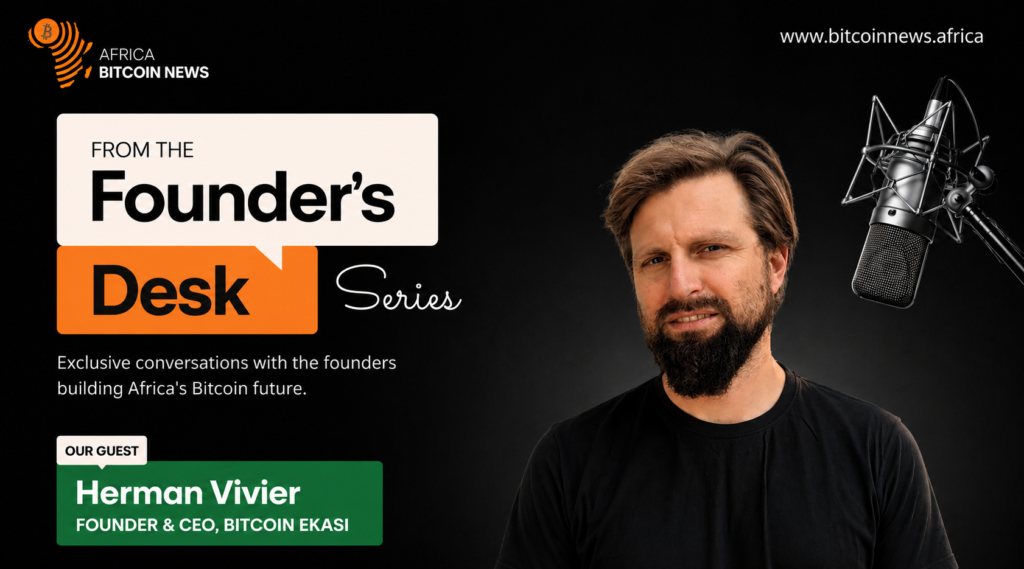
Bitcoin Ekasi didn’t start with code or venture capital. It started with a decade of community trust in a poor township, then layered Bitcoin on top to pay salaries in sats and get spaza shops accepting them.
In Mossel Bay’s JCC Camp township, government-funded schools have no sports, no extras, and chronic under-resourcing. Kids from the poorest families grow up in an economy that runs on donations and rand that lose value. Traditional charity keeps the lights on but never builds lasting financial agency.
Bitcoin Ekasi solved the exact gap: take an 11-year-old surf youth program with deep local trust, pay every coach 100% in Bitcoin, and have those coaches onboard the corner shops where they actually spend. The result is a circular economy where sats earned, spent, and saved stay inside the community, no middlemen, no forced conversion, no perpetual handout cycle.
The Founder’s Journey
Herman Vivier co-founded The Surfer Kids in 2010, the year South Africa hosted the Football World Cup. It began as a small after-school surf program for kids from the surrounding townships.
By 2015 it ran daily sessions with a tiny staff. Vivier and his wife also ran a tourism business; international payments and South Africa’s strict capital controls made every cross-border transaction a headache. He first encountered Bitcoin in July 2013 through an early copy of Bitcoin Magazine while the Cyprus banking crisis unfolded, bank deposits confiscated to bail out the system.
The parallel was immediate. He started accepting Bitcoin for tourism clients in 2015. Between 2015 and 2017 he ran the usual altcoin experiments, even tried running an Ethereum node that crashed his laptop, but returned to Bitcoin. The catalyst arrived in 2021 when he heard the Bitcoin Beach story.
“I only really figured out that I could incorporate Bitcoin into the Surfer Kids after hearing the Bitcoin Beach story,” Vivier says. “I had ideas before that, but the light bulb moment came when I heard the Bitcoin Beach story.” In July 2021 he began paying coaches in Bitcoin and onboarding local merchants.
The project formally launched on X in November 2021. Five years later, at the end of 2026, Bitcoin Ekasi will mark its anniversary on the same community platform that began as a simple surf charity.
Core Insights & Infrastructure
The mechanics are deliberately low-tech and high-trust. The Surfer Kids already had the confidence of parents, teachers, churches, and the township itself after more than a decade of consistent work. Coaches received salaries in Bitcoin and immediately spent them at newly onboarded spaza shops.
The circular loop started small and grew organically: earn in sats, spend in sats, save in sats. No one had to sell Bitcoin for rand unless they chose to.Vivier is clear about why it worked. “The coaches had the trust of the community. So it was not an impossible thing to do. If we had started from scratch it would have been very difficult.”
Challenges were constant. Locals initially associated Bitcoin with scams or assumed the project had unlimited money to hand out. Government officials sometimes approached with the same expectation. Explaining the why; Bitcoin as a tool for economic empowerment rather than speculation, proved harder than onboarding merchants.
The bigger operational shift came in the last two years: moving the entire organization away from donation dependence. “If we ourselves are reliant on outside charity, then are we really practicing what we preach? Are we really teaching people to be economically empowered if we’re constantly relying on donations?” Vivier asks.
To answer that question they built side projects that generate real income: old surfboards (non-recyclable and toxic in landfills) are upcycled into miniature Bitcoin-themed art pieces sold at conferences and to visitors. One salary now comes entirely from that line. They run a targeted competitive surfing program for kids who want it; one recently placed second in a major national pro-junior event, the best result in the project’s history. The goal is commercial sponsorships, not charity.
Get the Weekly Brief
Essential African Bitcoin news, curated for builders. No spam.
"*" indicates required fields
Smaller experiments include a thrift store, 3D-printed items, and an arcade machine, all aimed at the same end: internal revenue that does not rely on external handouts.South Africa’s macroeconomic realities shaped the approach from day one.
Strict exchange controls had already made Bitcoin useful in Vivier’s tourism business years earlier. The township’s poverty and rand inflation made a neutral, portable savings and payment tool obvious once the trust layer existed.
Future Outlook
Bitcoin Ekasi is now five years old. Thirty-two township shops accept Bitcoin. Twenty-one Surfer Kids staff earn 100% of salaries in sats. One full salary is covered by the upcycled surfboard art business. Competitive results are climbing.
The project is migrating to a self-hosted Fedimint federation for even tighter circular control and is actively pushing back against proposed regulations that would force liquidation of Bitcoin savings. The long-term vision is explicit: teach financial responsibility by building sustainable income inside the community.
Vivier frames the work in decades, not hype cycles. “It’s always gonna take much longer than you think it’s gonna take,” he says. “If your horizon for your project in your mind when you start is five years, then it’s probably gonna take ten years, or maybe more.” He adds a harder truth for founders: “Oftentimes the best part of the project is not necessarily the part of the project that you plan for.”
Bitcoin Ekasi itself was never the original plan. It emerged from a surf charity that had already earned the community’s trust. That unplanned intersection, eleven years of on-the-ground work plus Bitcoin as money, produced something that still stands while many flashier experiments have disappeared.
For anyone building in African Bitcoin today, Vivier’s record offers a simple metric: real circular economies are not built in eighteen months. They are built in the trenches, one trusted relationship and one sats transaction at a time.