
55 Women Built Bitcoin Tools in Nairobi. These Are the Projects That Won.
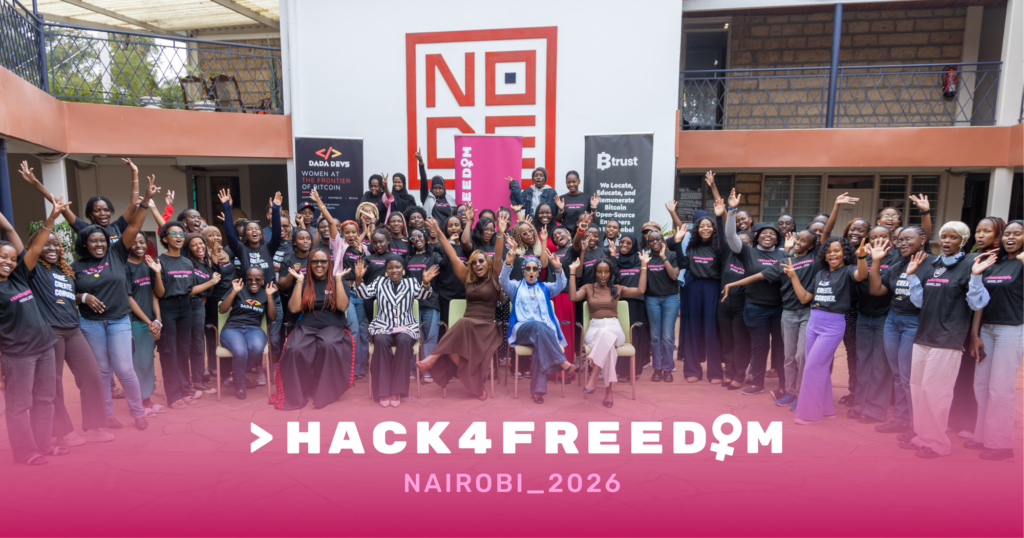
From September 22 to October 4, 2026, 55 women gathered in Nairobi for the biggest Hack4Freedom cohort to date. Over two weeks, they learned, built, and shipped open-source Bitcoin and freedom technology tools. On Demo Day, ten teams took the stage. Four won prize money. Every single project solved a real problem.
The program was delivered in partnership with Dada Devs, funded by Btrust, with the Nostr prize and AI tooling provided by Soapbox. It is the fourth Hack4Freedom city, following Kaduna, Lagos, and São Paulo. Nairobi is the largest yet. Furthermore, it brings the total to 140 builders, 40 open-source projects, four cities, and three countries.
Why Nairobi, and why women builders specifically
Hack4Freedom founder Brianna Honkawa d’Estries opened the program with a clear argument. Bitcoin adoption is not the bottleneck in Nairobi. People already earn, save, and transact in Bitcoin every day. The bottleneck is builders. Fewer than 3% of open-source contributors globally are women. Africa as a whole makes up less than 3% of developers on GitHub. Even in Kenya, one of Africa’s fastest-growing developer communities, women remain underrepresented in the rooms where Bitcoin gets built.
Lorraine Marcel, founder of Dada Devs and a co-organiser of the Nairobi cohort, challenged participants directly. Africa does not just need more people using technology. It needs more people building it. Specifically, she pushed the cohort to create with open-source protocols: Bitcoin, Lightning, Nostr, and eCash.
The program covered two weeks of technical workshops, mentorship sessions, and open-source contribution training from a lineup that included Amiti Uttarwar (Bitcoin Core’s first female contributor), Sharon Murugi of Btrust Builders, Sabina Waithira Gitau and Jason of Tando, Simon Njeru of BitDevs Nairobi, and more than a dozen other practitioners.
The winning projects
1st Place: ANZA ($2,000)
Built by Team Node One: Irene Mukii, Nady, Aisha, Jennifer, and Miriam.
Creators today have no way to make the first move in licensing. They wait to be chosen. ANZA changes that. It is open creator-licensing infrastructure where creators define their own terms, sign offers as Nostr events, brands pay over Lightning before delivery, and every transaction becomes a verifiable public record.
In short, ANZA gives African creators the ability to monetise their work on their own terms, without a platform intermediary, using Bitcoin as the payment rail and Nostr as the public record.
2nd Place: Resilience ($1,000 plus honorable mention from Lorraine Marcel)
Built by Team Nostr Warriors: Vanessa Kalondu, Adreen Nyawira Githinji, Wambugu Jane Rose Muthoni, Nelly Nakhero, Mona Tanei, Grace Mugoiri, and Daisy Sawe.
Survivors of gender-based violence cannot safely seek help on platforms that demand a name, phone number, or email. That data can be used against them. Resilience is a privacy-first support platform where the account is a Nostr keypair generated on the device. No phone number. No email. Nothing to subpoena. End-to-end encrypted conversations with verified counselors. Lightning payouts settled in Kenyan shillings over M-Pesa.
This is one of the most direct applications of Bitcoin and Nostr’s privacy properties to a real, urgent, life-and-safety problem on the continent.
3rd Place: MIKI ($500)
Built by: Riziki, Idah, Joy, Vanessa, Edith, and Vera.
Confirming a payment on screen is impossible for visually impaired users and impractical at busy market stalls. MIKI adds a voice layer to Lightning payments. An invoice is generated through Lightning node APIs, approved in a WebLN wallet, and on settlement the backend verifies it and speaks the confirmation aloud.
Accessibility in Bitcoin payments has been a largely ignored problem. MIKI addresses it directly.
Nostr Prize: Nuru Women ($1,000)
Built by: Rose Njuguna, Britney Kibaara, Casey Otieno, Anastacia Ngure, Joylizza Mwangi, Prudence Ngigi, and Joy Kibui.
Reliable, private, locally relevant health information is hard to reach for women facing stigma, misinformation, and language barriers. Nuru Women is a privacy-first women’s health platform. Women ask sensitive questions anonymously, with no account, email, or phone number, and receive guidance in English or Kiswahili across five health areas. Questions publish through Nostr with one-time signing keys. The team also built a research-gap visualisation spanning 53 African countries to show where the health evidence itself is missing.
The other six projects that belong on your radar
Choosing winners from this cohort was genuinely hard. According to Hack4Freedom, every team found a real problem and built a working answer with Bitcoin at the centre. The six non-winning projects are worth knowing:
Sauti gives writers a pseudonymous identity tied to a Nostr key they hold, paid in sats over Lightning or in Kenyan shillings over M-Pesa, so a book that criticises power never costs a writer their job or freedom. Built by Donisia Muthiani.
Safaripap lets matatu passengers scan a QR code and settle each fare instantly over Lightning, with a public receipt event to Nostr so earnings can be audited. It removes the privacy exposure of M-Pesa fare payments while giving vehicle owners a tamper-proof earnings record. Built by Team Lady Lightning.
PesaSense builds a private, on-device profile from M-Pesa history that shows a user a safe surplus range and grows a Bitcoin savings habit in a non-custodial Spark wallet. Built by a five-person team.
Taska routes AI responses to local evaluators, double-checks their work, and pays them over Lightning, directly addressing the problem of AI hallucinating fluently in African languages. Built by Florence Makaa and Stacy Kweto.
BillBridge enables cross-border fundraising for school and hospital bills in Kenya, with every bill verified and paid directly over Lightning. Built by a six-person team.
Spill is an offline-first journalism platform on Nostr where people discover and discuss local stories even without reliable internet. Built by Lucy.
All project repositories are available at github.com/hack-4-freedom/nairobi-2026.
What this adds up to
The numbers from Nairobi are significant on their own. 55 builders. 10 teams. 10 projects. More than $4,500 in prize money distributed. Furthermore, the quality of the work produced in two weeks by first-time Bitcoin developers is remarkable.
However, the more important number is the cumulative one. Four cities. 140 builders. 40 open-source projects. A global network of women contributing to Bitcoin and freedom technology that did not exist three years ago.
Hack4Freedom’s stated goal is not to run hackathons. It is to build a network of 100 or more women from the global majority working in freedom tech. Nairobi’s cohort moved that number significantly forward. Port Harcourt is next, with dates to be announced soon.
When women build, freedom follows. ⚡
Sources
- Hack4Freedom blog — Hack4Freedom Nairobi: Our Biggest Cohort Yet — https://blog.evento.so/hack4freedom-nairobi-our-biggest-cohort-yet/
- Hack4Freedom Nairobi 2026 GitHub — https://github.com/hack-4-freedom/nairobi-2026
- Hack4Freedom — https://hack4freedom.com/
- Dada Devs — https://dadadevs.com/
- Btrust — https://btrust.tech/
- Soapbox — https://soapbox.pub/
- Tando — https://tando.me/