
Africa’s Bitcoin Education Engine: Joseph Tětek on Why Bitcoin Is Being Used as Real Money Across Africa
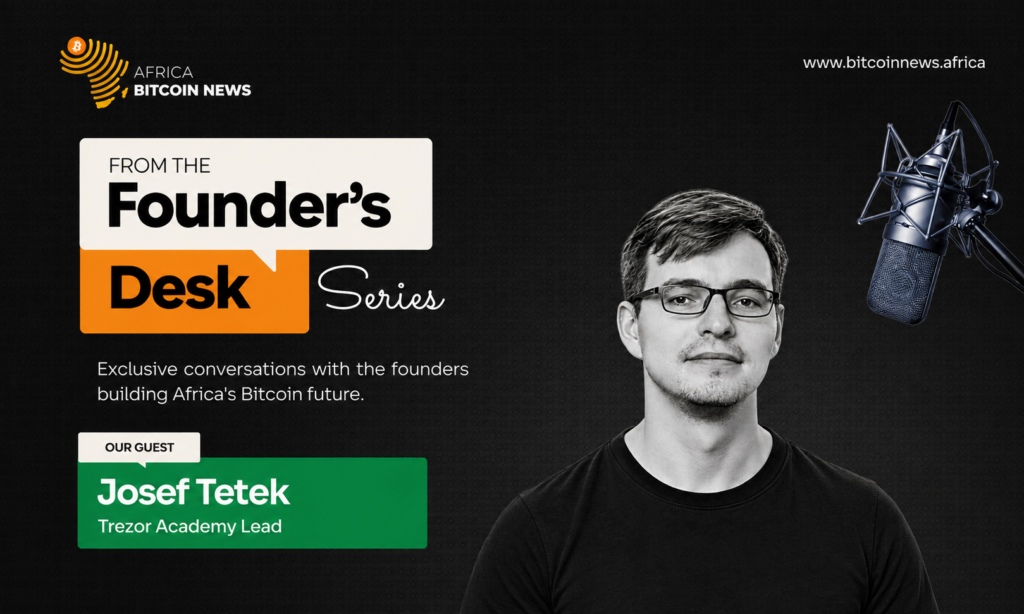
Bitcoin adoption is often measured through price, ownership, or exchange activity. But Joseph Tětek, the educator behind Trezor Academy, sees another measure: whether people are actually using Bitcoin to solve problems.
Across Africa, inflation, weak payment infrastructure, capital controls, and expensive cross-border transfers create a strong need for alternative financial tools. Trezor Academy is responding through free, in-person education delivered by local educators who understand their communities.
The Founder’s Journey
Joseph Tětek’s journey in Bitcoin has been closely connected to understanding and explaining Bitcoin’s monetary properties. His work as an educator has focused on helping people move beyond Bitcoin as an investment and understand its broader implications for money, savings, and financial sovereignty.
That thinking is reflected in his book, Bitcoin: Separation of Money and State, where he explores Bitcoin’s potential to separate money from direct state control. The book reflects a central theme of his work: understanding Bitcoin requires looking beyond its technology and price to the role money plays in society.
His focus on education eventually led him to Trezor Academy, where the goal is not simply to explain what Bitcoin is, but to help people understand how and why it can be useful in their own lives.
Africa became a particularly important part of that work because the need for practical financial education is often much more immediate. Across the continent, people deal with inflation, limited banking access, capital controls, and expensive cross-border payments. At the same time, many communities already have strong networks of local educators, organisers, and entrepreneurs who can carry that knowledge forward.
Tětek’s approach has therefore centred on local educators rather than outside experts. Trezor Academy identifies people who understand their communities, supports them with the knowledge and resources to teach Bitcoin, and allows those educators to build relationships locally.
That model has grown to more than 100 sessions and over 2,000 graduates. But for Tětek, the deeper measure of success is what happens after the classroom: people using Bitcoin, organising meetups, teaching others, and building businesses and communities around it.
His work in education, alongside the ideas explored in Bitcoin: Separation of Money and State, reflects a consistent focus: helping people understand not only how Bitcoin works, but what it could mean for the future of money.
Core Insights & Infrastructure
One of Tětek’s strongest observations is that Bitcoin can serve a different role in Africa than it does in wealthier markets.
In much of the West, existing payment systems are already fast and convenient. Bitcoin may therefore be used primarily as a store of value. Across Africa and the wider Global South, Bitcoin can address both saving and payments.
A person facing inflation can use Bitcoin to preserve value. The same person may also use it to receive money from abroad, pay another person, or move funds across borders without relying on traditional banking rails.
That practical use creates a different kind of adoption.
Get the Weekly Brief
Essential African Bitcoin news, curated for builders. No spam.
"*" indicates required fields
Circular economies are another important part of that process. Local businesses and individuals can earn, spend, and reuse Bitcoin within the same network, allowing Bitcoin to function as money rather than simply an asset someone holds.
But building these economies is difficult. They require enough businesses and users to participate, and they need sustained community activity. Not every attempt lasts.
The same principle applies to education. The biggest challenge is often not finding people interested in Bitcoin, but finding people who can teach, organise, and build trust over the long term.
Logistics also remain a challenge. Shipping books, hardware wallets, and other physical materials into African countries can involve customs delays, fees, and complicated processes. Local printing can solve some of the problem, but hardware still needs to be moved physically.
Digital infrastructure is easier to scale. Education can be delivered online, while Bitcoin itself can be used to send support to educators without relying on traditional financial rails.
Future Outlook
Tětek expects the next five to ten years to bring more Bitcoin circular economies, more Bitcoin-based cross-border businesses, and more companies building specifically for African conditions.
He points to projects such as Gridless, which combines Bitcoin mining with energy infrastructure in Kenya, as an example of how Bitcoin businesses can address broader infrastructure problems.
He also highlights African projects such as Machankura and Tando, which are building around mobile access, Lightning, and local payment realities.
The broader opportunity is for Africa to move beyond simply adopting products developed elsewhere and start producing more Bitcoin-native companies built around African constraints and opportunities.
Tětek believes the continent could eventually become one of the places where the separation between money and the state becomes most visible through Bitcoin. His reasoning is grounded in the conditions already present: young populations, monetary instability, widespread mobile access, and a need for better ways to save and move money.
His advice to future African Bitcoin founders is straightforward: keep building and keep educating, especially when the market is difficult.
Bear markets, small meetups, and slow progress are part of building something that lasts. The motivation has to go beyond price.
For African Bitcoin builders, the opportunity is not simply to participate in a global movement. It is to build products, communities, and financial networks that solve problems people face every day.
Trezor Academy’s approach reflects that principle: start locally, build trust, teach practically, and let adoption grow through real use.