
Africa’s Offline Bitcoin Builder: Kgothatso Ngako on Making Bitcoin Work Without Smartphones, Reliable Internet, or English.
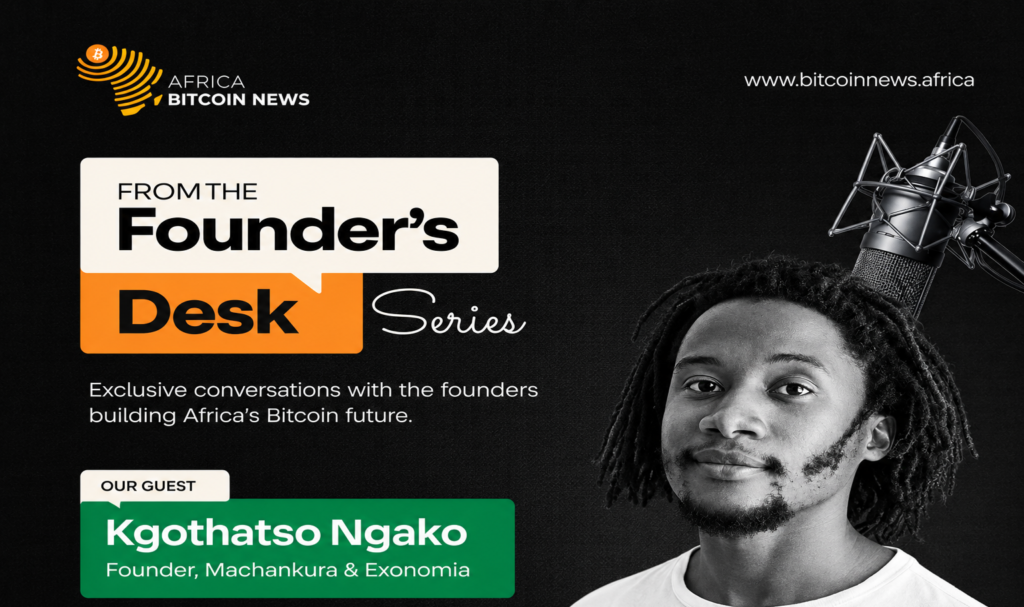
After losing money chasing “the next Bitcoin,” Ngako focused on Bitcoin’s long-term value and built Machankura and Exonomia to solve two practical barriers to adoption: access and language.
Bitcoin products often assume a smartphone, reliable internet, mobile data, and English. Much of Africa cannot make those assumptions. South African Kgothatso Ngako, founder of Machankura and Exonumia, built around that reality.
Machankura lets people send and receive Bitcoin and Lightning payments through USSD, WhatsApp, and an app, while Exonomia translates Bitcoin literature into African languages.
His journey from exploring crypto in 2017 to building Bitcoin infrastructure was shaped by personal losses, concerns about inflation, and a simple question: how do you make Bitcoin useful to people where they actually are?
The Founder’s Journey
Kgothatso Ngako entered the Bitcoin ecosystem in 2017, initially attracted by cryptocurrency, technology, and the possibility of making money. Like many newcomers, he explored other projects while looking for “the next Bitcoin.” Losing money during that search changed his perspective.
By 2018, he began looking beyond short-term price movements and asking what made an asset suitable for the long term. Bitcoin’s predictable supply schedule, monetary policy, and four-year halving cycle became more important to him than the possibility of finding the next big cryptocurrency.
His thinking was also shaped by the effects of inflation on ordinary financial planning. A salary that once appeared sufficient for a particular lifestyle can lose purchasing power over time, changing the affordability of homes, cars, and other long-term goals. Ngako questioned whether traditional inflation measures fully capture this experience because they record what people actually buy, not necessarily what they wanted to buy but could no longer afford.
That led him deeper into Bitcoin and eventually toward building. Exonumia emerged around the problem of education and language, while Machankura addressed access. The underlying question was practical: how can Bitcoin work for people who do not have the devices and connectivity that many Bitcoin products assume?
Core Insights & Infrastructure
Machankura was designed around Africa’s connectivity reality. A person interested in Bitcoin may not have a smartphone, reliable internet, mobile data, or enough storage for another application. USSD removes several of those barriers. Users can access Bitcoin and Lightning services by dialing a code on a feature phone, while those with smartphones can use the app or other interfaces such as WhatsApp.
The important design principle is not that everyone should use USSD. It is that the same Bitcoin service should be accessible across different levels of technology. Someone can start with a feature phone and later move to an app without having to abandon the underlying service.
“The first user experience matters.” If someone has already decided to try Bitcoin, requiring a modern smartphone, an internet connection, an app download, and additional storage can become the point where adoption stops. Machankura instead tries to make the first interaction as accessible as possible.
Infrastructure also means dealing with failure. Machankura experienced downtime following a BTC Pay Server security incident, forcing the team to take services offline, assess the situation, and apply a fix. The team operates different Lightning node implementations, including Core Lightning, LND, and Eclair, which allowed them to manage recovery across different parts of the infrastructure.
Get the Weekly Brief
Essential African Bitcoin news, curated for builders. No spam.
"*" indicates required fields
That experience reinforced the distinction between convenience and sovereignty. Machankura can make Bitcoin easier to access, but users still need to understand custody and security. Self-custody gives users greater control but also transfers responsibility for protecting funds to them.
Exonumia tackles another infrastructure problem: language. The project translates Bitcoin literature, including the Bitcoin white paper, into African languages such as Sesotho and Swahili. Ngako’s argument is that financial and technical participation should not be limited by English proficiency. If people cannot discuss technology, banking, investing, or money in their own language, they can be excluded from important parts of modern economic life.
But translation is only the first step. A translated document still needs a community around it, people who can read it, discuss it, improve the terminology, and adapt it to local linguistic and cultural contexts.

Future Outlook
Ngako sees Bitcoin’s future in Africa as closely connected to the continent’s ability to build around its own conditions rather than simply copy solutions designed elsewhere.
Machankura demonstrates what this can mean at the payments layer: Bitcoin and Lightning made accessible through feature phones, smartphones, messaging platforms, and different levels of connectivity. Exonomia applies the same principle to education: Bitcoin knowledge made available in languages that African communities already use.
His broader view is that Africa has missed or struggled to fully capture several major technological and industrial opportunities. New technologies will not automatically solve those underlying problems. What matters is whether Africans build products that address their own constraints and opportunities.
That is why his advice to African founders is centred on uniqueness, experimentation, and adaptation.
Solutions developed for Silicon Valley or other markets may provide useful starting points, but African founders need to account for different connectivity, infrastructure, purchasing power, regulation, and consumer behaviour.
Ngako also encourages young builders to experiment and accept failure as part of the process. Building has become faster and cheaper, making it easier to test ideas without waiting for permission.
His message is ultimately simple: build something.
Machankura and Exonumia show what that can look like in practice, one project tackling access to Bitcoin where smartphones and reliable internet cannot be assumed, another tackling access to Bitcoin knowledge where English cannot be assumed.