Dùnsin Abísuwà led the second block. The topic was fountain codes as a possible answer to Bitcoin’s growing storage burden.
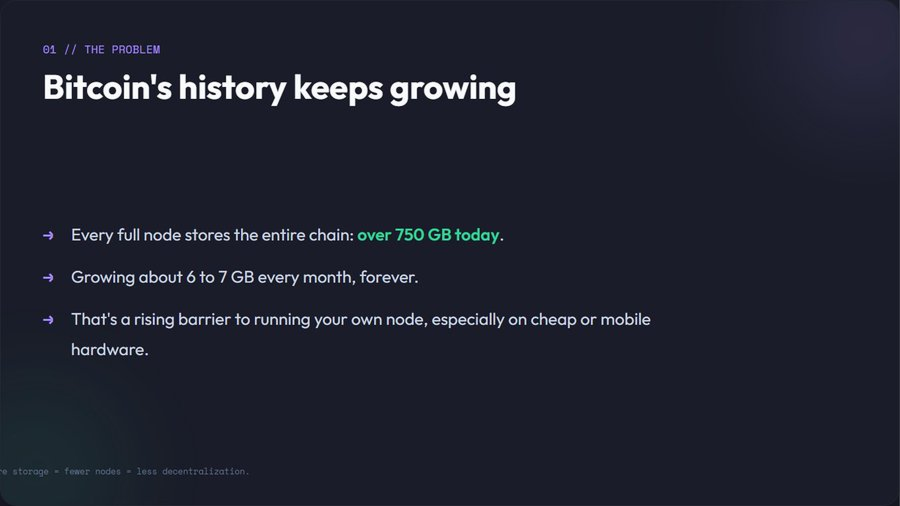
The slides put the problem in plain numbers. Every full node stores the entire chain. The presentation cited more than 750 GB today, with growth of about 6 to 7 GB each month. That cost makes it harder to run a node on cheap or mobile hardware. Fewer full nodes can weaken decentralization.
Pruned nodes save disk space, but they give up the ability to help new peers download history. That trade-off was the starting point for the research talk.
Fountain codes, especially Luby Transform (LT) codes, encode history into many small “droplets.” A node can store a thin slice instead of every old block. A new node collects enough droplets from peers, then reconstructs blocks and checks them against header Merkle roots.