
Beyond the Merchant Count.
Why African Bitcoin Circular Economies Still Lack Transparent Impact Metrics.
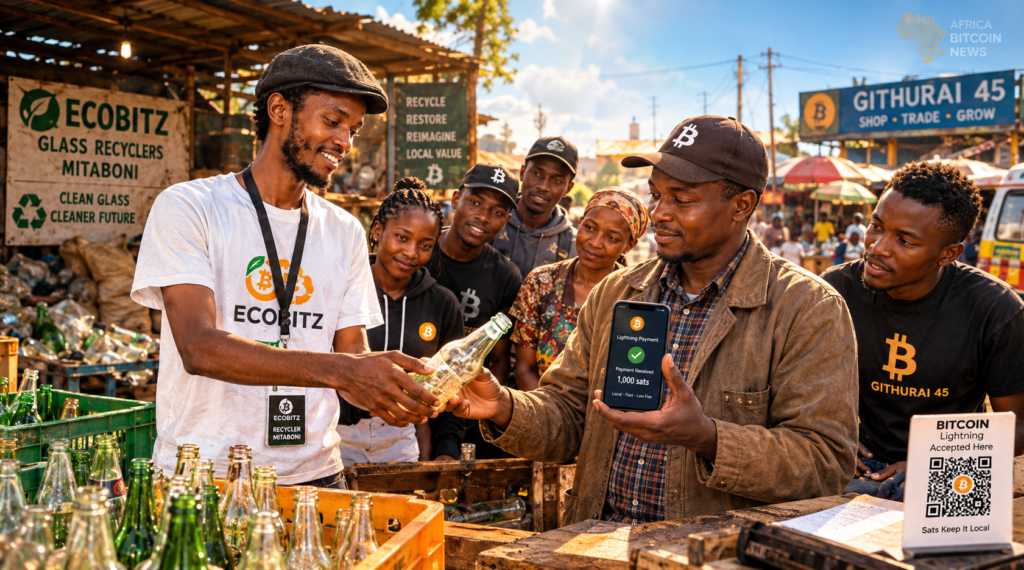
In Mitaboni, Kenya, recyclers collect glass bottles and receive 21 sats each. In Githurai 45, sixteen local shops now accept Lightning payments. These scenes have been celebrated as proof that Bitcoin circular economies work on the continent. Yet almost no public data exists on what happens next: how many of those sats stay local after thirty days, how many of the sixteen merchants still prefer sats over M-Pesa six months later or whether the loop creates lasting jobs rather than temporary photo opportunities?
That measurement gap is the most critically unaddressed pain point in African Bitcoin media coverage of circular economies today.
The Stories We Know Well.
EcoBitz, founded by Kelvin Makini, turns waste into Bitcoin. Recyclers earn sats for diverting glass and plastics from landfills; merchants in the Mitaboni network accept those sats for everyday goods. The project uses Fedi for community payments and has begun upcycling bottles into glassware.
Bitcoin Githurai, a project of The Core led by Felix Mukungu, began merchant onboarding in May 2025. It grew from one shop to six, then sixteen accepting Lightning. The team recently opened a physical education centre in Githurai 45 and regularly documents merchant-to-merchant spends.
Both initiatives appear on BTC Map, feature in summit discussions, and receive positive coverage for education cohorts and first transactions. The origin stories are compelling. The follow-up data is almost entirely missing.
The Measurement Vacuum.
A circular economy only functions when value circulates: people earn sats, spend them locally, and save or reinvest without converting everything back to fiat. African Bitcoin media has extensively covered the first step, onboarding and the inspirational second step early spends. It has rarely examined velocity, retention or leakage.
Public project statements offer clues. EcoBitz measures progress by “jobs created, transactions occurring, businesses accepting and keeping sats circulating locally, peer-to-peer.” Bitcoin Githurai reports transaction ranges that remain low (often 0–9 per day in earlier updates). Neither has published open longitudinal dashboards showing, for example:
- percentage of earned sats spent inside the community within 30 or 90 days
- merchant retention rate at the six- and twelve-month marks
- average number of local spends per sat before it exits the loop
- waste diverted in tonnes correlated with sats distributed
Summit participants across Africa have privately discussed liquidity challenges: the need for continuous external sats (donations, grants, visitor spends) to keep merchants interested. Without transparent tracking, it is impossible to know whether a circular economy is becoming self-sustaining or remaining dependent on external inflows.
A broader credibility critique published in mid-2026 argued that some African Bitcoin projects risk treating communities as marketing material rather than measuring solved economic problems. Independent verification of impact remains scarce.
Why Media Has Avoided the Hard Numbers.
Positive origin stories travel easily and attract zaps. Longitudinal data requires patience, trust from project leaders, and willingness to report incomplete or modest results. Directories correctly prune inactive projects, yet they still count initiatives rather than measure closed-loop performance. The result is a coverage landscape heavy on debuts and light on durability.
EcoBitz and Bitcoin Githurai are ideal places to close this gap. Both already emphasise peer-to-peer spending and local education. EcoBitz’s planned Multispend treasury and local upcycling machinery, and Githurai’s new physical hub, create natural points for consistent measurement. Publishing even simple monthly figures, active merchants, sats velocity, jobs sustained, would set a new standard.
What Transparent Metrics Would Change.
Clear data would help:
- Builders decide where to allocate limited liquidity
- Donors distinguish lasting models from temporary pilots
- Media move from celebration to accountability
- Neighbouring communities replicate what actually works rather than what photographs well
The alternative is continued ambiguity: projects that look successful in snapshots but cannot demonstrate whether sats truly circulate or simply pass through.
Call to Action.
African Bitcoin circular economies have proven they can start. The next test is whether they can measure and sustain the loop.
Zap EcoBitz directly at ecobitz_21m@blink.sv to support recycling rewards, local machinery or open reporting. Support Bitcoin Githurai and The Core education efforts through their listed addresses and Geyser campaigns. Visit the EcoBitz and Bitcoin Githurai communities on BTC Map, spend sats with a listed merchant, and ask the question that still lacks an answer: how many of those sats are still circulating here three months later?
If you run or support a circular economy anywhere in Africa, share your retention and velocity numbers with Africa Bitcoin News. The continent’s builders deserve better than unverified inspiration. They deserve data that proves the loop is real.
Get the Weekly Brief
Essential African Bitcoin news, curated for builders. No spam.
"*" indicates required fields