
AI Agents Running Their Own Lightning Nodes Could Reshape the Internet Economy
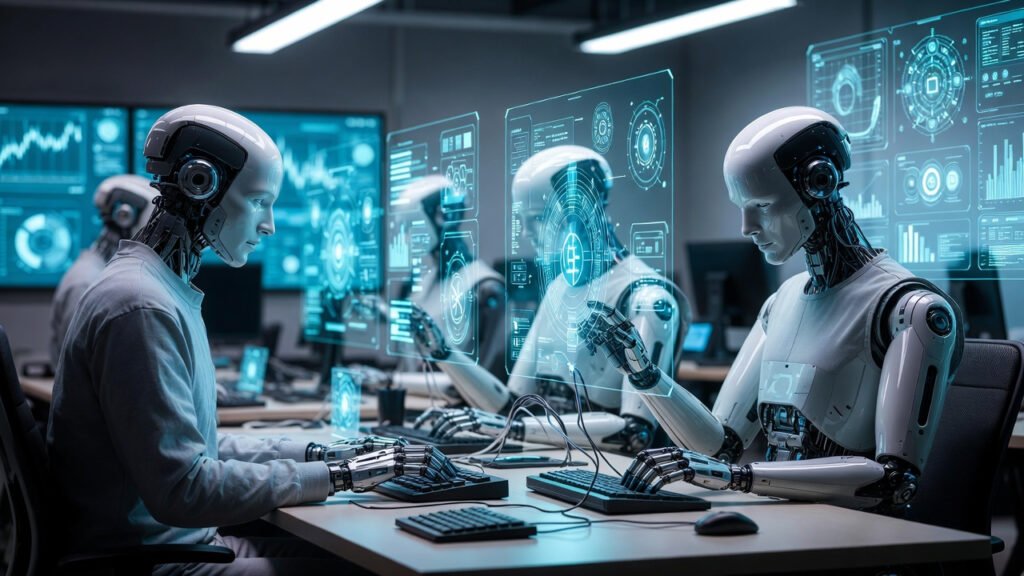
Artificial intelligence is evolving quickly. What began as tools that assist humans with tasks is rapidly becoming a world of autonomous agents capable of making decisions, executing workflows, and interacting with digital systems on their own.
But as AI agents become more independent, a fundamental question arises.
If AI agents are going to operate autonomously, how will they manage money?
An AI system that can hire services, pay for infrastructure, or charge users for its capabilities needs a financial system it can control directly. Traditional payment systems were never designed for software agents. Bank accounts require human identity verification. Credit cards depend on centralized institutions and manual oversight.
This limitation is pushing many developers to explore a different model.
AI agents that run and manage their own Bitcoin Lightning nodes.
The Rise of Autonomous AI Agents
AI agents are not just chatbots. They are systems designed to perform tasks independently. An agent can monitor markets, analyze data, deploy code, manage infrastructure, and coordinate complex digital workflows.
Developers are increasingly building agents that can interact with other software services through APIs and automated systems.
For example, an AI agent might:
Monitor cryptocurrency markets and execute trading strategies
Manage cloud infrastructure for a startup
Research data and generate reports
Automate marketing campaigns
Build and deploy software applications
These agents operate continuously and interact with multiple services across the internet. Many of those services require payment.
Without a native payment system, AI agents remain dependent on human controlled financial infrastructure.
Why AI Agents Need Their Own Nodes
For an AI agent to function as a truly independent system, it needs the ability to control and transfer value without waiting for human approval.
This is where Bitcoin becomes important.
Bitcoin allows any participant to hold and transfer value using cryptographic keys rather than institutional permission. When combined with the Lightning Network, payments can happen instantly and at extremely low cost.
If an AI agent runs its own Lightning node, it gains the ability to participate directly in the Bitcoin economy.
Instead of relying on a human owned wallet or payment gateway, the agent can manage its own channels, liquidity, and payment routing.
This creates a model where AI systems operate as autonomous economic actors.
What It Means for AI Agents to Run Lightning Nodes
Running a Lightning node gives an AI agent direct control over its financial operations.
The agent could open and close payment channels, send and receive Lightning payments, and manage liquidity within its node.
With the right software architecture, an AI system could automatically perform tasks such as:
Opening channels with other nodes
Adjusting routing fees dynamically
Balancing liquidity between channels
Monitoring node performance and uptime
Sending payments for services it consumes
Receiving payments for services it provides
In other words, the AI agent would not just use Lightning. It would actively operate part of the Lightning Network infrastructure.
This transforms the Lightning node into a financial engine controlled by software intelligence.
AI Managing the Economics of Its Own Node
One of the most interesting possibilities is AI agents optimizing the economic performance of their nodes.
Running a Lightning node involves decisions about liquidity allocation, routing fees, and channel management. These decisions can affect how profitable and efficient a node becomes.
AI systems are well suited to manage these types of optimization problems.
An AI agent could analyze network traffic patterns and adjust routing fees in real time. It could rebalance channels automatically to maintain liquidity. It could identify profitable routing opportunities and open strategic channels with well connected nodes.
Over time, autonomous node operators could make the Lightning Network more efficient and resilient.
Instead of relying entirely on human operators, the network could be partially maintained by intelligent software agents.
A Network of Machine Operated Nodes
As AI agents begin operating Lightning nodes, the network itself could evolve.
Today, most Lightning nodes are operated by individuals, companies, or infrastructure providers. In the future, some of these nodes may be controlled by autonomous software agents.
Imagine a network where thousands of AI systems run Lightning nodes to power their services.
One agent might provide data analysis services and charge a few satoshis per query. Another agent might offer AI inference or specialized computation. Others might provide data feeds, storage, or digital infrastructure.
Each of these agents could maintain its own Lightning node, allowing them to transact directly with other agents and users.
Payments would happen instantly and automatically, without centralized payment processors.
This type of ecosystem could form the foundation of what researchers call the machine economy.
Opportunities for Developers
The idea of AI agents running Lightning nodes opens new opportunities for developers working at the intersection of Bitcoin and artificial intelligence.
Building tools that allow agents to operate nodes safely and efficiently will become increasingly important. This could include automated channel management systems, AI driven liquidity optimization tools, and frameworks that allow AI agents to control Lightning infrastructure securely.
Developers who understand both Bitcoin infrastructure and AI systems are particularly well positioned to explore these possibilities.
Across Africa, communities of Bitcoin developers are already learning how to build and operate Lightning infrastructure. As AI technologies continue to advance, these skills could become even more valuable.
The combination of AI and Bitcoin may unlock entirely new types of applications.
The Beginning of a Machine Economy
The internet was originally built for humans to communicate and share information. Now it is evolving into an ecosystem where autonomous software systems interact with each other.
For these systems to function independently, they need a native way to exchange value.
Bitcoin and the Lightning Network provide the infrastructure that makes this possible.
If AI agents begin running and managing their own Lightning nodes, the internet could evolve into a network where software services operate as independent economic actors. They could earn revenue, purchase resources, and collaborate with other systems in real time.
This shift may mark the early stages of a new economic layer on the internet.
One where machines do not just process information, but also participate directly in the global financial network.