Btrust Backs Five More African Bitcoin Developers in Q4 2026 Grants

FUNDING

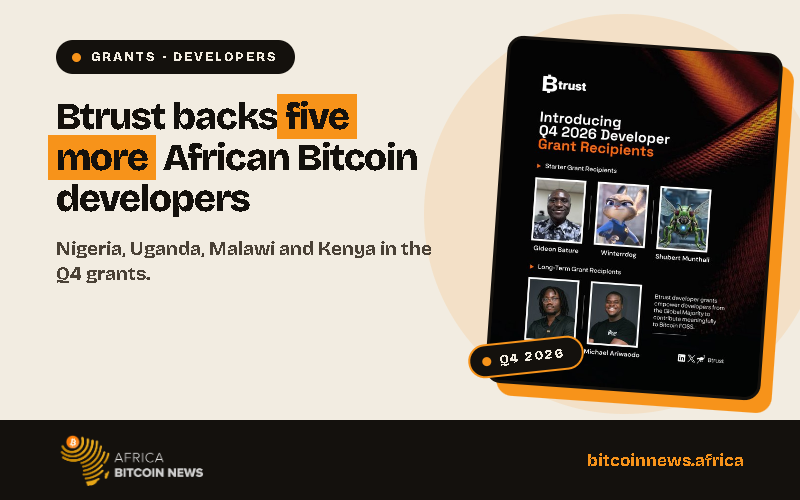
African Bitcoin developers got good news this week. On 24 November 2026, Btrust named five Bitcoin open-source developers for Q4 2026: three starter grant recipients and two long-term cohort members, based in Nigeria, Uganda, Malawi and Kenya. 

Btrust is a non-profit with the mission to decentralize the development of Bitcoin open-source software, focused on developer talent from the Global Majority. Here is how its two kinds of grants work, and who got them.

Two kinds of grants

Starter grants support software engineers ready to contribute full-time to Bitcoin open source, with time, mentorship and financial support. Long-term grants go to developers who have already shown commitment, so they can take on larger projects and handle ongoing maintenance and review.

The starter grant recipients

Gideon Bature (Nigeria) will work on the Validating Lightning Signer. It separates transaction signing from running a Lightning node and checks transactions against security policies before signing. He will expand tests for channel management, payment flows and other key signer functions. He has contributed to corepc, Rust-Payjoin, BDK Wallet and bark, and is active in BitDevs Kaduna and BitDevs Lagos.

Winterrdog (Uganda, Kampala) will focus on Bitcoin Core, with BlueWallet as a second project. His work includes more tests for Tor and I2P connections, reviewing wallet and transaction-signing changes, and better testing on FreeBSD and NetBSD. He is active in BitDevs Kampala, where he gives technical talks. 

Shubert Munthali (Malawi, Lilongwe) will build the Arkade Kotlin SDK. It is a library for building apps on Arkade’s off-chain payment system, which uses the Ark protocol from Ark Labs. He will also build a proof-of-concept Android wallet as a developer reference, not a finished consumer product. He is self-taught, started programming in 2017, and has joined BitDevs Malawi

The long-term grant recipients

Frankline Omondi (Kenya, Nairobi) works on Bitcoin Core testing and peer review. His focus is peer-to-peer networking and transaction validation. He will audit existing tests, build new fuzz-testing tools, and turn what he finds into fixes and regression tests. He also maintains bip353-rs, a Rust library for resolving DNS-based bitcoin payment instructions, and leads sessions at BitDevs Nairobi. 

Michael Ariwaodo (Nigeria, Lagos) works on Cashu. Cashu is a protocol for Bitcoin-backed ecash payments that uses blind signatures for payment privacy. His plans include conditional payments, multi-mint funded payments, and Cashu-based escrow for peer-to-peer trading. During his starter grant, he added P2BK support to Nutshell, gained maintainer access, and helped start weekly developer calls.

What stands out

Two things matter to me here.

First, the work is core Bitcoin work. Bitcoin Core testing, Lightning signing security and fuzz testing are not glamorous. They are the kind of work that keeps Bitcoin safe. After a year of hacks and emergency patches, more African hands on this work is welcome news. It is also the kind of skill I wrote about last week: security is becoming the most valuable skill we can build.

Second, there is a clear path. Frankline Omondi entered through the BOSS program, then received a starter grant, and now holds a long-term grant. That is a developer moving from learning, to full-time contribution, to long-term maintainer. This is the pipeline that African Bitcoin has been asking for.

How to apply

Applications for Btrust developer grants open in January 2027. Details are at btrust.tech/grants/developer. If you are building in open source, start getting your contributions in order now. Grants like this go to people who show up consistently.

Congratulations to all five.

Sources:
Btrust: Announcing Q4 2026 Btrust Developer Grant Recipients

ENJOYED THIS ARTICLE?Support the authorSend a zap over Lightning or on-chain