
BOSS Challenge Finalists Keep Building Bitcoin and Lightning Tools Long After Program Ends
African developers from the latest BOSS Challenge continue opening pull requests, reviewing code, and launching new tools for Bitcoin and the Lightning Network. Their ongoing work highlights how the program builds lasting skills and community, not just finished projects.
Btrust Builders shared the update on July 31, 2026. The organization partnered with Chaincode Labs to support developers from its talent pipeline. Of the 623 applicants who entered through that pipeline, eleven finalists stood out for their technical performance and continued contributions after the challenge ended.
What Is the BOSS Challenge?
The ₿OSS Challenge, created by Chaincode Labs, is a global program for developers starting careers in Bitcoin open-source software. It ranks among the most technical programs of its kind.
Participants write code, study Bitcoin specifications, debug implementations, and explore real codebases. The first month focuses on guided coding exercises with support from active Bitcoin contributors. Top performers then receive two more months of advanced mentorship. They build proof-of-concept projects and begin collaborating with established Bitcoin and Lightning repositories.
The rest of the cohort joins partner programs, including Btrust Builders pathways. Many of this year’s standout participants had already completed earlier training through Btrust Builders, Hack4Freedom, Chaincode seminars, Dada Devs, Africa Free Routing bootcamps, or GitHub’s All In Africa program. Several had studied Mastering Bitcoin or practiced Bitcoin Core via the command line.
Local communities such as BitDevs Lagos, BitDevs Nairobi, and BitDevs Kaduna provided ongoing support. Mentors, peers, and friends helped participants balance the intensive workload with school, jobs, and daily responsibilities.
Mindset Shift: You Do Not Need to Know Everything
Several finalists entered BOSS believing they had to master every aspect of Bitcoin before contributing. That view changed.
Abdullateef Mubarak explained: “Initially, I thought I had to understand absolutely everything about Bitcoin before I could even think about contributing. The BOSS Challenge completely changed that mindset.”
Abraham Ujah added that the program showed Bitcoin open source is accessible to anyone willing to do meaningful work. Sharon Nkatha described moving from seeing the ecosystem as distant and intimidating to knowing how to open pull requests, respond to reviewers, and identify issues.
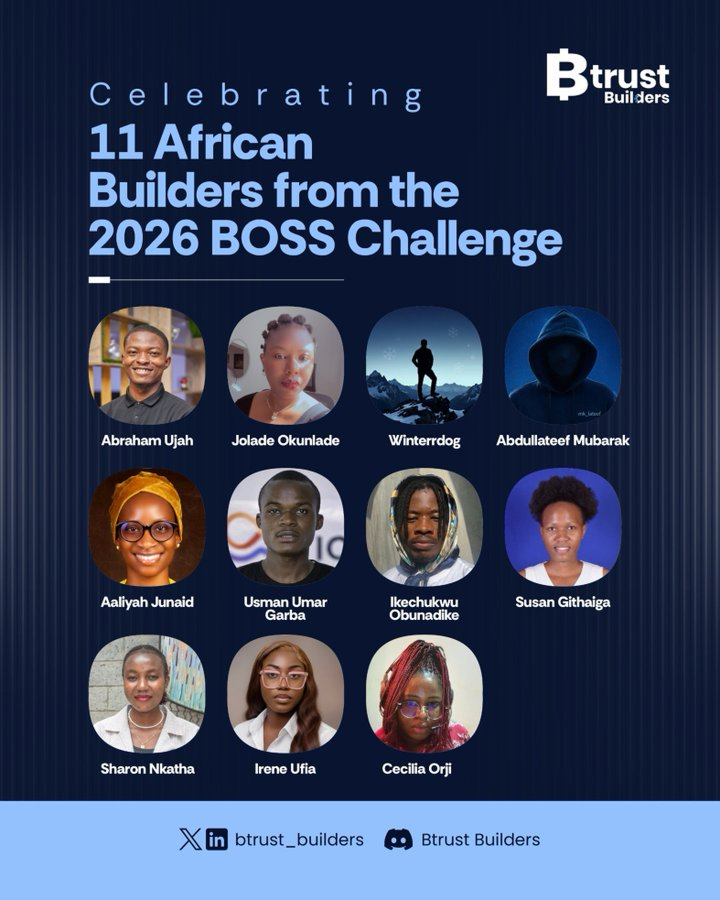
Where the Finalists Are Building Now
The developers have kept contributing across multiple projects:
- Abraham Ujah built Secure Fountain and Memq during the challenge. He now contributes to rust-bitcoin and rust-lightning and aims to make Bitcoin open-source development his career.
- Jolade Okunlade created dust-cleaner, a Rust tool that helps users identify suspicious dust UTXOs and generate PSBTs. After BOSS she won first place at the 2026 Hack4Freedom hackathon in Lagos with GhostKey, a non-custodial inheritance tool. She is also building BitPilot and contributing to the Lightning Dev Kit.
- Winterrdog fixed a backend stability issue in Saving Satoshi (later merged) and began reviewing Bitcoin Core pull requests. One of his reviews led to a co-authored change. Btrust supported his travel to Bitcoin++ Nairobi.
- Abdullateef Mubarak, a final-year university student in Abuja, added PSBT v2 support to btcd. He is studying LND and preparing for deeper mentorship and possible open-source funding.
- Aaliyah Junaid, 2025 Hack4Freedom winner, worked on BIP 329 wallet labels for the Bitcoin Dev Kit. She continues contributing to Polar, exploring Payjoin, and mentoring at Hack4Freedom.
- Usman Umar Garba returned for a second year and built the Lightning UTXO & Anchor Manager. He is exploring LND and Polar while developing SatsFor, a Lightning-powered tipping app.
- Ikechukwu Obunadike (Chukwu) added external WIF key sweeping to the Bitcoin Dev Kit Android reference wallet and is exploring Rust RPC bindings for Bitcoin Core.
- Susan Githaiga created a Lightning anchor fee-bumping service and contributed multiple merged improvements to BTCPay Server and the Bitcoin Dev Project website. She co-built SiriScore, which received an honourable mention at Bitcoin++ 2026, and is considering an M-Pesa plugin for BTCPay Server.
- Sharon Nkatha fixed Tor onion address handling in Warnet (merged), built the self-hosted privacy tool Know Your Coin History, and contributes to SeedSigner and Braidpool. She was also part of the SiriScore team.
- Irene Ufia developed bip353-go, a Go implementation of BIP 353 DNS Payment Instructions. She later improved security in the multiparty computation project mpcium and is exploring Neutrino.
- Cecilia Orji co-built the Bitcoin UTXO Observatory with Irene, focusing on testing and reliability. She is now looking at lndhub.go, btcd, and Lightning Labs’ Loop.
Confidence and Community Matter Most
Technical knowledge of PSBTs, UTXOs, Taproot, fee bumping, and Lightning infrastructure grew. Yet most finalists said the biggest change was confidence. They learned to read specifications, work without step-by-step guides, ask maintainers questions, and treat failed tests as normal.
Aaliyah Junaid noted: “It showed me that contributing is less about already knowing everything and more about being willing to learn consistently, ask questions, and stay curious.”
Jolade Okunlade described the moment a raw-byte transaction she built was accepted by the network: “Nobody vouched for the transaction. The system accepted it purely because the math and serialization were correct.”
Community support proved essential. BitDevs groups, Dada Devs, Africa Free Routing, Hack4Freedom, and Btrust Builders created spaces to ask questions and meet other contributors. Several finalists now mentor the next wave of developers. Susan Githaiga and Sharon Nkatha facilitate for Dada Devs. Aaliyah returned to Hack4Freedom as a mentor.
A Clear Message for African Developers
The eleven developers began from different points, some with years of experience, others with a single introductory program. They used Rust, Go, Python, Kotlin, and JavaScript. What they shared was the willingness to learn, ask for help, and tackle work that initially felt out of reach.
Btrust Builders concluded: African developers are not standing at the edge of Bitcoin’s open-source ecosystem. They are writing code, reviewing contributions, improving infrastructure, and helping others enter.
Their stories show that the real value of BOSS is not finishing a project. It is leaving with the skills, confidence, and community to keep going.