Nigeria’s Central Bank Just Made It Official. Every Bitcoin P2P Platform Needs a Licence, and It Is Not Cheap

REGULATION POLICY

What Changed on November 5

On November 5, 2026, the Central Bank of Nigeria published the Regulations for the Operations of Non-Security Virtual Assets in Nigeria (download). The rules took effect immediately. They capture every platform involved in buying, selling, transferring or holding digital assets in the country, including peer-to-peer platforms, exchanges, custodial wallet providers and payment processors. This is the most comprehensive set of digital asset rules any African central bank has issued to date.

For Bitcoin users in Nigeria, the most important provision is Section 10.2: there is no standalone P2P licence. Any platform that facilitates peer-to-peer Bitcoin trading must hold an Other Services Licence, an Other Services Authorisation, or an approved extension under Section 9, with P2P activity explicitly named. The minimum paid-up capital for exchanges, wallet providers and similar operators is 1 billion naira (about $742,000). Platforms that fail to apply within 180 days must shut down their regulated activities. Unauthorised operation carries a minimum fine of 100 million naira, plus at least 1 million naira for every day the violation continues.
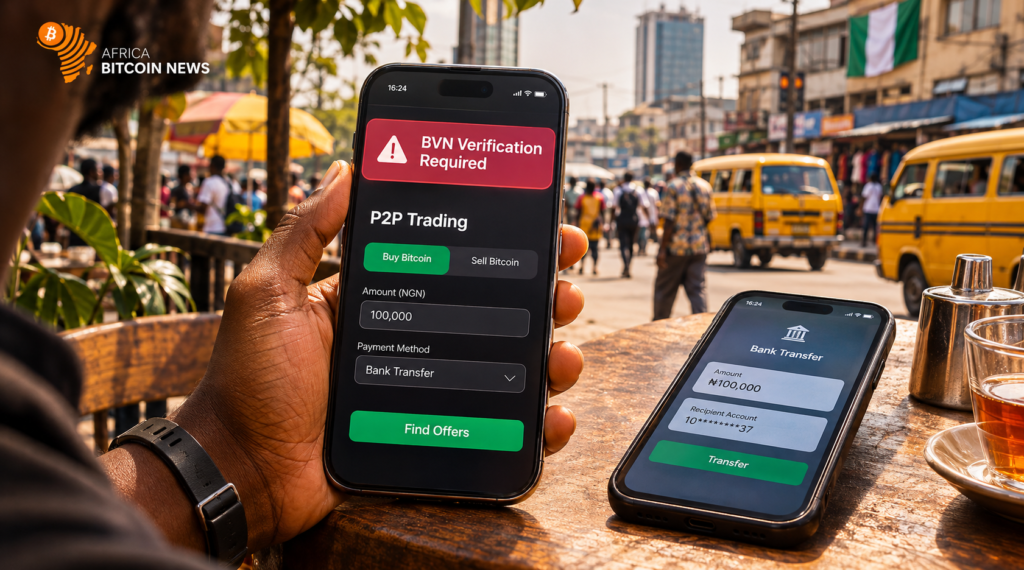

BVN Matching and the End of Anonymous Trading

Section 10.3.3 introduces a requirement that will reshape how P2P actually works in practice. A platform may not release or credit any regulated token until the naira account name and Bank Verification Number match the verified customer. That means the days of trading Bitcoin through mismatched or nominee accounts on P2P desks are formally over. High-volume or advertised P2P sellers face stronger identity checks, trade limits and reporting duties. Nominee, mule, third-party, fake and wrong-name accounts are all prohibited.

For the millions of Nigerians who have used P2P platforms as their primary on-ramp to Bitcoin since major exchanges pulled naira services, this is a significant shift. P2P will not disappear, but it will look different. The platforms that survive will be the ones that can meet the capital requirements, implement BVN verification at the transaction level and maintain the compliance infrastructure the CBN now demands.

The Wider Regulatory Architecture

The P2P and exchange rules are only part of the package. The regulations also ban algorithmic digital assets outright: tokens that try to hold their value through code-driven supply adjustments rather than actual reserves. Digital assests issuers face steep capital requirements. A company issuing dollar-backed digital assets must be a Nigerian-incorporated entity with at least 15 billion naira (about $11.1 million) in paid-up capital, a staffed local office and a resident compliance officer. Naira-backed issuers need 10 billion naira (about $7.4 million). All digital assets reserves must be fully backed with an additional 2% buffer, and holders must be able to redeem at face value within one business day.

These rules follow President Tinubu’s July 2026 executive order on coordinating digital asset oversight, the SEC’s sandbox programme (which has admitted 14 firms), and new tax guidelines from the Federal Inland Revenue Service. Nigeria is not banning Bitcoin. It is building a regulatory framework that makes every participant in the ecosystem legible to the state. For Bitcoiners, the question is whether this framework creates a more stable environment for long-term adoption or whether the capital requirements and compliance costs push smaller operators and their users further into informal channels.

ENJOYED THIS ARTICLE?Support the authorSend a zap over Lightning or on-chain