Btrust Awards Q3 2026 Bitcoin Developer Grants to 10 Open-Source Contributors Across Africa and Global South

OPEN SOURCE DEVELOPMENT ECOSYSTEM

Btrust, the nonprofit working to decentralize Bitcoin open-source development, has announced its Q3 2026 developer grant recipients.

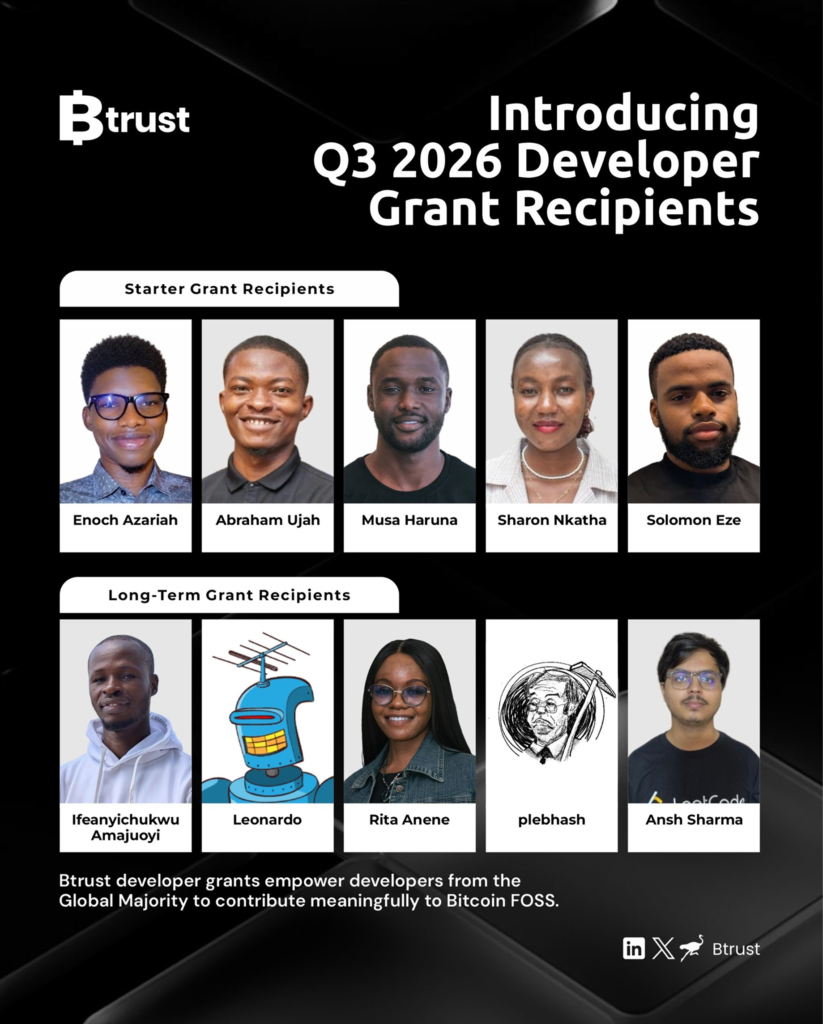
Ten engineers will receive support this quarter: five through starter grants and five through long-term open-source cohort grants.

The announcement marks a milestone. For the first time, Btrust developer grants are going directly to contributors outside Africa.

Through the recent expansion of its long-term grant program across the Global Majority, the organization is now funding developers in Brazil and India alongside recipients in Nigeria and Kenya.

Their work spans Bitcoin Core, mining infrastructure, Lightning tools, wallet libraries, and privacy-preserving payments. Btrust said a defining theme of the cohort is “the infrastructure behind everyday bitcoin use.”

Starter Grants: Six Months of Focused Contribution

The starter grant is designed for software engineers ready to contribute full-time to Bitcoin open source. Recipients receive time, mentorship, and financial support to work on a focused area and grow into longer-term contributors. The grant typically lasts six months.

Q3 2026 starter grant recipients:

  1. Enoch Azariah (Adamawa, Nigeria) will work on Bitcoin Core’s inter-process communication (IPC) mining interface, libmultiprocess, and the Stratum V2 template provider. These components help Bitcoin Core exchange information with external mining software and supply candidate block data used by mining infrastructure.
  2. Abraham Ujah (Kaduna, Nigeria) entered Bitcoin open source through BitDevs Kaduna. He later completed Chaincode Labs protocol seminars, a Lightning Developer Bootcamp by Africa Free Routing, Bitcoin Core Principles by Librería de Satoshi, and the Btrust Builders 2026 BOSS Challenge. His grant work focuses on testing, protocol libraries, and developer tooling in rust-bitcoin and rust-lightning.
  3. Musa Haruna (Borno State, Nigeria) completed the 2025 BOSS program and the 2025 Btrust Builders Open-Source Bootcamp. He will concentrate on Bitcoin Core review, fee estimation research, and kernel/API development. He also chaperones the Btrust Builders Mastering Bitcoin pathway, moderating weekly discussions for other developers.
  4. Sharon Nkatha (Nairobi, Kenya), an alumna of Dada Devs and Btrust Builders, made her first major open-source contribution during the 2026 BOSS Challenge. She will work on Braidpool mining infrastructure, including Stratum V1 reliability, protocol completeness, and scalability, helping connect existing mining equipment to decentralized pool software. She also helps lead discussions at BitDevs Nairobi.
  5. Solomon Eze (Lagos, Nigeria) focuses on Cashu wallet infrastructure, primarily Coco, with integration into eNuts. Cashu is an open-source ecash protocol for privacy-preserving payments. He is also a Btrust Builders faculty member.

Long-Term Grants: Continuity for Established Contributors

Long-term grants give established contributors the continuity to maintain critical software and take on work that extends beyond a single development cycle. Cohort members typically receive support for one year, with the option to renew.

Q3 2026 long-term grant recipients:

  1. Rita Anene (Lagos, Nigeria) works on LDK Node, a Lightning node library that helps developers add Lightning functionality to applications. She will focus on reliability and easier integration so apps can support both on-chain and Lightning payments. She is active in BitDevs Lagos and serves as a Btrust Builders pathway chaperone.
  2. Ifeanyichukwu Amajuoyi (Lagos, Nigeria) works on LDK Server, including monitoring, Postgres support, unified logging, and API improvements. These operational foundations help developers connect applications to Lightning functionality, manage data, and diagnose problems.
  3. Ansh Sharma (India) is one of the first developers Btrust has funded directly outside Africa. He works on Braidpool, a project building decentralized Bitcoin mining pool infrastructure. His grant work targets performance, scalability, and network resilience as participation grows.
  4. Plebhash (Brazil), also among the first recipients outside Africa, works on Stratum V2, the protocol used for communication between mining devices, proxies, and pools. He will maintain the specification and reference implementation, improve interoperability, and strengthen production reliability.
  5. Leonardo Souza (Brazil) works on the Bitcoin Development Kit (BDK), a collection of libraries for building Bitcoin wallets. He maintains BDK’s blockchain data-source clients, which wallets use to track transactions and balances. He will continue that maintenance work alongside developer mentorship.

Why the Mining and Infrastructure Focus Matters?

Several recipients this quarter are working on different layers of the mining stack: Bitcoin Core’s mining interface, Braidpool, and Stratum V2. Btrust said supporting this work helps strengthen the open-source infrastructure that miners and mining software developers depend on.

The rest of the cohort is concentrated on the libraries and services that wallet and Lightning developers use every day, BDK, LDK Node, LDK Server, rust-bitcoin, rust-lightning, and Cashu components. Improvements at this layer make applications more reliable and give other developers better tools to build with.

Many recipients also came through local BitDevs meetups, Btrust Builders pathways, BOSS, and other education programs. Btrust noted that developer journeys often begin before a grant, and that events, education programs, and local communities remain part of its pipeline.
How to Apply?

Btrust developer grant applications are open year-round. The organization said it is looking for people already contributing to Bitcoin open-source software or ready to contribute full-time.

Learn more and apply via btrust.tech. Btrust also offers event and education grants for organizers building local Bitcoin developer communities.

ENJOYED THIS ARTICLE?Support the authorSend a zap over Lightning or on-chain