Dada Devs Cohort 5 Completes 8-Week Mastering Bitcoin Program

ADOPTION COMMUNITY DEVELOPMENT

Africa’s women-focused Bitcoin developer initiative Dada Devs has closed its eight-week Mastering Bitcoin Cohort 5 with a final session that moved beyond protocol knowledge and into career readiness.

The finale, held on 26 August 2026 and announced the following day, was led by founder Lorraine Marcel. The working session asked a sharper question than “Can you code on Bitcoin?” It asked whether participants were opportunity-ready.

The official wrap-up post described the close as the “grand finale” of the program and framed the last class as a challenge to think past technical skill alone.

What the final session covered?

The closing class was titled “Beyond the Code: What it actually takes to become an employable Bitcoin & technology developer.” Screenshots from the live session show a virtual gathering inside the Dada Devs Hub. With a slide deck focused on professional credibility, visibility, and proof of skill.

Marcel pushed the cohort to treat employability as a practice, not a job title. According to Dada Devs, the session explored whether developers can:

  • Show what they have already built.
  • Work with other contributors.
  • Contribute to open source.
  • Make their work findable and trustworthy.
  • Demonstrate skill before anyone offers a formal role.

The organization said the session also covered practical ways to build evidence, gain real experience. Become discoverable, and position for opportunities inside the Bitcoin ecosystem.

That framing matches Dada Devs’ broader mission. The program is not designed as a certificate factory. It is built to move experienced African female engineers from using Bitcoin to contributing to it.

What Cohort 5 studied over eight weeks

The Mastering Bitcoin track is Dada Devs’ foundational pathway. It is anchored on Mastering Bitcoin (3rd Edition) by Andreas M. Antonopoulos and runs for eight weeks.

Participants are expected to do more than read theory. The curriculum takes engineers through Bitcoin Core, keys and wallets, transactions, scripting. Network architecture, consensus, privacy, security, and second-layer tools such as Lightning. Learners also run nodes, work in GitHub, and complete project work in the final weeks.

Recent Cohort 5 sessions publicly covered:

  • Keys, addresses, and wallets, including the principle “not your keys, not your coins”.
     
  • The Lightning Network as a way to scale everyday Bitcoin payments from Africa.
     
  • A wider ecosystem view under the theme “Bitcoin is bigger than Bitcoin”.

The program’s stated outcome is protocol literacy: enough fluency to understand how Bitcoin actually works. And to use that knowledge as a base for later tracks, open-source work, and product building.

Why the “opportunity-ready” message matters

Dada Devs was founded in 2024 by Lorraine Marcel after she saw a gap inside Bitcoin Dada, her wider Bitcoin education initiative for African women. Software engineers were joining Bitcoin education spaces. And then looking for a technical home designed for African women who wanted to build on Bitcoin and Lightning.

“Dada” is Swahili for sister. The technical program positions itself as the home of Africa’s first generation of female Bitcoin developers, with a simple operating idea: code, collaborate, contribute.

That matters because Bitcoin’s builder base still does not reflect the regions where the protocol can have the most practical impact. Africa has a large pool of software talent, but women remain underrepresented in protocol-level and open-source Bitcoin work. Dada Devs was created to close that gap through contribution, not only classroom theory.

The group’s builders have already shown up in public competitions. At bitcoin++ Nairobi in 2026, projects with Dada Devs contributors earned multiple awards and recognitions, including work on privacy, Bitcoin Core contribution pathways, and mobile Bitcoin tools.

The finale’s message was consistent with that record: knowing the protocol is necessary, but visible work, collaboration, and open-source proof are what turn training into opportunity.
Tutors, peer leads, and the people behind the cohort

In its closing notes, Dada Devs thanked tutors Wandia Mugo, Megasley, Sadiq, Susan Githaiga, Nkatha, and Mercy Mbao, plus the peer leads who supported learning groups throughout the eight weeks.

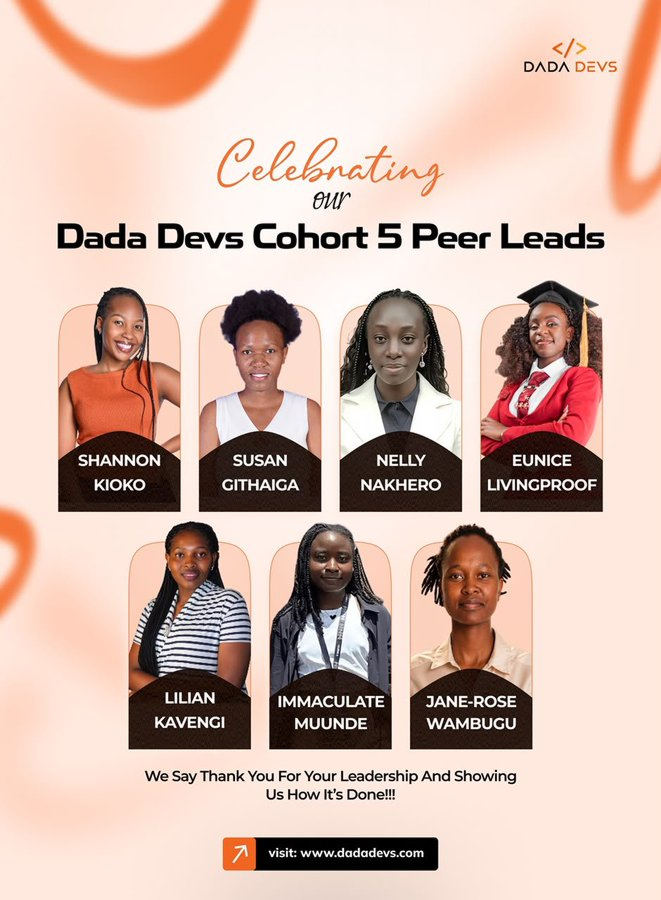
A day earlier, the organization separately named Cohort 5 peer leads, including Kaluki Tiiime, Susan Githaiga, Nelly Nakhero, Eunice Livingproof, Lilian Kavengi, Immaculate Munde, and Mujojo Jayar (JR). Their role was to keep study groups accountable through assignments, code review, troubleshooting, and project support.

The closing statement from Dada Devs was direct:“Bitcoin needs more people who can build, contribute and take responsibility for the systems they are helping create. We’re proud of what this cohort has done in these eight weeks. Now, let’s see what they build next.”

African women developers collaborating on Bitcoin projects during a Dada Devs training session

What this signals for Bitcoin development in Africa?

Cohort 5’s close is a small news event with a larger pattern behind it. Bitcoin Dada has spent years building a women-first education pipeline across multiple African countries. Dada Devs is the technical layer of that work: a pathway for engineers who want to run nodes, ship Lightning applications, and contribute upstream.

Marcel has previously described Dada Devs as an incubation environment where women identify problems in their own contexts and build Bitcoin- and Lightning-based tools for those communities.

The organization has also moved toward more durable infrastructure, including a physical hub in Kenya for in-person collaboration.

ENJOYED THIS ARTICLE?Support the authorSend a zap over Lightning or on-chain