Nigeria Unveils Coordinated Bitcoin Framework as President Tinubu Signs Virtual Assets Executive Order

POLICY

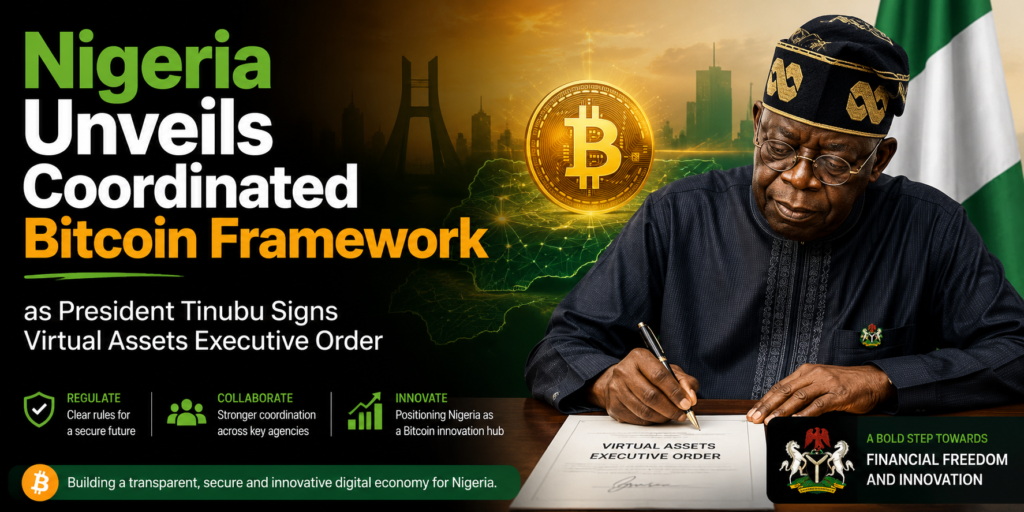
In a major effort to formalize Africa’s largest digital asset market, Nigerian President Bola Ahmed Tinubu has signed the Presidential Executive Order on Virtual Assets Coordination, 2026. Taking immediate effect, the directive establishes a unified, cross-agency supervisory architecture designed to eliminate regulatory fragmentation, combat fraud, and foster responsible fintech innovation.

According to an official statement by the Presidency, the policy addresses an environment where digital assets increasingly blur the lines between traditional currencies, commodities, and securities. By bridging the gaps left by agencies previously operating in silos, the order aims to protect citizens from predatory, unregistered operators while securing national financial integrity.

Core Architecture: The New Supervisory Structure

Crucially, the executive order does not introduce an entirely new regulatory body; instead, it optimizes the oversight capabilities of existing institutions.

Streamlined Division of Roles

To eliminate jurisdiction overlaps, registration and monitoring are strictly categorized by the nature of the asset class:

  • The SEC: Retains full enforcement and registration power over virtual assets classified as securities.

  • The CBN: Oversees payment rails, settlements, custody, and all non-security digital asset activities.

Key Policy Initiatives Under the Order

InitiativeDescription
CBN Regulatory SandboxA highly controlled environment enabling eligible operators to test blockchain solutions and virtual asset products under direct supervision.
Tax Compliance RoadmapThe NRS is operationalizing dedicated tax policies for digital assets, ensuring the booming sector contributes to national revenue.
National White PaperThe Federal Government is finalizing a comprehensive Virtual Assets White Paper to outline long-term economic objectives and stakeholder roadmaps.

Timeline Alert: The newly formed Virtual Asset Council has been given a strict 30-day deadline to submit a harmonized implementation framework to guide participating agencies.

Strategic Implications for the Bitcoin Ecosystem

For years, Nigeria’s hyper-growth in Bitcoin adoption has been driven by retail peer-to-peer (P2P) trading, remittance flows, and inflation hedging. However, institutional capital remained largely on the sidelines due to regulatory ambiguity.

This framework changes the landscape. It builds on the SEC’s recent momentum in admitting several high-profile digital asset firms  into its Accelerated Regulatory Incubation Programme (ARIP). By transforming gray markets into structured environments, the order protects everyday consumers from scams while signaling to global investors that Nigeria is evolving into a mature, compliant digital asset hub.

For further updates on the rollout, you can track official press statements released directly via the Nigeria State House Web Portal.

ENJOYED THIS ARTICLE?Support the authorSend a zap over Lightning or on-chain