
Namibia’s Bitcoin Builder: Okin Tjongarero on Teaching Through Experience, Not Theory
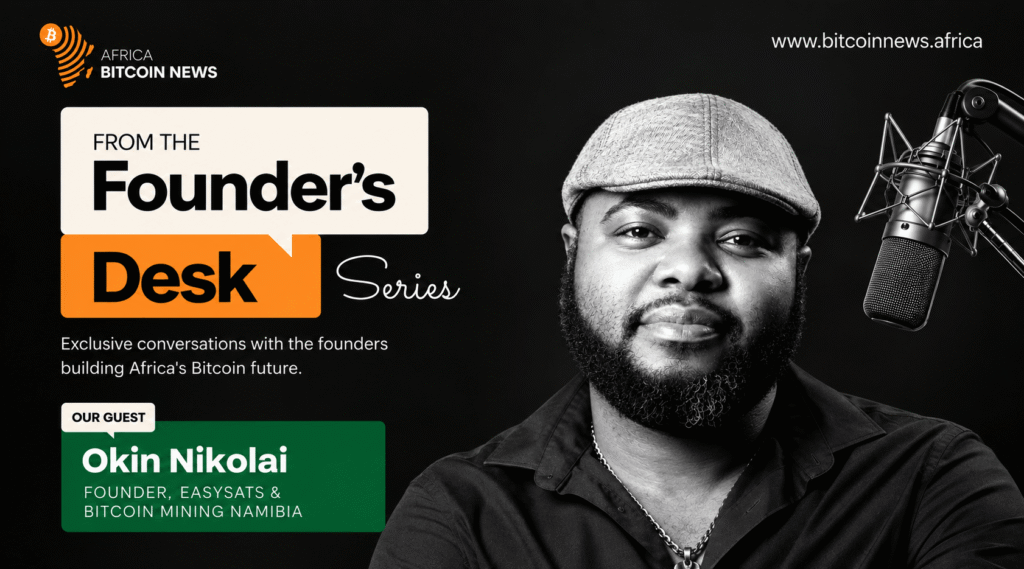
Bitcoin adoption does not always begin with ideology or speculation. For Nikolai Tjongarero, better known as Okin, it began with practical questions: how could he get paid for the value his podcast was creating, and how could he send money across borders more easily?
Those experiences pushed him to learn Bitcoin more deeply and eventually build EasySats as a platform focused on helping people understand how to earn, store, and use Bitcoin.
His work later expanded into merchant integration, community events, and Bitcoin Mining Namibia, giving him firsthand experience with the infrastructure required to bring Bitcoin into everyday life.
The Founder’s Journey
Okin Tjongarero discovered Bitcoin through use cases rather than speculation. His podcast was gaining international attention, and he was looking for a way to monetise its growing engagement. A friend who had been trying to introduce him to Bitcoin since 2012 pointed him toward it again. Around the same time, he used Bitcoin to send money to his brother in Dubai. These practical experiences gave him a reason to move beyond simply hearing about Bitcoin and start researching how it worked. Bitcoin eventually became, in his view, both a monetary asset and a tool for greater freedom.
That led to a more important question: how could he make what he had learned useful to other people? EasySats grew from that question. Rather than simply promoting Bitcoin, Okin wanted to help peers, families, businesses, and communities understand how to earn, store, and use sats safely.
Education became the entry point, but experience became the method. Through initiatives such as Bitcoin Burgers and Beers, participants could learn about Bitcoin while actually using it to pay for food and drinks. A Bitcoin pool tournament took the same approach, allowing participants to receive Bitcoin, spend it to enter the tournament, send and receive sats, and decide what to do with their winnings. Instead of sitting through a lecture, people were learning by using Bitcoin.
Core Insights & Infrastructure
Okin’s approach to education is straightforward: make Bitcoin useful before expecting people to understand everything about it. EasySats focused on practical questions—how to get Bitcoin, how to keep it safe, and how to use it in everyday life. Merchant integration became an important part of that work because accepting Bitcoin gives people an opportunity to encounter the technology through normal economic activity rather than speculation.
The experience also taught Okin that Bitcoin education cannot always follow a fixed format. When traditional education sessions began attracting fewer people, the team changed direction rather than simply repeating the same model. Social events and practical activities created stronger engagement because Bitcoin was connected to something participants already understood.
Get the Weekly Brief
Essential African Bitcoin news, curated for builders. No spam.
"*" indicates required fields
His experience with Bitcoin mining followed the same learning-by-doing approach. Okin purchased mining machines, dealt with suppliers, paid through the banking system, completed customs procedures, and worked through the logistics of moving equipment from China to Namibia. That firsthand experience eventually led others to approach him for help sourcing mining hardware and pushed him to consider the wider role mining could play in Namibia.
But mining also exposed a broader African infrastructure challenge: every country has its own rules and realities. Import requirements, customs procedures, shipping, electricity, suppliers, and local regulations all matter. What works in one African market may not work in another.
Okin also learned this lesson through an early attempt to build a Bitcoin circular economy. He acknowledged that the first attempt failed because he tried to reproduce patterns he had seen elsewhere instead of starting with what Namibians actually needed. The lesson was clear: local adoption cannot simply be copied and pasted.
“How do I translate what I’ve learned into something useful for my peers, friends, family, and business owners?” became the question behind much of his work.
Future Outlook
Okin sees the next phase of Bitcoin adoption in Namibia moving beyond simply teaching people how to buy Bitcoin. The focus is increasingly on earning, spending, saving, and integrating Bitcoin into existing businesses and systems.
That means merchants accepting Bitcoin, businesses finding ways to pay or earn in sats, communities using Bitcoin in practical settings, and local builders developing infrastructure suited to Namibian realities.
His philosophy is that Bitcoin should be treated as a tool. People do not need to understand every technical detail of a computer before using one; similarly, they do not need to become protocol engineers before they can use Bitcoin safely and productively.
The broader opportunity is therefore not to make everyone interested in Bitcoin, but to make Bitcoin useful enough that people have a reason to use it.
No founder sees every problem from every angle. One person may understand the technology, another the market, another funding, and another the local community. Bringing those perspectives together can produce stronger solutions and help projects move faster.
Okin’s journey from discovering Bitcoin through everyday problems to building EasySats and exploring mining infrastructure illustrates a practical adoption model: start with a real problem, teach through experience, adapt to local needs, and work with others.