Btrust Announces Q2 2026 Developer Grant Recipients

DEVELOPMENT OPEN SOURCE PRESS RELEASE

Btrust, the non-profit organization dedicated to decentralizing Bitcoin open-source development, announced its Q2 2026 cohort of developer grant recipients.

Seven talented engineers from across Africa and the Global Majority have been awarded grants to advance critical projects in Bitcoin Core. Wallet infrastructure, privacy tools, peer-to-peer exchange systems, and developer tooling.

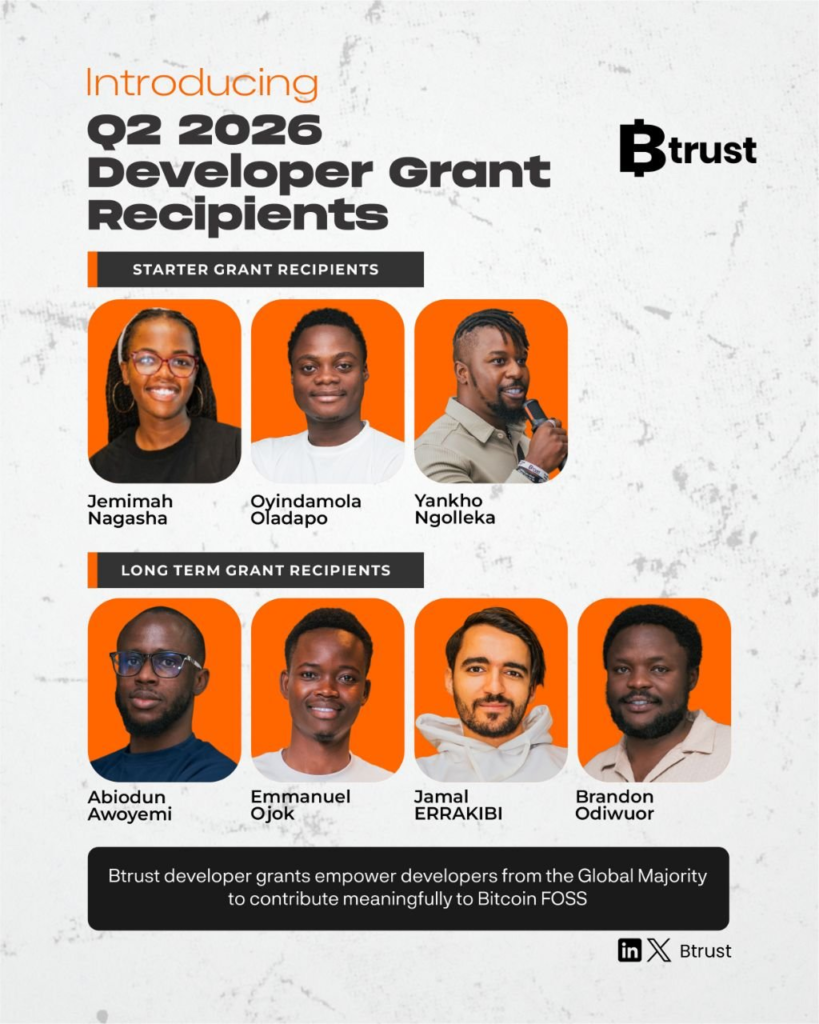
The announcement highlights Btrust’s continued commitment to supporting contributors from underrepresented regions. This quarter’s cohort includes three starter grant recipients and four long-term open-source cohort members.

Their work spans essential areas that strengthen Bitcoin’s resilience, usability, and accessibility worldwide.
About Btrust and Its Mission

Btrust focuses on identifying, educating, and funding talented software developers from Africa and the Global Majority.

Through grants, the Btrust Builders education program, mentorship, and support for local BitDevs communities. The organization aims to make Bitcoin development more decentralized and inclusive.

Applications for Btrust developer grants remain open year-round, with new recipients announced quarterly.

Starter Grant Recipients

The Btrust starter grant provides full-time funding, mentorship, and support for engineers ready to make meaningful open-source contributions and transition into long-term Bitcoin developers.

  1. Jemimah Nagasha (Kampala, Uganda): Nagasha contributes to Polar, the popular open-source desktop application that lets Bitcoin and Lightning developers create safe local testing environments. With the grant, she will focus on improving usability and reliability, including better Core Lightning support on Windows, wallet locking/unlocking workflows, seed phrase management, and bug fixes. She also organizes BitDevs Kampala.
  2. Oyindamola Oladapo (Kaduna, Nigeria): Oladapo works on privacy-focused tools, particularly Rust-Payjoin and the Payjoin Development Kit. Payjoin improves transaction privacy by making ownership patterns harder to analyze. His grant work will advance multiparty Payjoin research, simulations, testing, documentation, and protocol refinements. He co-hosts BitDevs Kaduna and has supported local Bitcoin education events.
  3. Yankho Ngolleka (Lilongwe, Malawi): Ngolleka contributes to MostroP2P, a peer-to-peer Bitcoin exchange built on Nostr and the Lightning Network. This marks Btrust’s first grant supporting peer-to-peer exchange infrastructure, tools that enable direct Bitcoin trading without centralized on-ramps. His work focuses on reliability, error handling, mutation testing, command-line improvements, and running a live Mostro node in Malawi. He plans to grow BitDevs Malawi.

Long-Term Grant Recipients

The Btrust Open-Source Cohort provides sustained funding and support for established contributors working on high-impact Bitcoin projects.

  1. Abiodun Awoyemi (Lagos, Nigeria): A secondary maintainer of bdk-tx (part of the Bitcoin Dev Kit ecosystem), Awoyemi focuses on wallet infrastructure. His contributions include fee calculation fixes, anti-fee-sniping support, Payjoin examples, and more. With the long-term grant, he will improve fee handling, error messages, transaction ordering, policy-aware building, timelocks, and foreign function interface support. He co-organizes BitDevs Lagos.
  2. Emmanuel Ojok (Kampala, Uganda): Ojok contributes to BlueWallet, the popular self-custodial Bitcoin and Lightning wallet for iOS and Android. His past work includes major codebase modernizations (JavaScript to TypeScript, Buffer to Uint8Array) and Silent Payments support. Planned work includes Android 16KB page size compliance, reproducible builds, Gradle modernization, hardware wallet interoperability, and expanded testing. He co-organizes BitDevs Kampala.
  3. Jamal Erakibi (Morocco): Erakibi works on lower-level libraries in the rust-bitcoin ecosystem, including the hashes crate and consensus encoding. His contributions feature SHA256 ARM hardware acceleration, benchmarking improvements, and test vectors. With the grant, he will optimize double-SHA256, add SIMD implementations, benchmark crates, deepen rust-secp256k1 work, review Silent Payments support, and create educational content. He created learning resources like BTCillustrated.
  4. Brandon Odiwuor (Kenya): A long-time Bitcoin Core contributor, Odiwuor focuses on build systems, testing, continuous integration (CI), functional tests, documentation, RPC improvements, and GUI work. Past contributions include functional test enhancements, Signet support, and extensive CI reviews. His long-term project involves prototyping CTest integration, improving the CDash dashboard, updating CI workflows, and enhancing sanitizer/coverage reporting. He leads Socratic seminars at BitDevs Nairobi.
Btrust Q2 2026 developer grant recipients

Key Themes: Community, Education, and Expanding Scope

A major highlight of this cohort is the strong pipeline from Btrust Builders, nearly all recipients participated in the structured learning program. This demonstrates how education and hands-on open-source experience successfully transition developers into funded contributors.

Many grantees actively organize or support BitDevs meetups across Lagos, Kampala, Kaduna, Malawi, and Nairobi, strengthening local Bitcoin developer ecosystems.

The inclusion of peer-to-peer exchange infrastructure (MostroP2P) represents an exciting expansion of Btrust’s grant focus. Supporting tools that improve Bitcoin access in regions with limited traditional on-ramps.

How to Apply for Btrust Developer Grants

Btrust developer grant applications are open year-round. Whether you are already contributing to Bitcoin open-source software or ready to begin full-time work, you can apply now.Btrust also offers support for BitDevs communities. Check the BitDevs Playbook and apply for sponsorship if needed.
ENJOYED THIS ARTICLE?Support the authorSend a zap over Lightning or on-chain