
Farida Nabourema Says the African Bitcoin Ecosystem Has a Credibility Crisis. She Is Right to Say It.
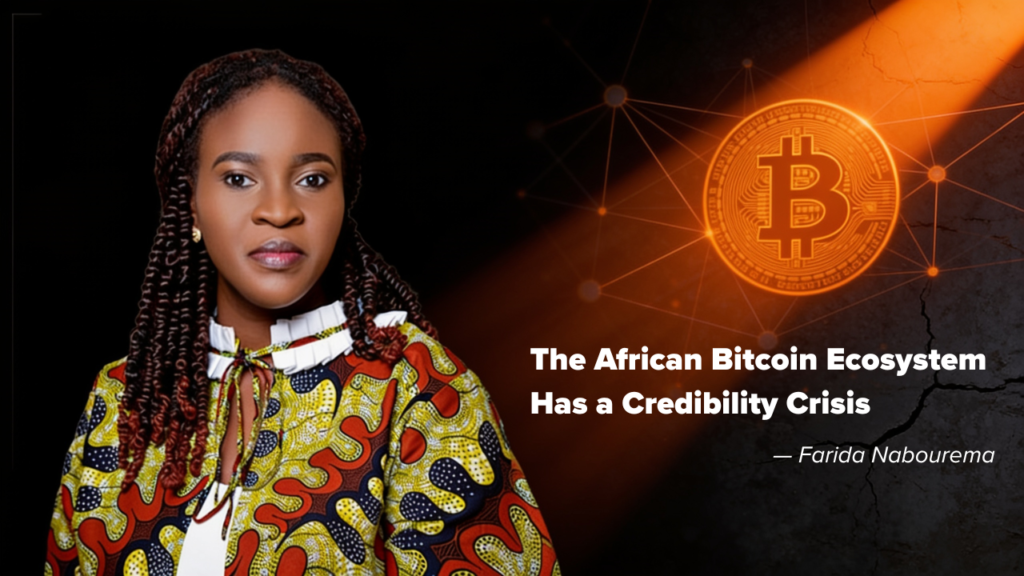
On July 10, 2026, Farida Nabourema, founder of the Africa Bitcoin Conference, Togolese human rights activist, and one of the most credible voices in African Bitcoin, published an essay that the ecosystem needs to sit with.
The title is direct: “The African Bitcoin Ecosystem Has a Credibility Crisis.”
It is a five-minute read. It is uncomfortable. And it is one of the most important things written about African Bitcoin in years.
Who is saying this, and why it matters
Farida Nabourema is not an outsider lobbing criticism from a distance. She built the room. She founded the Africa Bitcoin Conference in 2022 when, as she writes, fewer than twenty initiatives across the entire continent were genuinely working on Bitcoin. She has spent years making the case, to institutions, governments, businesses, and communities, that Bitcoin deserves serious engagement in Africa.
Furthermore, her motivation for doing so was never narrowly financial. As a longtime critic of French neocolonial influence in West Africa and the CFA franc system specifically, Nabourema saw Bitcoin as part of a much older political struggle. Specifically, she describes it as connected to Africa’s long fight for monetary sovereignty, a fight that, in her telling, cost Togo’s first president, Sylvanus Olympio, his life.
When a person with that background and that track record publishes a piece titled “credibility crisis,” the ecosystem owes her a careful read. Not a defensive one. A careful one.
What she is actually arguing
The essay opens with a clear-eyed assessment of what the African Bitcoin ecosystem looked like at the beginning and what it looks like now. On paper, the growth is spectacular. Hundreds of Bitcoin initiatives now claim to exist across Africa. New projects surface almost weekly. New communities announce ambitious missions monthly.
However, Nabourema is not celebrating. Instead, she writes that what she sees is the emergence of an incentive structure she recognises from the international development sector. In her framing, the pattern works like this: a project is created in the name of serving a community, the community becomes the marketing material, the photographs and reports become fundraising instruments, and the community itself remains largely unchanged, while the founder’s life consistently improves.
Her argument is that Bitcoin has simply become the newest label attached to this old model. Attach the word to education, football, a village, agriculture, youth programs, or women’s cooperatives, anything that photographs well, produce compelling images, tell an inspiring story, and grants, sponsorships, and international speaking invitations follow.
Notably, she does not accuse every funder of bad faith. On the contrary, she acknowledges that many organisations funding these initiatives genuinely want to help Africa. However, she argues that good intentions do not replace due diligence. And the questions that would actually measure impact, how many people remain active six months later, what measurable economic problem has been solved, how much funding reached the community versus administrative costs, are asked far too rarely.
The number that stops you cold
The most arresting claim in the essay is also the most specific. Nabourema writes that if one combined every genuinely active participant across all the projects celebrated as proof of African Bitcoin adoption, she doubts the total would exceed 10,000 people, on a continent of well over one billion.
That is a damning number. Furthermore, it lands harder because it comes from someone who has spent years trying to grow that number. In other words, this is not cynicism from the outside. It is a reckoning from within.
She is careful to distinguish between the failure inherent in experimentation, which she calls inevitable and even healthy, and what she describes as a more sophisticated form of deception. Specifically, she identifies a pattern where community poverty is used as fundraising capital, where symbolic amounts of Bitcoin are distributed while substantial funding is collected elsewhere, and where carefully curated stories replace measurable outcomes. As she writes, receiving five dollars on a mobile wallet does not constitute financial empowerment. Yet these small demonstrations are repeatedly presented as evidence that entire communities are being transformed.
The silence problem
Perhaps the sharpest point in the essay is not about the bad actors. It is about everyone else.
Nabourema writes that for too long, many insiders have stayed silent, telling themselves that criticism risks fracturing a young ecosystem that cannot afford division. She has come to believe, she writes, that this silence is itself a form of complicity.
That is a serious charge. It is also, on reflection, a fair one. Ecosystems that cannot tolerate internal accountability tend not to self-correct. They tend to calcify around the narratives that fund them. Therefore, if the African Bitcoin community genuinely believes in what it is building, it should be able to hold itself to the same standards it would demand of anyone else.
What she is calling for
Nabourema is not calling for the ecosystem to collapse. She is calling for it to grow up. Specifically, she argues that the African Bitcoin ecosystem must demand real transparency, real accountability, real measurement, real communities, real adoption, and real impact.
Her closing argument is worth quoting directly, within fair use: the objective, she writes, was never to build organisations that survive on Bitcoin. The objective was, and remains, to build an Africa that can thrive because of it.
That distinction, surviving on Bitcoin versus building with Bitcoin, is the sharpest line in the piece. Furthermore, it is a useful test for any project operating in this space. Which side of that line does it sit on?
Why Africa Bitcoin News is covering this
Africa Bitcoin News is a Bitcoin-only publication. Therefore, we are not in the business of defending the broader “crypto” ecosystem or the grant-chasing projects that have attached themselves to it. However, we are in the business of honest reporting about what is actually happening with Bitcoin in Africa.
Nabourema’s essay is a primary source document from one of the ecosystem’s most credible voices. It deserves to be read widely. Furthermore, it deserves to be taken seriously, not dismissed as divisive, not softened into a “both sides” non-story, and not buried under the week’s more comfortable announcements.
The African Bitcoin ecosystem is doing genuinely important work in places like Kibera, in Lightning developer bootcamps, in mining facilities running on hydro power, and in merchant payment infrastructure reaching millions of M-Pesa users. That work is real. However, if Nabourema is right, and we have no reason to doubt her, it is sharing a stage with a much larger volume of performative activity that exploits the continent’s communities while producing little of lasting value.
That is worth naming. She named it. Now the rest of us have to decide what to do with it.
Read Farida Nabourema’s full essay here: The African Bitcoin Ecosystem Has a Credibility Crisis