
Three Weeks in Kenya Changed How I See Bitcoin’s Future in Africa
I just spent more than three weeks in Kenya. I am heading home now, grateful, energised, and more convinced than ever that Africa is where Bitcoin’s most important story is being written.
This was not a single-event trip. Instead, it was one of those rare stretches where everything you believe about Bitcoin gets stress-tested in real life. Specifically, the technology, the people, the conversations, and the moments all came together in a way that is hard to manufacture and impossible to forget.
The first thing I noticed was the money, or rather, the absence of the old kind.
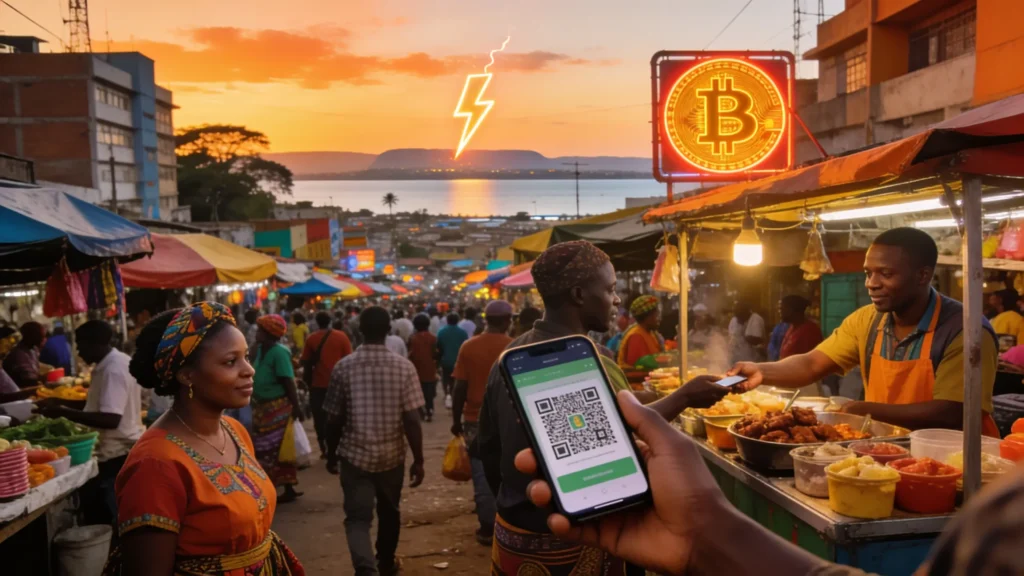
Throughout my stay, I paid for literally everything in Bitcoin. Meals in Westlands, matatus across the city, groceries, coffee runs, random market purchases. Furthermore, none of it required a conversion, a forex counter, or a fiat backup. Tando made it seamless. Specifically, I sent sats from my Lightning wallet, merchants received shillings over M-Pesa, and nobody skipped a beat.
There is a meaningful difference between understanding that Bitcoin circular economies exist and actually living inside one. Specifically, when Bitcoin stops being something you hold and becomes something you spend, the whole thesis shifts from intellectual to visceral. Kenya gave me that shift, repeatedly, over three weeks.
Kisumu: Africa Free Routing's 14th Lightning Developer Bootcamp
One of the week’s most meaningful moments had nothing to do with conferences. Instead, it happened in a room in Kisumu, on the shores of Lake Victoria.
From June 8–12, I hosted Africa Free Routing’s 14th Lightning Developer Bootcamp in Kisumu, Kenya’s third-largest city and a region that has not historically been at the centre of the country’s Bitcoin developer activity. Watching developers spend five intensive days learning, building, and taking their first steps into Lightning development reminded me exactly why education remains the most important investment we can make for Bitcoin’s future in Africa.
Notably, Kisumu matters geographically. The city sits close to the borders of Uganda, Tanzania, and Rwanda. Therefore, the developers we trained there are not just local talent. They are the seed of a regional builder cluster. Furthermore, the bootcamp wrapped up just two weeks before the Bitcoin Nairobi Conference, giving graduates a direct runway from their first Lightning code into one of Africa’s biggest Bitcoin rooms.
Africa Free Routing has now trained developers across more than a dozen countries on the continent. However, every new city we enter feels like the first time. The hunger in that room in Kisumu was real.
The Bitcoin Payments Retreat with Minmo and HRF
Between the bootcamp and the main conferences, I had the privilege of attending the Bitcoin Payments Retreat, hosted by Minmo in partnership with the Human Rights Foundation. This was a smaller, more intimate gathering, and precisely because of that, the conversations went deeper.
Specifically, the retreat brought together people building the future of Bitcoin payments: wallet developers, Lightning infrastructure engineers, merchant tooling builders, and advocates working on financial freedom in high-risk environments. As a result, the discussions were honest about both the opportunities and the hard problems still to solve.
For me, the retreat was a reminder that Bitcoin’s payment layer is still early. The tools are getting better fast. However, the gap between “this works technically” and “this works for a grandmother in Kisumu” is still real, and closing it requires both engineering and education.
Bitcoin++ Nairobi: Lightning Education as Infrastructure
Speaking at Bitcoin++ Nairobi (June 17–19 at the Pride Inn Azure, Westlands) was a genuine privilege. This was the first Bitcoin++ event on African soil — the Open Source Edition. Therefore, the audience was exactly the kind I find most energising: developers, contributors, and builders who came to ship, not to speculate.
My session made a single argument: Lightning developer education is not a nice-to-have. It is infrastructure.
Specifically, protocols alone are not enough. We need developers who understand them, communities that support them, and educational programs that continuously grow the talent building on Bitcoin. In Africa, that pipeline does not yet exist at the scale the continent needs. Therefore, programs like Africa Free Routing’s bootcamps are not supplementary. They are foundational.
It was encouraging to see so much genuine interest in that conversation, from African developers and from international builders who are increasingly paying attention to what is happening on this continent.
Bitcoin Nairobi Conference: Explaining Lightning to the Next Wave
The following week, I spoke at the Bitcoin Nairobi Conference (June 24–26, ASK Dome, Jamhuri Park). My session there had a different focus. Specifically, it was aimed at helping people understand how the Lightning Network actually works and why it matters for Bitcoin adoption.
I genuinely enjoy those sessions. There is something satisfying about watching the moment when Lightning clicks for someone, when they move from “I’ve heard of it” to “I understand why it exists.” The questions and discussions that followed were sharp and enthusiastic. Furthermore, the closing day’s guided walk through Afribit Kibera’s Bitcoin Valley put everything we had discussed on stage into living context.
Kibera is not a case study. It is proof of work.
The people made the trip
Beyond every event and session, the best part of three weeks in Kenya was simpler: the people.
Reconnecting with friends I have built relationships with over years of shared work in the African Bitcoin ecosystem. Meeting new builders, educators, and community organisers whose names I had only known from Telegram groups and X threads. Every conversation reminded me how genuinely collaborative and welcoming this community is. The relationships we build are just as valuable as the technology we are creating.
And to top it all off, I had the joy of celebrating the wedding of two wonderful friends, Mary and Jodom. It was a beautiful, warm celebration, and a perfect way to close out an unforgettable stretch.
Kenya continues to be one of my favourite places on earth. And I already look forward to the next time.