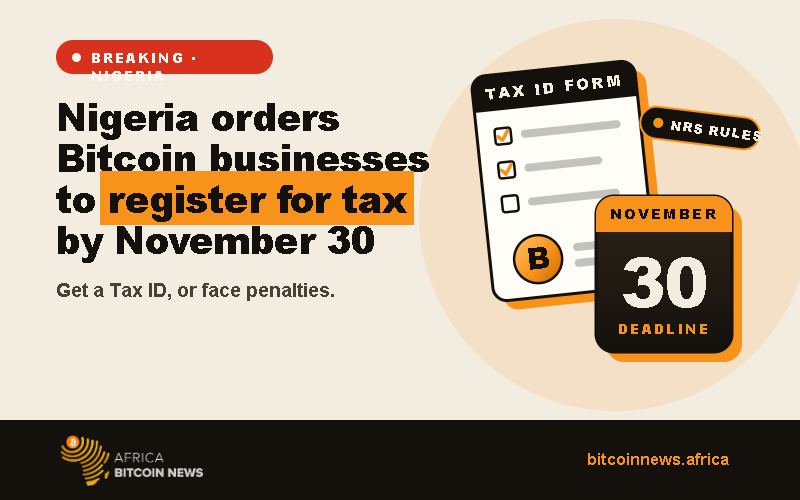
BREAKING: Nigeria Orders Bitcoin Businesses to Register for Tax by November 30

REGULATION

Exchanges, P2P desks, Lightning payment apps and custodians serving Nigerians have one week to act or risk sanctions.

Nigeria’s tax office has given Bitcoin businesses one week to get on its books. The Nigeria Revenue Service (NRS) has set November 30, 2026 as the deadline for virtual asset service providers in Nigeria to register on its new tax compliance portal. Bitcoin counts as a virtual asset under Nigerian law, so Bitcoin businesses are covered. 

Missing the deadline could be costly. Operators that fail to register risk regulatory sanctions.

Two deadlines, not one

Businesses must submit a registration form by November 30, then finish integrating with the portal by December 31, 2026. The second step means connecting your systems to the portal, which will allow transaction reporting, tax assessment and payment of taxes collected.

Submitting the form alone is not enough. The NRS says registration is not complete until both stages are done.

The directive appeared in a public notice titled “Virtual Asset Service Providers Compliance Registration.”

Who is affected?

The directive covers businesses that exchange virtual assets for fiat, transfer assets or hold them in custody for customers.

That includes:

  • Bitcoin exchanges and P2P platforms

  • Lightning payment apps and payment processors

  • Bitcoin remittance services

  • Custodians and other virtual asset service providers

The rules apply regardless of branding or physical location, including foreign businesses serving Nigerian residents.

Affected businesses must also maintain records and comply with tax registration, filing, reporting and payment requirements.

Ordinary Bitcoin users are not the target. Individuals buying and holding Bitcoin in their personal wallets are not required to register under this directive, although their individual tax obligations remain separate.

What the portal does and doesn't do

The NRS says the portal does not introduce new taxes. It is designed to manage existing tax obligations and support anti-money laundering compliance.

Registration also does not constitute a licence to operate. Businesses still require applicable regulatory approvals from bodies such as the SEC or CBN.

Why now?

The move aligns with FATF Recommendation 15, which requires countries to regulate virtual asset service providers and address money laundering risks.

It follows Nigeria’s broader tightening of crypto oversight. Earlier this year, the NRS issued crypto tax guidelines covering businesses, individuals, service providers and P2P operators, while the CBN introduced stricter controls on platform-facilitated P2P transactions.

Nigeria’s Bitcoin industry is increasingly operating within a formal regulatory framework.

What this means for Bitcoin in Nigeria

Nigeria has moved from restricting Bitcoin to regulating and taxing its ecosystem. That shift creates room for legitimate businesses to operate, but compliance requirements are accumulating across the SEC, CBN and NRS.

Large exchanges may have the resources to manage these obligations. Smaller Bitcoin startups, P2P merchants and Lightning builders may not.

Short deadlines and rising compliance costs could push smaller businesses out of the market, reducing competition and access—or driving users toward platforms operating outside the regulatory framework.

Regulation should protect users and create clarity without making it unnecessarily difficult for local Bitcoin businesses to survive.

What businesses should do

If your business serves Nigerian customers, review the NRS notice, seek professional tax advice and complete registration before November 30. Begin planning your portal integration well ahead of the December 31 deadline.

Africa Bitcoin News will continue following this story.

This article is for informational purposes only and does not constitute legal or tax advice.
ENJOYED THIS ARTICLE?Support the authorSend a zap over Lightning or on-chain