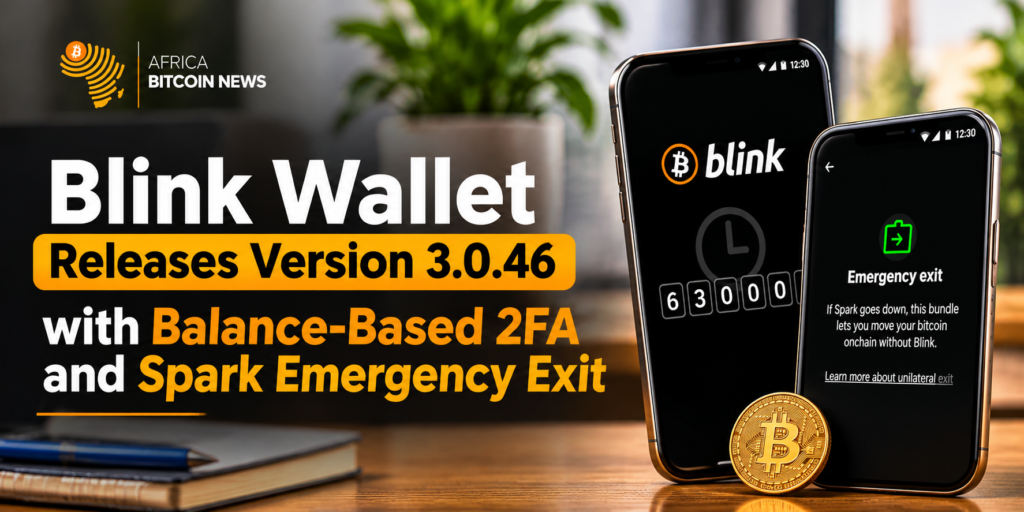
Blink introduced self-custodial (non-custodial) accounts in 2026, powered by the Spark protocol. Users hold a 12-word recovery phrase. Spark operators co-sign payments, but they cannot spend funds without the user’s key.
If the operators become unreachable, the 12-word phrase alone is not sufficient to recover funds. A recent snapshot of the wallet’s state, called an “emergency bundle”, is also required.
From version 3.0.46, the app automatically creates the emergency bundle after the first transaction and refreshes it after every subsequent payment. No user action is needed for creation. The bundle is saved alongside the encrypted cloud backup (Google Drive or Apple iCloud).
If the cloud copy falls more than a week behind, the Home screen prompts the user to update it. Users who prefer not to use cloud backup can manually download the bundle from Settings → Security and Privacy → Emergency exit. Blink never receives the bundle.
If Spark operators go offline, recovery uses the bundle plus the 12-word phrase with open-source tooling (not yet an in-app button). The process takes roughly two weeks because of on-chain timelocks, incurs Bitcoin network fees, and recovers only the Bitcoin balance, not any Dollar (Stablesats) balance.
This builds on a documented July 2026 mainnet case study in which the team successfully forced approximately 90,000 of 100,000 sats back onto the Bitcoin chain using only a seed and a previously saved recovery bundle.