HakiFedha Launches Lipa, an Open Directory for Spending Bitcoin Across Africa

ADOPTION EDUCATION INNOVATION

Lipa, a project from HakiFedha, is now live at lipa.hakifedha.org. A Swahili version is available at lipa.hakifedha.org/sw/. The name is deliberate. Lipa means “pay” in Swahili.

The site is an open, living directory of tools that help people across Sub-Saharan Africa spend bitcoin or convert it into local payment systems.

Those systems include mobile money, bank transfers, remittances, airtime and data, utility bills, and merchant payments.

Why the directory exists?

Bitcoin adoption in Africa is often discussed in terms of wallets, price, or regulation. Everyday use is harder. High remittance costs, cash dependence, limited banking access. And shifting platform rules all sit between holding bitcoin. And paying rent, sending money home, or buying airtime.

Lipa is built for that last mile. It does not sell bitcoin. It does not process payments. It maps existing platforms that can move value from bitcoin into local rails, country by country.

HakiFedha frames the work around financial justice and privacy. The organization publishes research and guides for journalists, NGOs, activists, educators. And other civil society groups that may need censorship-resistant money, not a trading app.

The GitHub repository describes Lipa as a practical directory of Africa-focused platforms that convert bitcoin directly into local currency. Without always requiring a traditional centralized exchange.
What users can do on the site?

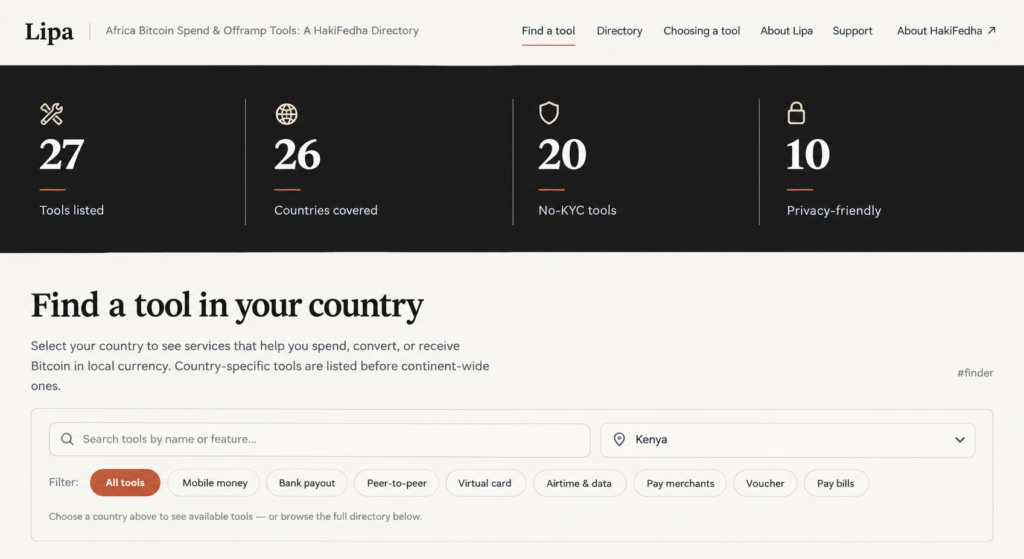
Visitors can browse the full directory or filter by country. The site also points to continent-wide services that may work in a given location.

Each listing is meant to be compared before use. Lipa highlights four practical issues that often get buried in marketing pages:

  • Identity checks (KYC): Badges include no KYC, no formal KYC, KYC required, and KYC unconfirmed. “No formal KYC” means a government ID may not be required, but an email or phone number might still be requested.
  • Privacy: A privacy-friendly badge flags tools that collect less data or support peer-to-peer trading.
  • Custody: A custodial badge marks tools that hold funds during conversion, instead of leaving the user in control of the keys.
  • Availability: Coverage can change by country with little notice.

The directory also links to two companion resources:

Crypto Sheria Tracker is another HakiFedha project. It maps how governments treat Bitcoin. And digital assets, including licensing, KYC/AML rules, tax treatment, self-custody, and peer-to-peer trading. It is presented as a research tool, not legal advice.

Swahili version puts local language first

The Swahili site uses the same structure as the English version. Headings, badge explanations, contribution notes, and the “living reference” warning are translated.

That matters in East Africa, where Swahili is widely used and “Lipa” already appears in everyday payment products. Localization is also part of HakiFedha’s stated plan. The team says it wants the directory to work in more African languages over time.

The project is still being built

Lipa is explicit about its status: it is a work in progress. The public pages currently show placeholder counts for listed tools, countries covered, no-KYC tools, and privacy-friendly tools.

The team says the bitcoin tool landscape changes quickly. Platforms launch, change KYC rules, expand or leave countries, or shut down. Entries are supposed to be re-verified on a rolling basis.

Users are told to bookmark the page and check back if a working option is not listed for their country today.

Clear limits: no endorsements, no advice

Lipa’s own terms of use are unusually direct for a directory of this kind. Listings are informational. They are not endorsements. Availability and KYC requirements can change without notice. Users should verify a tool directly before relying on it for a large transfer.

Nothing on the site is financial or legal advice. Institutional support does not buy placement. HakiFedha says funding or partnerships will not decide which tools appear, how they are described. Or how their KYC and privacy badges are assigned.

The directory is published under a Creative Commons CC-BY 4.0 license.

Who can contribute?

Corrections, new tools, and updated country coverage are invited by email at info@hakifedha.org or through the GitHub repository.

The team is also asking for help with:

  • Ongoing verification of listings, fees, and KYC rules.
  • Research and testing of new spend and offramp tools.
  • Interface and search improvements.
  • A network of trusted local contributors.
  • Translation and localization.

Organizations that work on wallets, peer-to-peer exchanges, fintech, or payments in Africa are invited to discuss support. Supporters can be named on the site unless they prefer to stay anonymous.

Why this matters now?

Africa already has dense mobile-money networks. Banks and fintech firms have launched many “Lipa” and QR payment products of their own. Those products usually move local currency.

Lipa sits one step earlier. It tries to show whether bitcoin can reach those same local rails, and at what cost in privacy, identity disclosure, and custody.

For households, that can mean cheaper remittances or a way to pay bills without first finding a cash buyer.

For civil society groups, it can mean a documented map of options when conventional payment channels become slow, expensive, or politically constrained.

The directory will only be useful if the listings stay current. That is the test ahead. For now, Lipa is a public starting point in English and Swahili. With an open invitation to keep the map honest.

Explore the directory: https://lipa.hakifedha.org/
Toleo la Kiswahili: https://lipa.hakifedha.org/sw/

ENJOYED THIS ARTICLE?Support the authorSend a zap over Lightning or on-chain