
Walking Kibera’s Bitcoin Circular Economy: The Day That Defined the Bitcoin Nairobi Conference 2026
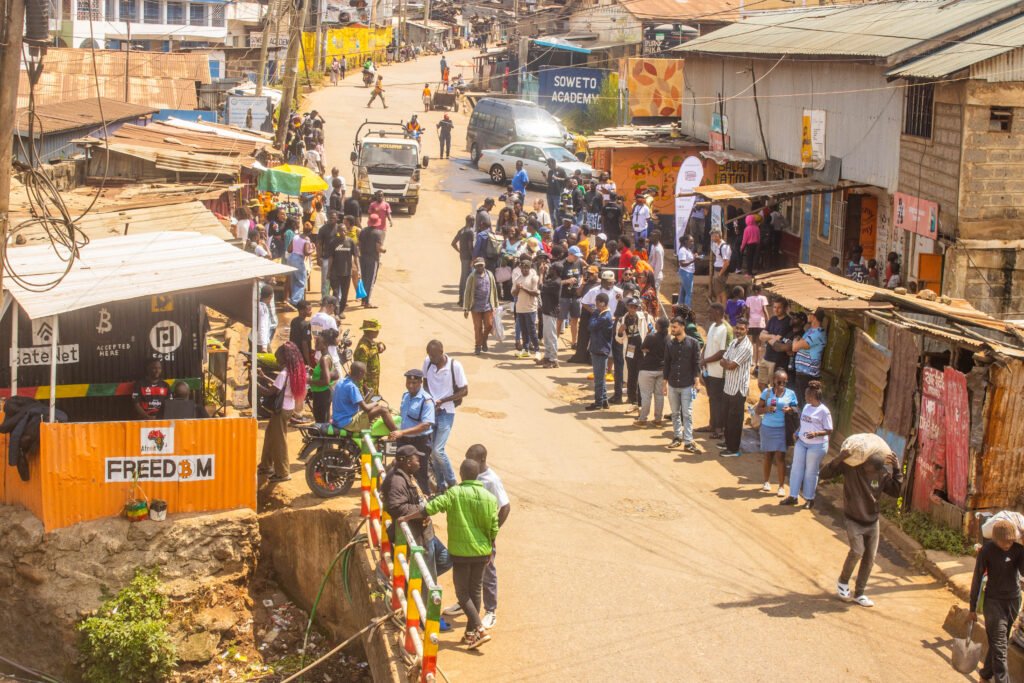
The Bitcoin Nairobi Conference 2026 ended on June 26, not in a conference hall, but on the streets of Kibera. Specifically, the closing day took participants out of the ASK Dome and into Africa’s largest Bitcoin circular economy, for a guided walk through the community that has been quietly proving Bitcoin works as everyday money since 2022.
The conference ran June 24–26 at the ASK Dome, Jamhuri Park, Nairobi, built on the belief that Bitcoin is no longer simply an emerging technology, it is already being used, built upon, taught, and studied across the continent. Furthermore, it was organised through a collaborative effort by AfriBit Kibera, Gorilla Sats, Trezor Academy, Bitika, and Tando, with event production led by TALO, CIO Africa by dx5, and Capital FM as media partners.
Notably, the conference also carried a sharper local identity than most Bitcoin events. Organisers described it as a Bitcoin conversation designed for Africa, by Africa, real adoption, real policy, real economic impact.
What happened at the ASK Dome: June 24–25
The first two days were dense and deliberate. No price talk. No speculation panels. Instead, the programme focused on understanding how Bitcoin can address real financial challenges facing Kenya and the broader African continent, from chamas in Kibera to merchant settlement in Kampala to remittances across borders. Afro btc Conference
Sessions explored how communities across Kenya, including Afribit Kibera, Bitcoin Babies, BTC Biashara, and BTC Githurai, are making Bitcoin everyday money. Furthermore, speakers tackled practical challenges: value leakage, merchant onboarding, and what it takes to scale a circular economy beyond a single neighbourhood. Practitioners from South Africa (Bitcoin Ekasi), Uganda, Tanzania, and several local Kenyan projects took the stage alongside developers and policy voices.
The conference brought together over 60 speakers, 350+ attendees, and 30+ panels and workshops, uniting builders, developers, entrepreneurs, and grassroots leaders from across 7 East African countries. Afrobitcoin
Ronnie Mdawida of Afribit Kibera anchored the circular economies track as lead, giving sessions a practitioner’s grounding rather than a theorist’s framing. Likewise, Serah Mucha of Afribit Kibera captured the organising spirit plainly: “We are organising the Bitcoin Nairobi Conference because Africa should not just witness the future of Bitcoin. We should help shape it.” YouTube
The policy dimension ran through every conversation. The conference arrived as authorities weighed how to structure oversight for virtual assets, with participants’ immediate concern being whether regulation would reflect how Bitcoin is actually being used across the country. Kimberly Sandra, co-founder of Bitika, put the stakes clearly: “Kenya is at a defining moment when it comes to virtual asset regulation, and this process should not be built in isolation, it should involve continuous engagement.”
What are Bitcoin circular economies?
Before June 26, the conference spent two days explaining the answer to that question. Specifically, a Bitcoin circular economy is a self-sustaining local system where people earn, spend, save, and teach Bitcoin within a community. Merchants accept sats for goods and services. Salaries and incentives flow in Bitcoin. Education ensures participants understand self-custody, Lightning payments, and sound money principles.
The result is resilience. In environments where naira, shilling, or birr can devalue overnight, a community holding Bitcoin is insulated. Furthermore, because Lightning payments settle in seconds for fractions of a cent, even the smallest transactions, a jerrycan of water, a matatu fare, a kiosk snack, become viable in Bitcoin.
As Jason Grunstra, co-founder of Tando, framed it: “We’re building on what M-Pesa created and integrating Bitcoin into the system so that anyone in the world can come to Kenya and spend their Bitcoin.” Therefore, Kenya’s existing mobile money infrastructure is not a competitor to Bitcoin adoption here. Instead, it is the on-ramp.
June 26: The Bitcoin Valley Walking Tour
It is one thing to discuss Bitcoin adoption in a conference hall. It is another to walk through Soweto West and watch a resident pay for a jerrycan of water with a QR code that settles instantly and for free. Sched
That is exactly what June 26 delivered.
The closing day offered a guided walk through Africa’s largest Bitcoin circular economy, Afribit Kibera. Participants were transported from the ASK Dome to Kibera, where they walked the streets of Bitcoin Valley with community guides. The route covered: Afro btc Conference
- Merchants accepting Bitcoin daily — kiosks, supermarkets, and service providers who receive sats and settle in shillings.
- Community projects where residents earn Bitcoin — through waste collection, small businesses, and educational participation.
- Real families using Bitcoin for savings, school fees, and cross-border remittances.
- Gmax Supermarket’s Wall of Fame — where participants could sign one of Kibera’s most recognisable Bitcoin landmarks. Afro btc Conference
Notably, Afribit Africa has been doing this work since 2022, the grassroots Bitcoin economy in Kibera is small but functional, built through patient, education-first onboarding and Lightning-powered low-cost payments. Therefore, the June 26 walk was not a launch event. Instead, it was a display of what four years of community work looks like when it compounds. Sched
Pre-conference side events had already offered a taste. Specifically, the Bitcoin Babies Experience on June 23 included an immersive walk through similar community touchpoints. However, the June 26 tour was the largest-scale demonstration of the week, the one that put regulators, international visitors, builders, and journalists face-to-face with the people already living inside Africa’s most mature Bitcoin economy.
Why the Kibera visit mattered beyond community
For any regulators in attendance, the visit would be a reality check. Specifically, Kenya’s VASP Act was signed into law in November 2025, and draft regulations published in March 2026 were still being finalised at the time of the conference. Therefore, the Kibera walk was not just a community showcase. It was an informal feedback channel. Sched
The question hanging over the event was straightforward: does the new regulatory framework recognise and protect grassroots Bitcoin use like what is happening in Kibera, or does it inadvertently squeeze out the communities that have adopted it most actively? Sched
Peer-to-peer transactions and personal self-custody fall outside the licensing perimeter under the current VASP framework. However, the edges remain unclear. As a result, the Bitcoin Valley walk gave regulators and policymakers a concrete, human picture of what they are writing rules around — and who those rules will affect.
The full-week picture
The Bitcoin Nairobi Conference 2026 did not stand alone. Instead, it was the closing chapter of a remarkable Nairobi Bitcoin week. Specifically, Bitcoin++ Nairobi ran June 17–19, the first Bitcoin++ event on African soil, bringing deep protocol work, open-source sessions, and a developer-first culture to Westlands. Then the Bitcoin Nairobi Conference followed, shifting the lens from code to community, policy, and real-world use.
As a result, the same city hosted the full stack of Bitcoin work in one week: builders shipping code at Bitcoin++, followed immediately by grassroots practitioners, policymakers, merchants, and community members at the Bitcoin Nairobi Conference. The transition from June 19 to June 24 was almost seamless. The builder energy from the open-source gathering flowed directly into adoption, policy, and community sessions. Afrobitcoin
Furthermore, the Tando announcement earlier in May had set the week’s backdrop perfectly. As of 12 May 2026, every Kenyan mobile number connected to M-Pesa, roughly forty million of them, became automatically reachable as a Lightning address. No application download, no KYC for basic receipts, no new wallet to set up. Therefore, by the time participants walked Kibera on June 26, the infrastructure that made those merchant payments possible had already reached forty million phones.
What attendees left with
Participants at the Bitcoin Nairobi Conference did not leave with price predictions or trading strategies. Instead, they left with practical tools and real connections. Specifically, the conference provided:
- Onboarding curricula from Trezor Academy, Bitcoin Diploma, and local educators.
- Technical playbooks for Lightning merchant integration, low-bandwidth solutions, and self-custody education.
- Community models from Kibera, Bitcoin Ekasi, and projects across Uganda, Tanzania, and East Africa.
- Regulatory context — a detailed picture of Kenya’s VASP framework and where it still needs to evolve.
- A network of builders, educators, and community organisers who can replicate or support similar projects at home.
In other words, the Kibera walk was not just a tour. It was a masterclass. And for the developers, policymakers, and international visitors who attended, it reframed what Bitcoin adoption actually means.
The takeaway
The Bitcoin Nairobi Conference 2026 proved a simple point. Africa is not waiting for institutional adoption, regulatory clarity, or global permission to build with Bitcoin. Communities are already here.
The infrastructure is being laid. The door is being widened. And as Kibera’s Bitcoin Valley shows, the most important work is happening not on a main stage, but on the streets — one sat, one merchant, one family at a time. Afrobitcoin
For those who missed it, footage and reports including Capital FM coverage capture the energy. The next step is straightforward: more builders taking inspiration back to their cities and turning it into local action.
Nairobi showed what is possible. The rest of the continent is watching.
Sources
- Bitcoin Nairobi Conference 2026 — https://bitcoinnairobiconference.com/
- Afribit Kibera on X — https://x.com/AfribitKibera
- Techish Kenya — Bitcoin Is Already Running in Kibera —
- Capital FM Business — Stakeholders Push for Policy Dialogue — https://www.capitalfm.co.ke/business/2026/04/stakeholders-push-for-policy-dialogue-and-real-world-use-ahead-of-adopting-bitcoin-conference/
- CIO Africa — Kenya To Host The Bitcoin Nairobi Conference 2026 — https://cioafrica.co/kenya-to-host-the-bitcoin-nairobi-conference-2026/
- TechTrends Kenya — Nairobi Hosts Adopting Bitcoin Conference 2026 — https://techtrendske.co.ke/2026/04/13/nairobi-bitcoin-conference-2026-policy/
- This Is Africa — The Calendar Held — https://thisisafrica.me/bitcoin-in-africa/the-calendar-held/
- Satlantis — Adopting Bitcoin Nairobi — https://www.satlantis.io/events/2073/adopting-bitcoin-nairobi