
Bitchat Can Now Spread Itself Without the Internet. That Changes Everything for Africa.
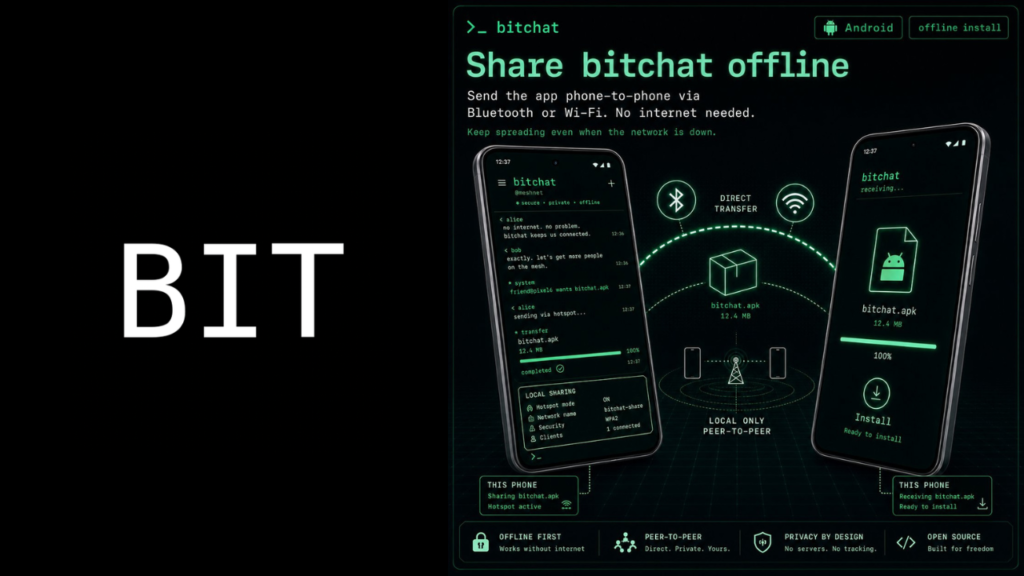
On July 28, 2026, Bitcoin developer Calle (@callebtc) posted a single line on X that lit up the Bitcoin world. “Bitchat can now send itself to another Android phone with no internet required.”
The post has already attracted over 400,000 views, 1,700 likes, and 403 reposts. Furthermore, the feature it describes is arguably the most significant upgrade bitchat has received since launch. Specifically, bitchat can now transfer its own installation file, the APK, directly from one Android phone to another over Bluetooth or Wi-Fi hotspot, with zero internet required at any step.
For Africa, where internet shutdowns, low connectivity, and infrastructure gaps define daily life for hundreds of millions of people, that capability is not a novelty. It is a lifeline.
What bitchat actually is
Bitchat is a decentralised, peer-to-peer messaging app launched by Jack Dorsey in July 2025. It operates over Bluetooth mesh networks. No internet is required, no servers, no phone numbers.
The mechanics are straightforward. Bitchat is built on Bluetooth Low Energy (BLE) mesh networks, using managed flooding and message hops to carry messages from device to device. Each node broadcasts encrypted message fragments to all nearby nodes. Those nodes relay the message further, reducing a time-to-live counter until it reaches its destination or expires. GitHub
In plain language: your phone becomes a node. Nearby phones relay your message further. The network forms itself from the people present, not from any server or tower. Direct Bluetooth reaches roughly 10 to 30 metres. However, a seven-hop maximum extends coverage across crowds, buildings, and entire neighbourhoods.
Bitchat combines Noise Protocol encryption for local mesh communication with optional Nostr relay integration for global reach when internet is available. Therefore, it works offline first and upgrades automatically when connectivity returns.
Furthermore, no registration is required. No phone numbers, no tracking, no ads. Just install and start chatting. The app generates on-device cryptographic keys automatically on first launch. APKPure
The new feature: spreading itself without the internet
The update Calle highlighted is specifically about offline installation sharing. Previously, getting bitchat onto a phone required downloading the APK from GitHub or the Google Play Store. Both routes need internet access.
Now, that requirement is gone. Specifically, one Android phone with bitchat installed can transfer the 12.4 MB APK directly to another Android phone via Bluetooth or a local Wi-Fi hotspot. The receiving phone can then install bitchat and join the mesh immediately. No internet. No data. No app store.
The feature is called Share bitchat offline, and the tagline on the official graphic says it directly: “Keep spreading even when the network is down.”
This matters because software distribution has always been the hidden weak point of offline communication tools. Specifically, you cannot use an offline app if you cannot get it onto your phone without being online first. Therefore, the offline APK sharing feature closes the last gap in bitchat’s censorship-resistance story. Now the app can propagate through a community entirely over Bluetooth, even if every internet connection in the country has been shut down.
Why this matters specifically in Africa
Africa has seen more government-imposed internet shutdowns than any other region in the world. The pattern is consistent. A contested election approaches. Protests begin. Authorities order ISPs to cut connectivity. Communication between citizens, organisers, and journalists stops.
In January 2026, Uganda’s government suspended internet access for 101 hours ahead of a contested election. Within days, bitchat had been downloaded 400,000 times and reached the top spot on both the Apple App Store and Google Play Store. Opposition leader Bobi Wine publicly recommended it to supporters who needed to stay in contact. Google Play
However, Uganda’s shutdown also exposed the distribution problem. Specifically, the people who most needed bitchat during the blackout were also the people who could not download it because the internet was already down. The new offline APK sharing feature directly solves that problem.
Now, a single person with bitchat already installed can walk into a crowd, open a local hotspot, and transfer the app to dozens of nearby phones in minutes. Those phones can then spread it further. As a result, bitchat can propagate through an entire community without a single byte of internet data.
Nepal saw downloads surge from roughly 3,300 to more than 48,000 within five days after the government blocked 26 social platforms in September 2025. Iran’s nationwide blackout produced 1.5 million aggregate installs. Those numbers will grow faster with offline sharing available.
The Bitcoin connection
Bitchat is not a Bitcoin wallet. However, it is a tool built by people deeply embedded in the Bitcoin ecosystem, with design principles that mirror Bitcoin’s core values.
Specifically, it is open-source, peer-to-peer, requires no central server, and is privacy-by-design. Traditional messaging apps depend on centralised infrastructure that can be monitored, censored, or disabled. Bitchat creates ad-hoc communication networks using only the devices present in physical proximity.
That is the same threat model Bitcoin was designed around. Money that no server can censor. Messages that no server can censor. Both start from the same premise: centralised infrastructure is a single point of failure and a target for control.
Furthermore, bitchat already supports Bitcoin payments over the mesh. Within an hour of bitchat’s launch in July 2025, users had started sending Bitcoin using the peer-to-peer encrypted mesh network. Therefore, in a country where both internet connectivity and financial access are cut simultaneously, bitchat offers both communication and Bitcoin transactions over the same offline network. GitHub
That combination has direct relevance to every activist, dissident, journalist, and ordinary citizen in Africa who has ever had their bank account frozen or their internet access cut during a moment of political tension.
The offline-first stack Africa actually needs
Africa’s Bitcoin community has spent years building tools for low-connectivity environments. Tando bridges Bitcoin Lightning payments to M-Pesa so users need no Bitcoin infrastructure on the merchant side. MoneyBadger settles in local currency so merchants bear no volatility risk. Africa Free Routing trains developers to build Lightning solutions for African networks specifically.
Bitchat’s offline APK sharing adds a new layer to that stack. Specifically, it solves the communication layer. Bitcoin can move value without the internet over Lightning’s mesh-adjacent protocols. Bitchat can move messages without the internet over Bluetooth mesh. Now bitchat can also move itself without the internet.
Therefore, for the first time, a community facing a complete internet shutdown has a credible answer to both “how do we talk?” and “how do we transact?” that requires nothing from any central server, any ISP, or any government.
Download and use bitchat
Bitchat is free, open-source, and available on Android 8.0 and above. Get it from the Google Play Store or download the APK directly from GitHub. Once installed, enable the local hotspot sharing mode from within the app to share the APK to nearby phones without internet.
The network is the people in the room. In Africa, rooms are rarely empty.
Sources
- Calle on X — https://x.com/callebtc/
- bitchat Android GitHub — https://github.com/permissionlesstech/bitchat-android
- bitchat on Google Play — https://play.google.com/store/apps/details?id=com.bitchat.droid
- Blockspot — What Is BitChat? Bluetooth Mesh Messaging Explained — https://blockspot.io/what-is-bitchat/
- CCN — What Is Bitchat? Jack Dorsey’s Offline Messaging App Explained — https://www.ccn.com/education/crypto/bitchat-offline-messaging-app-jack-dorsey/
- Mobile Hacker — Offline, Encrypted, and Private Messaging Using Bitchat — https://www.mobile-hacker.com/2025/07/10/offline-encrypted-and-private-messaging-using-new-bitchat-bluetooth-app/