
Ghana Has a Bitcoin Regulator. It Just Cannot License Anyone Yet.
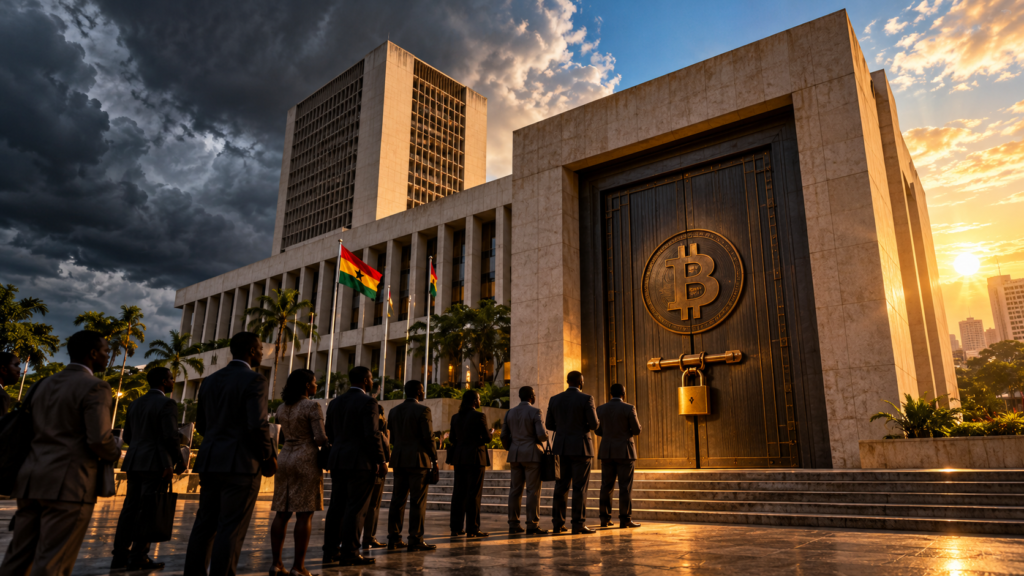
Ghana’s central bank has formally established a department to regulate Bitcoin and digital assets. However, the firms waiting to operate legally still cannot apply for a licence. Furthermore, the deadline for opening applications has already passed, quietly, with no new date announced.
The Bank of Ghana (BoG) listed its new Virtual Assets Department in its 2026 Right to Information Manual, approved by Governor Dr Johnson Pandit Asiama on September 23, 2026. The department sits in the Governor’s direct reporting line and is responsible for overseeing, supervising, and regulating Ghana’s virtual assets ecosystem under the Virtual Asset Service Providers Act, 2025 (Act 1154), in collaboration with the Securities and Exchange Commission (SEC).
On paper, that is a meaningful institutional step. In practice, it changes very little for the more than 100 firms that registered with the BoG in 2025 and have been waiting ever since.
The law exists. The licensing window does not.
Parliament passed the Virtual Asset Service Providers Bill on December 12, 2025. It received presidential assent on December 24, 2025. Under the law, providing a virtual asset service without registration, a licence, or other permission is unlawful.
The BoG’s virtual assets webpage told visitors throughout October 2 that details on applications and fees would be “available by the end of the third quarter of 2026.” The third quarter ended on September 30. The page still says the same thing. No new deadline has been published.
Officials have indicated privately that the Act will not be fully operationalised until 2027, as regulators complete guidelines and policy sandboxes. That means the gap between “the law exists” and “the law can be complied with” is stretching toward two years.
A timeline of missed targets
This is not the first time Ghana’s crypto regulation timetable has slipped. The pattern goes back several years.
Shortly after taking office, Governor Asiama said crypto regulations would be introduced by September 2025. The BoG subsequently required virtual asset service providers to register by August 15, 2025, while stressing that registration was not a licence to operate. It was simply an identification exercise.
More than 100 firms registered. In November 2025, the central bank published a policy paper announcing plans for a Virtual Assets Regulatory Office. In December 2025, Parliament passed the law. In January 2026, the SEC issued sandbox guidelines and admitted six firms to a one-year sandbox the following month.
Then, on February 20, 2026, a joint BoG-SEC directive gave virtual asset providers 48 hours to remove their advertising. Over 100 firms that had registered in good faith suddenly could not market themselves to users. Furthermore, they still cannot legally advertise today.
In July 2026, Tahiru Alhassan was identified as Head of the Virtual Assets Department. He described a dual regulatory model: the BoG responsible for payment systems and financial infrastructure, and the SEC overseeing investment-related activity. In August 2026, the BoG inaugurated the Virtual Assets Coordinating Committee required by Act 1154, bringing together the BoG, SEC, Ministry of Finance, Cyber Security Authority, and Financial Intelligence Centre.
The committee exists. The department exists. The law exists. The licences do not.
What this means for Bitcoin users and businesses in Ghana
Ghana is one of Africa’s most active Bitcoin markets. Specifically, an industry estimate valued Ghana’s digital asset transactions at approximately $3 billion in the year to June 2024. Furthermore, roughly 3 million Ghanaians, or about 17% of adults, use digital assets. That is a significant user base operating in a legal grey zone that the government created but has not yet resolved.
For Ghanaian Bitcoin users, the immediate impact is limited. Self-custody wallets, peer-to-peer transactions, and Lightning payments sit largely outside the licensing perimeter regardless of the VASP framework’s status. The law targets service providers, not individual users holding or transacting Bitcoin privately.
However, for the businesses serving those users, the situation is frustrating and increasingly expensive. Specifically, they cannot advertise. They operate under legal ambiguity about whether their existing registrations are sufficient. They also face the risk that when licensing finally opens, the requirements may disadvantage operators who built businesses during the regulatory vacuum.
Notably, Dr Seyram Pearl Kumah, the BoG’s then-Lead for Virtual Assets Regulation, warned soon after the law passed that the Act did not legalise crypto trading. That framing tells you something about how the regulator approaches this space. Caution is the default. Speed is not.
The broader African regulatory context
Ghana’s situation is not unique. Kenya’s VASP Act passed in late 2025 and is still working through implementation. Nigeria’s framework has been operational longer but created its own complications, including monthly transaction reporting requirements and a Securities classification that treats Bitcoin like a stock rather than a commodity.
South Africa remains the most advanced. The FSCA has issued hundreds of VASP licences, Absa just launched institutional Bitcoin custody, and FNB launched retail Bitcoin trading this week. The common thread across South Africa’s success is a regulator that moved from framework to licensing relatively quickly and clearly.
Ghana’s framework is structurally sound. The dual BoG-SEC model, the Coordinating Committee, and the sandbox approach all suggest a thoughtful design. However, thoughtful design without execution is just a plan. Over 100 firms registered in good faith more than a year ago. They are still waiting.
What to watch
The RTI Manual gives no indication of when licensing will open, how many firms could qualify, or what will happen to unapproved operators when the regime becomes fully effective. Therefore, the industry has no timeline to plan against.
The most important signal to watch is when the BoG’s virtual assets webpage changes from “available by end of Q3 2026” to something with an actual date. That update, whenever it comes, will be the real starting gun for Ghana’s Bitcoin regulation story.
Until then, the department exists, the law exists, and 100-plus firms wait.
Sources
- Ghana Guardian — Ghana crypto regulator established but licensing system still unavailable — https://ghanaguardian.com/ghana-crypto-regulator-established-but-licensing-system-still-unavailable