Women Are Building Bitcoin’s Future in Africa, And Btrust Is Funding Them

OPEN SOURCE DEVELOPMENT

Bitcoin promises open, neutral, and fair money for everyone. However, the people building that money have not always reflected that promise. Specifically, a 2019 Decrypt report found that fewer than 5% of open-source Bitcoin developers were women. That gap was never about ability. It was about access.

Btrust is working to close it. Furthermore, the results are showing. In the just-concluded Q1 2026 Mastering Bitcoin cohort, 34% of participants were women, one of the highest levels of female participation in any Btrust Builders cohort to date, and a striking contrast to the broader ecosystem.

In a recent post, Btrust spotlighted three African women whose work shows exactly what that future looks like.

Rita Anene — Building Lightning full-time

Rita spent over three years as a software developer before discovering Bitcoin’s development ecosystem in 2024. Specifically, she found people maintaining infrastructure, debating design choices, and building tools that support real-world use. That discovery changed everything.

She joined the BOSS program, run in partnership with Chaincode Labs, while still working full-time. She read Bitcoin chapters on her commute, studied on weekends, and coded late into the night. By Week 4, the Lightning Network had captured her completely.

Her first open-source contribution integrated Circuit Breaker into Warnet, a Bitcoin and Lightning network simulator. She still remembers her hands shaking when she forked the repository. But she opened the pull request, worked through multiple review rounds, and got it merged.

Today, Rita works on LDK Node full-time, funded by a Btrust Starter Grant received in Q3 2025. Her recent contributions include rebuilding payment store synchronization into an event-driven architecture and implementing fee-bumping for unconfirmed transactions. In short, she is doing careful, foundational work that shapes how Lightning nodes behave for the developers and applications that depend on them.
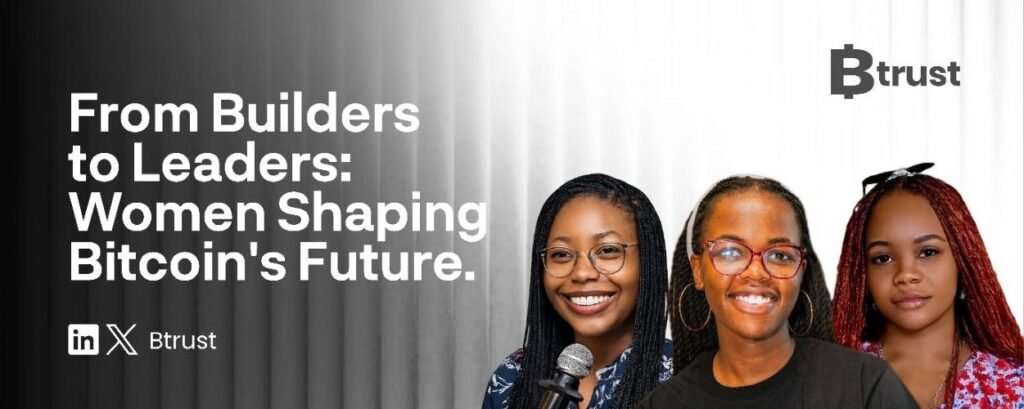

Jemimah Nagasha — From civil engineering to Bitcoin infrastructure

Jemimah was managing public infrastructure projects in Uganda when curiosity pulled her toward software. Then, at the first BitDevs Kampala event, Bitcoin clicked. It was no longer something she had heard about. Instead, it became a serious technical system she needed to understand.

She applied to the Btrust Builders Program and began decoding transactions, creating Lightning channels, and contributing to Polar, a tool that helps developers run Bitcoin and Lightning nodes locally. She did all of this while working full-time as a civil engineer.

What started with attending BitDevs Kampala quickly became organising it. By 2025, Jemimah was leading the community. She also joined the Btrust Builders Faculty, mentoring the next cohort of developers. In April 2026, she received the Btrust Starter Grant and made the full transition into Bitcoin open-source development.

“This journey has given me more than technical skills,” she wrote. “It has given me a community, a sense of purpose, and the chance to build tools that make Bitcoin more accessible.”

Enigbe Ochekliye — Where engineering meets Lightning research

Enigbe is a Lightning developer based in Nigeria. Her background is unusual and powerful. Specifically, she holds a Master’s in Energy from the University of Auckland and a Bachelor’s in Mechanical Engineering from Ahmadu Bello University. That engineering lens gives her a unique way of thinking about Lightning — not just as software, but as a live system with many moving parts.

Her contributions to the LDK ecosystem include improvements to logging infrastructure, chain synchronization features, and infrastructure reliability. Furthermore, she is currently pursuing research into distributed control systems for Lightning Network liquidity management, modelling Lightning as a multi-agent dynamical system and exploring how decentralised controllers can coordinate liquidity across the network.

Notably, Enigbe is the first member of the Btrust Open Source Cohort to focus on research. Therefore, her work expands what contribution looks like. Open-source work is not only about writing code. It is also about asking hard questions and turning research into tools the ecosystem can build on.

The bigger picture

Rita, Jemimah, and Enigbe are not isolated stories. Instead, they are part of a growing pipeline. Btrust supports over 13 BitDevs chapters across Africa, several led by women. Furthermore, organisations like Africa Free Routing, Dada Devs, and Hack4Freedom are building parallel pathways, training developers, building communities, and expanding who gets to take part in Bitcoin’s open-source work.

The lesson is straightforward. When access is made intentional, who builds Bitcoin changes. And when who builds Bitcoin changes, what Bitcoin can do for the world changes too.

As Btrust puts it, curiosity is enough for the first step. Consistency carries you further.

Sources

ENJOYED THIS ARTICLE?Support the authorSend a zap over Lightning or on-chain