Blink Wallet Launches Non-Custodial Accounts: Empowering Self-Custody Bitcoin Users Across Africa and the World

LIGHTNING NETWORK ADOPTION DEVELOPMENT

In a major milestone for everyday Bitcoin adoption, Blink Wallet has rolled out non-custodial accounts on both iOS and Android. Users now hold their own keys with the same simple, fast Lightning experience they’ve come to love.

The announcement, shared directly by the Blink team on X, marks the end of six years of development. It shifts the popular wallet from custodial to self-custody while preserving everything users rely on for daily transactions.

What Changed and What Stayed the Same?

Blink Wallet’s core mission has always been making Bitcoin usable as everyday money, especially for merchants, vendors, and communities with limited access to traditional banking.

What’s new:

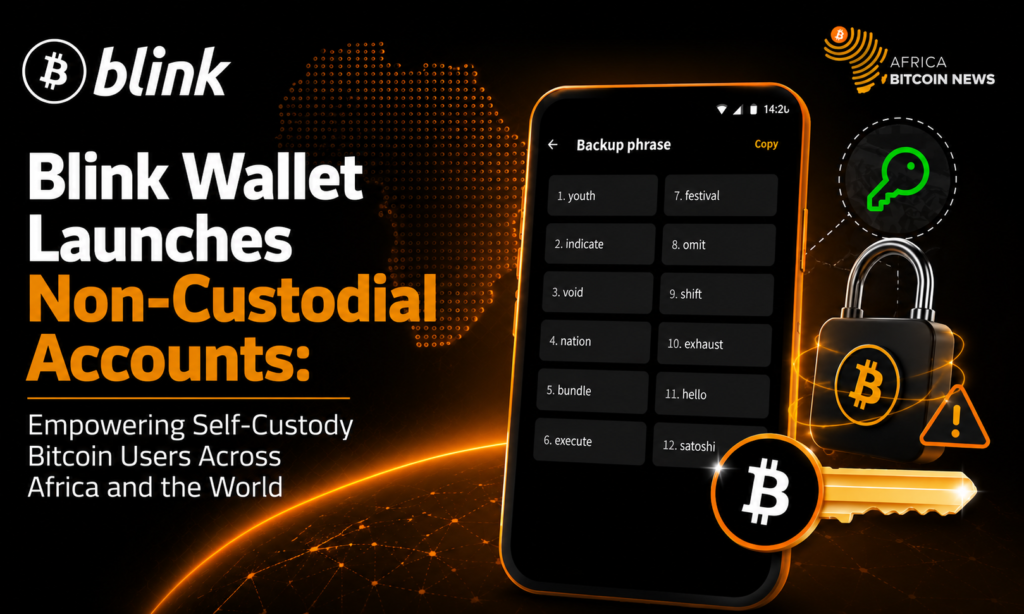
  • Users receive a 12-word recovery phrase (BIP39 standard).
  • Full self-custody: You control your private keys. Blink cannot access or freeze your funds.
  • Funds live on the Spark protocol (by Lightspark), a trust-minimized federated state chain that supports Lightning payments, offline receiving, single-satoshi transactions, and no fund expiry.

What remains exactly the same:

  • Your existing Lightning address (username@blink.sv).
  • Instant Lightning payments and QR code scanning.
  • Low (or zero) fees for Blink-to-Blink transfers.
  • Dollar Balance feature (now powered by USDB stablecoin on Spark).
  • Overall app interface and user experience.

Existing custodial accounts continue to work. A guided migration path for moving funds to non-custodial accounts will roll out soon (and may become mandatory in certain regulated jurisdictions).


Why Non-Custodial Matters Now?

Blink originally launched as a custodial Lightning wallet in El Salvador’s Bitcoin Beach project to deliver the best possible user experience for real-world adoption.

New layer-2 technology (Spark) finally allowed self-custody without sacrificing speed, simplicity, or reliability.

The move also helps the wallet navigate tightening global regulations around custody services, including rules in South Africa and Kenya. By going non-custodial, Blink reduces its own compliance burden while keeping the tool available worldwide.

What This Means for Africa?

Africa stands to gain significantly from this development. The continent already leads in mobile money adoption (think M-Pesa in Kenya) and has some of the world’s fastest-growing Bitcoin communities.

Blink has long supported grassroots projects across the continent:

These projects focus on circular Bitcoin economies, using sats for daily purchases, small business payments, and remittances.

Key benefits for African users:

  • Financial sovereignty — In countries with currency volatility, capital controls, or banking instability, holding your own keys means no third party can restrict access to your money.
  • Remittances made easier — Africa receives over $100 billion in remittances annually. Lightning enables near-instant, low-cost transfers that integrate with mobile money ecosystems.
  • Micro-payments & daily use — Single-satoshi support and offline receiving work perfectly for unreliable internet or small daily transactions common in many African markets.
  • Volatility protection — The Dollar Balance feature (USDB on Spark) lets users hold stable value alongside Bitcoin, helping merchants and families manage price swings.
  • Regulatory resilience — Non-custodial design helps keep the app accessible even as rules evolve in South Africa, Kenya, and other markets.
For millions of unbanked or underbanked Africans, a simple, self-custodial Lightning wallet like Blink represents a powerful step toward greater financial independence, without needing to sacrifice usability.
Important User Responsibilities

With great power comes great responsibility. Because Blink no longer controls the funds:

  • Secure your 12-word recovery phrase immediately. Write it down, store it offline (best option), and consider encrypted cloud backups (Google Drive/iCloud) or a password manager.
  • If you lose the phrase, no one can recover your funds — not even Blink support.
  • Start small if you’re new to self-custody. Test with a small amount first.

The app includes practical backup guidance to make this easier than traditional “steel plate” methods.

How to Get Started?

  1. Update or download Blink Wallet from the App Store or Google Play.
  2. Choose to create a non-custodial account (or keep using your existing custodial one).
  3. Back up your 12-word recovery phrase securely.
  4. Start sending and receiving via Lightning instantly.

The app remains free, open-source at its core, and available in 20+ languages.

The Bottom Line

Blink Wallet’s non-custodial launch delivers true ownership without compromising convenience — a critical combination for bringing Bitcoin to everyday users worldwide, especially across Africa.
 
As one of the most user-friendly Lightning wallets available, this update strengthens Bitcoin’s position as a practical tool for financial inclusion, remittances, and economic resilience on the continent.
 
Ready to take control of your Bitcoin?
Download Blink Wallet today and experience self-custody the simple way.
ENJOYED THIS ARTICLE?Support the authorSend a zap over Lightning or on-chain