Why Sub-Saharan Africa Is Quietly Building the Most Practical Bitcoin Economy on Earth in 2026
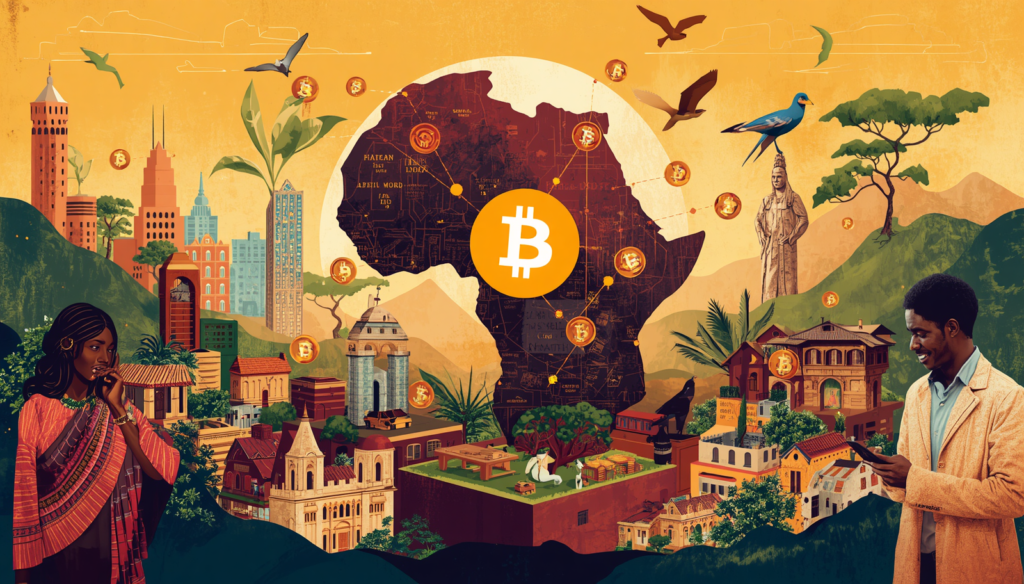
In Sub-Saharan Africa, Bitcoin is not a meme stock. It is rent money, school fees, remittances, and weekly groceries. Therefore, while much of the Western world still argues over whether Bitcoin is a hedge, an ETF play, or a casino chip, Africa is quietly answering a simpler question. Can sound, open, peer-to-peer digital money actually work for people who have been failed by the existing financial system?
The data from 2025 and early 2026 is now in. Furthermore, the answer is increasingly clear: yes — and at scale.
The headline numbers: $205 billion and counting
According to the Chainalysis 2025 Geography of Cryptocurrency Report, Sub-Saharan Africa received over $205 billion in on-chain value between July 2024 and June 2025. Moreover, that figure represents a 52% year-over-year increase, making it the third-fastest-growing region for digital asset activity in the world — behind only Asia-Pacific (69%) and Latin America (63%). TechAfrica NewsTechAfrica News
The region is still small in absolute terms. Specifically, it accounts for roughly 2% of global on-chain volume. However, the texture of African adoption is what makes it remarkable. In short, this is not whales moving billions. It is millions of small, real-life transactions.
Chainalysis found that over 8% of all value transferred in Sub-Saharan Africa was in transactions under $10,000, versus 6% for the rest of the world. In other words, Africa is the most retail-driven, grassroots Bitcoin economy on the planet. TechAfrica News
The country leaderboard
Here is how the top markets stack up in the most recent Chainalysis data:
- Nigeria — $92.1 billion in on-chain value received, ranking 6th globally on the Chainalysis adoption index and 2nd in the world for grassroots adoption. IT News Africa
- South Africa — second in the region, but still nearly three times smaller than Nigeria. Notably, South Africa now hosts one of the world’s most active Bitcoin merchant payment ecosystems through MoneyBadger.
- Ethiopia — the surprise mover, now the 8th largest Bitcoin mining country in the world, accounting for ~2.7% of the global Bitcoin network hashrate.
- Kenya — home to the most-watched Bitcoin circular economy on the continent, in Kibera.
- Ghana rounds out the top five.
Across the continent, the picture is consistent. Adoption is rising fastest where economic pressure is greatest.
Why necessity beats hype in Africa
To understand the African Bitcoin economy, you have to look at what Bitcoin is replacing, not what it is competing with. Generally, that comes down to four real-world problems.
1. Remittances are still painfully expensive
Sending money home to Africa remains one of the most expensive financial activities in the world. Specifically, traditional remittance corridors into Sub-Saharan Africa average 7–8% in fees, well above the UN’s Sustainable Development Goal target of 3%.
Bitcoin transfers — and especially Lightning Network payments — can settle in seconds for fractions of a cent. For millions of African families, that delta is not theoretical. It is groceries. Furthermore, Bitcoin requires no permission, no bank account, and no correspondent intermediary. As a result, a Bitcoin remittance from London to Lagos clears faster than a domestic bank transfer inside Nigeria.
2. Inflation and currency collapse
This is the loudest signal in the entire Chainalysis dataset. In March 2025, Sub-Saharan Africa saw monthly on-chain volume hit nearly $25 billion. According to Chainalysis, the surge was driven largely by centralized exchange activity in Nigeria, where a sudden currency devaluation prompted increased crypto adoption. TechAfrica News
The same pattern played out in Ethiopia. After the government liberalized the birr in July 2024 as part of an IMF deal, the birr promptly lost approximately 30% of its value. Consequently, Ethiopians moved to harder forms of money at scale. Peach Payments
In other words, every time a Sub-Saharan African currency falls, Bitcoin adoption rises. Therefore, this is not speculation. This is survival. And it is exactly the use case Satoshi described in the Bitcoin whitepaper.
3. Dollar shortages and the IOU problem
There is an honest conversation that Bitcoin-only media has to have here. Specifically, in the short term, many Africans facing currency collapse have reached not for Bitcoin but for dollar-pegged tokens like USDT. Chainalysis data shows these tokens now make up a sizeable share of African on-chain activity.
However, this is not a competing success story — it is a symptom. Notably, when capital controls prevent citizens from holding US dollars in their local banks, USDT becomes a synthetic workaround. It is an IOU issued by a private company, backed by reserves the holder cannot directly audit, and freezable at the issuer’s discretion. Therefore, it solves the FX problem at the cost of trust assumptions Bitcoin was designed to eliminate.
The longer-term play is clear. As Bitcoin volatility normalizes and Lightning adoption deepens, more African users will move from “I need a digital dollar to escape the naira” to “I need sound money I actually own.” Already, the rise of Bitcoin-native circular economies — where prices are quoted in sats and never touch fiat — suggests where this is going.
4. Mobile-first, bank-light economies
Africa already leads the world in mobile money. M-Pesa in Kenya is the global case study. Furthermore, that infrastructure makes Bitcoin integration much easier than in markets where banks dominate. Developers like Tando in Kenya are now , so that a user paying in sats can settle a merchant in shillings instantly — or keep the value in Bitcoin if they choose.
The circular economies: proof of spend, not just proof of stake
The most underreported story in African Bitcoin is the rise of circular economies — local ecosystems where merchants and customers transact in Bitcoin without converting to fiat at all.
In Kibera, Nairobi, the Afribit Kibera project has been running a working Bitcoin economy since 2022. According to , residents pay for everyday goods — including water from jerrycans — using Lightning QR codes that settle instantly and for free. Likewise, similar grassroots Bitcoin projects have emerged in townships in South Africa, fishing communities in Ghana, and student hubs in Nigeria.
Meanwhile, on the merchant infrastructure side, South African Bitcoin payments company MoneyBadger now enables Bitcoin acceptance across more than 650,000 merchant locations through partnerships with Pick n Pay, Peach Payments, Ozow, Scan to Pay, and Zapper. Recently, the company processed R7.77 million across 19,536 transactions in the first half of 2025 alone, with Bitcoin making up 73% of all payments processed. Bitcoinke
This is what Bitcoiners call “proof of spend” — actual usage as money, not just storage as an asset.
Ethiopia: where Bitcoin meets African energy sovereignty
Ethiopia deserves a separate mention. The country is no longer just an adoption story. Notably, it has become the 8th largest Bitcoin mining country in the world, accounting for ~2.7% of the global Bitcoin network hashrate.
This matters for a Bitcoin-only reason. Specifically, Ethiopia’s miners run almost entirely on hydroelectric power from the Grand Ethiopian Renaissance Dam (GERD). Therefore, the country is monetizing stranded renewable energy — power that would otherwise dissipate — and converting it directly into the hardest money ever created. In short, Bitcoin mining is acting as the buyer of last resort for African renewable energy infrastructure.
That model is now being studied across the continent, with similar early-stage operations exploring deployments in the DRC, Malawi, Kenya, and Zambia.
Regulation is finally catching up
For years, regulatory ambiguity slowed institutional involvement in African Bitcoin markets. However, that is shifting fast. Notably, recent regulatory developments include:
- Nigeria has rolled out an SEC sandbox program for digital asset service providers.
- Kenya passed its Virtual Asset Service Providers Act, with public comment closing on April 10, 2026. According to legal firm Bowmans, .
- South Africa has begun issuing VASP licenses under the Financial Sector Conduct Authority (FSCA).
- Ghana, Mauritius, and Rwanda are advancing their own frameworks.
- Multiple African countries — including Nigeria and South Africa — have exited the FATF grey list in 2025, partly due to improved oversight of digital asset sectors.
Of course, challenges remain. For instance, occasional restrictions, capital controls, and uneven tax treatment still create friction. Still, the overall trajectory points toward clearer rules and rising institutional confidence — particularly for Bitcoin, which most regulators treat as a distinct, commodity-like asset.
Why this matters beyond Africa
Sub-Saharan Africa’s story matters for three reasons that extend far beyond the continent.
First, it is a real-world stress test for Bitcoin as money. In markets with hyperinflation, currency controls, and unreliable banking, Bitcoin is doing what it was designed to do — give individuals a way to hold and move value without permission.
Second, it is a template for the Global South. Latin America, parts of Southeast Asia, and the Middle East face similar pressures. Therefore, the Bitcoin playbooks emerging in Lagos, Nairobi, Cape Town, and Addis Ababa are exportable.
Third, it is a counterweight to the Western narrative. In Wall Street’s framing, Bitcoin is a portfolio allocation. In Africa’s framing, Bitcoin is plumbing. Ultimately, both can be true — but the second is far more transformative.
The takeaway
Africa is not chasing the next bull run. Instead, the region is solving for expensive remittances, unreliable currencies, financial exclusion, and broken banking rails. As a result, Bitcoin is filling those gaps faster than any other monetary technology in the past decade.
The numbers — $205 billion in on-chain value, 52% growth, Nigeria 6th globally, Ethiopia 8th in mining, 8% of transfers under $10,000 — tell a clear story. Specifically, this is grassroots, necessity-driven Bitcoin adoption, not hype.
In a world chasing trends, Africa is quietly building the future of money. One Lightning payment, one mining facility, one circular economy at a time. One sat at a time.
Sources
- Chainalysis — Sub-Saharan Africa Shows Strong Crypto Retail Activity (2025 Geography of Crypto Report) — https://www.chainalysis.com/blog/subsaharan-africa-crypto-adoption-2025/
- Chainalysis — The 2025 Global Crypto Adoption Index — https://www.chainalysis.com/blog/2025-global-crypto-adoption-index/
- Crypto.news — Africa’s crypto economy balloons 52% as Chainalysis tracks $205b flows — https://crypto.news/africas-crypto-economy-balloons-52-as-chainalysis-tracks-205b-flows/
- Mariblock — Sub-Saharan Africa now the third-fastest-growing crypto region — https://www.mariblock.com/sub-saharan-africa-now-the-third-fastest-growing-crypto-region-chainalysis/
- All Business Africa — Crypto and Stablecoins in Africa: Why Nigeria Leads the World in Grassroots Adoption — https://allbusiness.africa/insights/africa-crypto-stablecoins-2026
- Techish Kenya — Bitcoin Is Already Running in Kibera —
- TechTrends Kenya — Nairobi Hosts Adopting Bitcoin Conference 2026 — https://techtrendske.co.ke/2026/04/13/nairobi-bitcoin-conference-2026-policy/
- BitcoinKE — Ethiopia is Now the 8th Largest Bitcoin Miner in the World — https://bitcoinke.io/2026/02/ethiopia-among-largest-bitcoin-miners-globally/
- Peach Payments — Peach Payments x MoneyBadger partnership goes live — https://www.peachpayments.com/scale/peach-payments-moneybadger-partnership-goes-live/
- MoneyBadger — https://www.moneybadger.co.za/