Your First Merged PR Is Not the Finish Line. Btrust’s Engineers Explain What Comes Next.

DEVELOPMENT OPEN SOURCE

Getting your first pull request merged into a Bitcoin open-source project is a moment most contributors never forget. However, according to engineers at Btrust, it is also one of the most misunderstood moments in a developer’s journey.

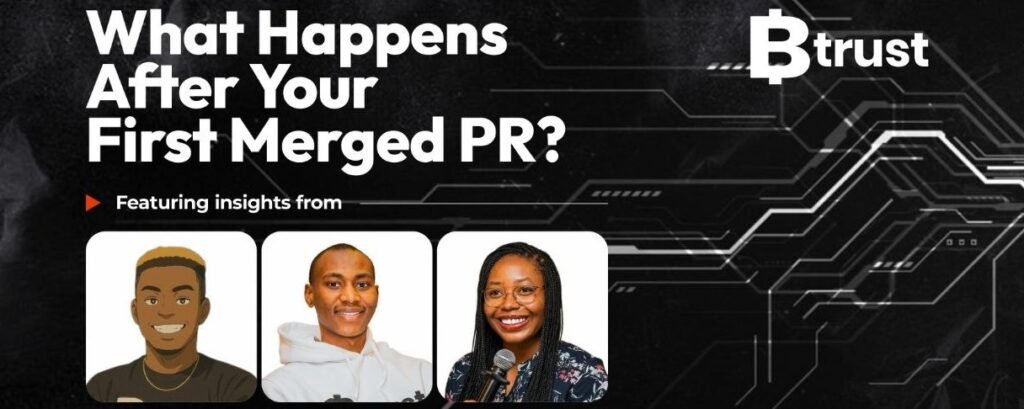
In a new piece published by Btrust, Kelvin Isievwore (Head of Engineering at Btrust), Abubakar Sadiq, and Enigbe Ochekliye share what actually happens after that first merge. Their answer is consistent and clear. The real work begins after the notification arrives.

"The real work begins after that first merge"

Kelvin Isievwore has reviewed dozens of contributions and mentored developers across the Bitcoin ecosystem. He has noticed a pattern among new contributors. Specifically, many assume the work gets easier once the first PR lands.

His experience says the opposite is true.

“Many people think it gets easier after the first merged PR, but it’s actually the opposite,” he said. “Now you’re expected to keep learning, improve your technical skills, communicate more effectively, help other contributors, and become better at receiving and acting on feedback.”

For Kelvin, the turning point came in 2023. He found a bug that had been unresolved for more than a year. It had gradually become a bottleneck for new contributors. Before writing a single line of code, he spoke with the project maintainer to understand what others had already tried.

Those conversations shaped nearly two months of investigation. Furthermore, the experience changed how he thought about open-source work entirely.

“That was the moment I realised this would become my routine, solving hard problems. It was also the moment I knew I wasn’t going to stop contributing anytime soon.”

One PR leads to the next

Abubakar Sadiq learned this lesson almost immediately after his first contribution. His initial PR improved a functional test he found while reading through a project’s codebase. Once it was merged, reviewers suggested a follow-up fix that would apply the same improvement elsewhere.

In other words, the merge did not close the task. It opened the door to the next one.

The review process itself also surprised him. Specifically, the level of scrutiny felt intense even for a test PR.

“I was surprised by how thorough and lengthy the review process was, even for a test PR,” he said.

His advice to new contributors is straightforward. “If there are suggested follow-up review comments, see them through by opening a new PR that addresses them.”

That mindset reflects a broader truth about Bitcoin open-source work. Progress is rarely about one contribution. Instead, it is about returning, improving, and building on what you already learned.

Curiosity over completion

Enigbe Ochekliye, a Lightning developer and Btrust grantee based in Nigeria, took a different lesson from her first merged PR. Notably, her contribution involved Rust, a language she already felt comfortable using. The challenge came afterwards, when the full build refused to compile because of gaps in her understanding of the Foreign Function Interface (FFI).

The experience was frustrating. However, it became one of the most valuable lessons of her early open-source journey.

“It was a deeply humbling experience. It showed me the importance of understanding the broader system rather than focusing only on the part you’re directly modifying.”

That lesson still shapes how she approaches Bitcoin development today. Furthermore, it pushed her beyond writing code alone. Wanting to better understand Bitcoin and distributed systems, Enigbe started a small book club with fellow Bitcoin developers to study Bitcoin and computer science fundamentals together.

Her core observation from the experience is sharp. “Every contribution answered one question, uncovering several more, and that curiosity has kept me engaged.”

What separates contributors who stay

After years of mentoring, Kelvin has noticed that a first merged PR is not a reliable predictor of who becomes a long-term contributor. The difference, he says, is rarely about technical skill alone.

“Consistency, the ability to learn quickly from mistakes, and persistence make all the difference.”

He has watched contributors whose PRs were closed because the project changed direction. Others waited weeks for a review or had to rethink their approach entirely after detailed feedback. The ones who kept going, he says, learned to ask better questions and focused their energy on what the project actually needed.

Beyond writing code, Kelvin encourages new contributors to become active in the communities around their projects. Specifically, he points to joining Slack and Discord channels, attending project meetings, reading open pull requests, and engaging with maintainers as small actions that build trust over time.

Enigbe adds that reviewing other people’s pull requests is one of the most underrated growth tools available to new contributors. Code review lets developers explore unfamiliar parts of a codebase, see different engineering decisions, and offer feedback that moves the project forward. In short, meaningful contribution is not only about the PRs you merge yourself.

Why this matters for African Bitcoin developers

Africa’s Bitcoin developer pipeline is growing fast. Btrust’s Q1 2026 cohorts graduated 37 developers across 24 countries. Africa Free Routing has now run 14 Lightning developer bootcamps across the continent. BitDevs chapters operate in more than 13 African cities.

However, graduating from a bootcamp or merging a first PR is only the beginning. The gap between “first contribution” and “sustained open-source contributor” is where most developers quietly stop showing up. Therefore, the lessons from Kelvin, Abubakar, and Enigbe are directly relevant to every African developer currently working toward that first merge.

As Kelvin put it in the piece’s closing line: “Congratulations! Your Bitcoin open-source journey officially begins.”

Read the full Btrust piece here: What Happens After Your First Merged PR

Sources

ENJOYED THIS ARTICLE?Support the authorSend a zap over Lightning or on-chain