
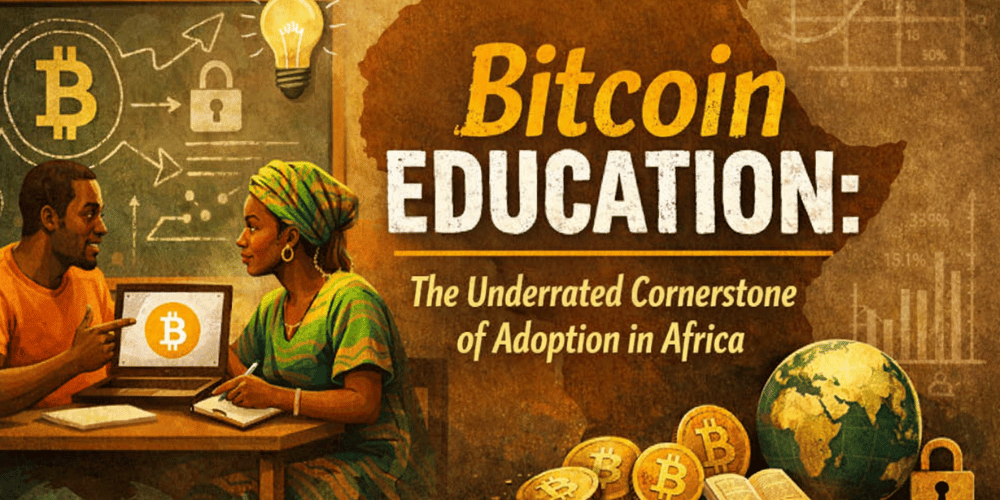
Bitcoin Education: The Underrated Cornerstone of Bitcoin Adoption in Africa
When people talk about Bitcoin in Africa, the focus is usually loud and immediate: infrastructure, Lightning nodes, exchanges, wallets, on-ramps, off-ramps. These things matter, but they are not where adoption truly begins.
Everything starts with knowledge.
Bitcoin education is the most underrated yet most critical pillar of Bitcoin adoption in Africa. Without it, infrastructure fails, users get burned, trust is lost, and Bitcoin is dismissed as a scam rather than understood as a tool.
Infrastructure Without Education Is Fragile
Africa has seen this pattern before. New financial tools arrive without proper understanding, and the result is predictable:
People confuse Bitcoin with scams and Ponzi schemes
Users leave funds on custodial platforms they don’t understand
Private keys are lost, phishing succeeds, and blame shifts to Bitcoin itself
Governments point to user losses as justification for crackdowns
None of these are Bitcoin failures. They are education failures.
You can deploy the best infrastructure in the world, but if users don’t understand self-custody, transaction fees, backups, or basic security, that infrastructure becomes dangerous instead of empowering.
Why Education Matters More in Africa
Education is not optional in Africa, it is essential.
Many Africans are:
First-time users of any form of digital finance
Operating in low-trust financial environments
Navigating volatile currencies and unstable regulations
Using shared devices, low bandwidth, or intermittent power
In this context, education is not about whitepapers or price charts. It is about practical survival knowledge:
What is Bitcoin, and what is it not?
Why self-custody matters
How to avoid scams and impersonators
How Lightning works and why fees matter
How to safely receive, store, and spend sats
Without this foundation, Bitcoin adoption becomes shallow and reversible.
Education Protects People First
Bitcoin is powerful, and power without understanding causes harm.
In Africa, bad experiences spread fast. One person losing funds can discourage an entire community. Education acts as a shield:
It reduces scam success rates
It builds realistic expectations
It teaches responsibility alongside freedom
It creates informed users, not dependent ones
This is why education must come before scale.
Builders Are Born From Education
Every African Bitcoin developer, Lightning operator, educator, or ecosystem builder started the same way: by learning.
Education doesn’t just onboard users — it creates contributors. It transforms people from passive participants into:
Open-source developers
Node operators
Educators and translators
Entrepreneurs building local solutions
Infrastructure does not build itself. People do. And people are built through education.
The Quiet Work That Sustains Bitcoin
Education is not flashy. It doesn’t pump numbers overnight. It doesn’t trend easily on social media.
But it does something far more important:
It creates long-term conviction
It builds resilient communities
It anchors Bitcoin adoption in understanding, not hype
In Africa, where trust has been broken repeatedly by financial systems, education is how Bitcoin earns legitimacy.
Start With Knowledge, Everything Else Follows
If Africa’s Bitcoin future is to be sustainable, it must be education-first.
Infrastructure will come. Tools will improve. Systems will evolve.
But without education, adoption will remain fragile and reversible.
Bitcoin education is not a side activity.
It is not a “nice to have.”
It is the cornerstone.
And the Africans doing this work quietly, consistently, and often without recognition, are laying the strongest foundations Bitcoin has on the continent.