
African Bitcoin Day 2026: One Day of Education Beats a Decade of Regulation
Across Africa, regulators continue drafting frameworks for digital assets, tightening reporting requirements, and debating how Bitcoin should fit into existing financial systems.
At the same time, something very different is happening on the ground.
Ordinary Africans are learning how Bitcoin works, setting up wallets, accepting Lightning payments, and joining local technical communities, often in a single afternoon.
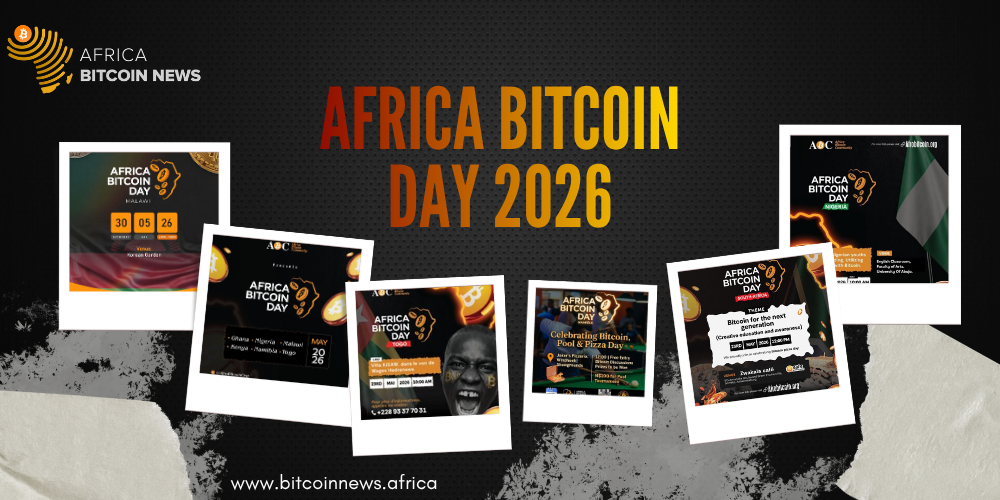
Africa Bitcoin Day 2026, a coordinated multi-city initiative running through late May, highlighted this growing contrast. While policy discussions continue at institutional levels, local communities across the continent are already experimenting with practical Bitcoin usage in real time.
On-the-Ground Action: The Decentralized Constellation
Across the African continent, localized educational initiatives are proving that peer-to-peer open-source tech is actively pacing ahead of top-down legacy policy. From township markets to university lecture halls, here is how independent regional hubs executed their strategy during Africa Bitcoin Day:
Kibera, Kenya
In the Soweto West neighborhood of Kibera, Afribit Kibera transformed the day into a powerful demonstration of Bitcoin’s real-world economic utility. Residents gathered for hands-on workshops exploring how Bitcoin can function as a practical parallel financial system in communities often underserved by traditional banking infrastructure.
What an incredible day at @AfribitKibera during the African Bitcoin Day celebration!
Special appreciation to @AfroBitcoinOrg, @Farida_N, and @IamMissNabs for making this memorable event possible.
To our fellow Bitcoiners and partners, your support, dedication, time, and presence… pic.twitter.com/jpWbm0W5Fh— AFRIBIT KIBERA (@AfribitKibera) May 26, 2026
Blantyre, Malawi
In Blantyre, BitcoinBoma partnered with Unipod Malawi to host an intensive educational hub at the Malawi University of Business and Applied Sciences (MUBAS). Lecture halls filled with students, developers, and curious newcomers as facilitators broke down Bitcoin fundamentals, Lightning infrastructure, wallet security, and multi-signature custody in a highly practical format.
Happy Tuesday everyone! This Tuesday, we chose Bitcoin over and over again and so should you. ⚡🟠
— ₿itcoin ₿oma (@BitcoinBoma) May 26, 2026
On Saturday, we had an incredible time celebrating African Bitcoin Day at MUBAS @UnipodMalawi in Blantyre! The energy, curiosity, and engagement in the room showed just how eager… pic.twitter.com/Bt4FpS4FP6
Lomé, Togo
In Lomé, the local Bitcoin community organized by Togo Bitcoin hosted a full-scale Bitcoin Festival that blended education, commerce, and culture into a live demonstration of circular Bitcoin economies in action.
🎥⚡ La vidéo officielle de l’Africa Bitcoin Day est disponible !
— Togo Bitcoin Community Officiel (@Togo_Bitcoin) May 26, 2026
Après les photos , revivez maintenant l’ambiance, les échanges, les activités et les meilleurs moments du Bitcoin Festival
Merci à toute la communauté, aux participants, partenaires et bénévoles qui ont rendu… pic.twitter.com/FyQC5poku4
Windhoek, Namibia
In Windhoek, Bitcoin Namibia alongside local builders transformed Joker’s Pizzeria at the Showgrounds into a vibrant Bitcoin playground centered around real-world usage and FreedomTech.
A massive thank you to @AfroBitcoinOrg for sponsoring this amazing event which will now be done multiple times a year as we had the Man who started the Namibian Pool Federation in attendance as well.
— EasySats | Namibia | Bitcoin (@EasySats_) May 26, 2026
He loved the Bitcoin Q&A section & is already looking forward to the next one🥳 pic.twitter.com/EH6ZWfbFcc
Accra & Dodowa, Ghana
In Ghana, local financial educators hosted student-focused financial literacy programs across Accra and Dodowa. Executive Director Finally, Gidkom led sessions exploring how Bitcoin can create economic opportunities within African communities, particularly for young people navigating unstable financial systems and limited access to global markets.
Africa Bitcoin Day was a huge success.
— Africa ₿itcoin Conference (@AfroBitcoinOrg) May 22, 2026
Thank you to everyone that participated. #ABC2026 #Bitcoin #Africa pic.twitter.com/ZcxSPQN2Zx
Nigeria
Across Nigeria, local Bitcoin communities organized grassroots celebrations, blending education, social gatherings, and Bitcoin Pizza Day culture into highly localized community events.
Don’t miss Africa Bitcoin Day in Nigeria.
— Africa ₿itcoin Conference (@AfroBitcoinOrg) May 14, 2026
Join innovators, builders, and young leaders for meaningful conversations on *“The Role of Nigerian Youth in Understanding, Utilizing and Building with Bitcoin.”*
Be part of the conversation shaping the future of Bitcoin adoption and… pic.twitter.com/zgkAqbYyu8
Soweto, South Africa
In Soweto, SowetoBTC, Exonumia together with local township merchants hosted a vibrant Africa Bitcoin Day celebration that merged Bitcoin Pizza Day culture with an unmistakably local South African identity.
Happy #africabitcoinday, celebrating the day with a twist of Soweto flavor. Big ups to @ExonumiaAfrica & @AfroBitcoinOrg for making the day worthwhile. pic.twitter.com/lJsxeUwSLn
— SowetoBTC ® 🇿🇦 (@SowetoBTC) May 23, 2026
The Macro Picture: "Policy Theater" vs. Sovereign Code
These grassroots developments are unfolding alongside increasing regulatory activity across the continent.
In South Africa, the National Treasury’s publication of the Draft Capital Flow Management Regulations 2026 has formally extended exchange control oversight to digital assets. The framework introduces mandatory written declarations within 30 days for foreign digital assets and strict compliance tracking for cross-border transactions.
Similarly, Nigeria’s enforcement of the Investments and Securities Act (ISA) 2025 has firmly brought virtual assets under the regulatory purview of the SEC as securities, introducing mandatory licensing and extensive Anti-Money Laundering (AML) reporting metrics for all active Virtual Asset Service Providers (VASPs).
Other African jurisdictions are exploring similar guardrails. For instance, Kenya’s National Treasury recently concluded public consultations on its comprehensive Draft Virtual Asset Service Providers (VASP) Regulations 2026, establishing strict reserve backing rules for stablecoins and clear oversight mechanisms divided between the Central Bank of Kenya and the Capital Markets Authority.
Supporters of these policies argue they are necessary for consumer protection, financial stability, and market transparency. At the same time, critics worry that excessive compliance burdens could slow innovation and create barriers for smaller grassroots initiatives.
Why Education Is Creating Faster Results
One of the clearest takeaways from Africa Bitcoin Day is that education produces immediate participation.
A workshop can result in:
- a first Lightning transaction,
- a merchant accepting Bitcoin,
- or a developer joining the ecosystem.
These outcomes happen quickly and often require little infrastructure beyond smartphones, internet access, and local coordination.
By contrast, regulatory processes typically move at institutional speed, involving consultation periods, legal reviews, implementation phases, and enforcement structures that can take years to mature.
That does not mean regulation is irrelevant. Sustainable growth will likely require both education and sensible legal clarity. However, Africa Bitcoin Day demonstrated that adoption itself is increasingly being driven from the bottom up.
A Growing Parallel Ecosystem
Perhaps the most important lesson from Africa Bitcoin Day 2026 is that Bitcoin adoption in Africa is no longer theoretical.
Communities are actively building educational hubs, onboarding developers, training merchants, and experimenting with peer-to-peer economies long before comprehensive regulatory frameworks are finalized.
The rise of community initiatives, technical bootcamps, local merchant networks, and resources like the Live Bitcoin Directory suggests that a decentralized ecosystem is already forming across the continent.
While regulators continue shaping policy, local builders are shaping usage.
And in many parts of Africa, adoption appears to be moving faster than legislation.