Opinion: South Africa’s New Crypto Rules Are a Bold Attack on Financial Freedom

OPINIONS

The Bitcoin community in South Africa spent this past weekend in a state of high alert. Specifically, the cause of this alarm was the National Treasury’s release of the Draft Capital Flow Management Regulations 2026. While the government claims these rules simply modernize the law, Bitcoiners see them as something much more dangerous. In fact, many believe this is a direct assault on the fundamental right to financial privacy.

The Return of 1961 Controls

The draft seeks to pull Bitcoin and other crypto assets into the 1961 Exchange Control framework. For context, this is an aging system designed for a pre-digital world. By applying these old rules to modern technology, the Treasury is attempting to treat code like physical cash.

Consequently, the proposed rules are incredibly invasive. For example, the draft includes these key points:

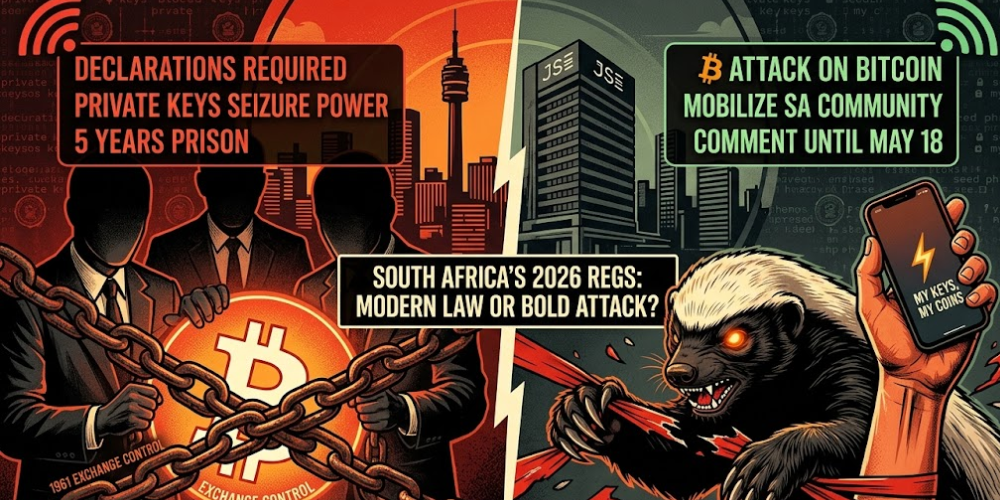
  • Mandatory Declarations: Holders must declare their global assets to the Treasury within 30 days if they meet a certain threshold.

  • Approval for Transfers: You would need government permission to move large amounts of Bitcoin offshore.

  • Draconian Enforcement: Officers could legally demand your private keys, seed phrases, or PINs.

  • Severe Penalties: Non-compliance could result in five years in prison or a R1 million fine.

A Clash with the Courts

However, the Treasury may be on thin legal ground. Recently, a High Court ruling in the Standard Bank case suggested that crypto does not fit the old legal definition of “capital.” Therefore, trying to force Bitcoin into these 1961 regulations creates a massive legal contradiction.

Moreover, these rules ignore the reality of how Bitcoin works. As a result, the government is creating a system that is almost impossible to enforce without violating basic human rights. If an officer can demand your seed phrase, then the concept of “private property” in South Africa has effectively disappeared.

Pushing Innovation Underground

Instead of fostering a safe environment for tech, these rules will likely have the opposite effect. Because the regulations are so strict, many honest users may move their activity offshore. Alternatively, they might move “underground” into unregulated P2P markets.

Furthermore, the push to route all activity through licensed providers (CASPs) threatens the very idea of self-custody. Ultimately, if South Africa makes it legally risky to hold your own keys, it is not regulating Bitcoin—it is attacking it.

The Window for Pushback

Fortunately, there is still time to act. The public comment period is open until May 18, 2026. As a result, the community is already mobilizing to fight these draft rules.

How to Submit Your Comment

The community is currently mobilizing because the window for feedback is very short. If you want your voice heard, you must act before the deadline.

In conclusion, South Africa stands at a crossroads. The government can either embrace the future of “Freedom Tech” or try to cage it with laws from the 1960s. However, Bitcoin was designed to be uncensorable. Consequently, the Treasury may find that you cannot easily regulate a technology that was built to bypass the very controls they are trying to impose.