
Sovereignty Can’t Be Borrowed — It’s Time to Teach Bitcoin the African Way
Across Africa, a pattern we know too well is repeating itself.
In our schools, in our religious institutions, in our governance systems — and now even in Bitcoin education — the default curriculum often comes from somewhere else. Imported. Pre-packaged. Pre-approved. Branded with global credibility.
And once again, we risk sidelining our own voices.
Today, as Bitcoin adoption grows across the continent, we are seeing a surge of programs built on Western-designed syllabi. Many are well-funded. Many are well-marketed. Many dominate headlines. But too often, they overlook something essential: Africans are already building powerful, locally grounded Bitcoin education frameworks — for Africans.
This is not about rejecting global collaboration. It is about ownership.
Sovereignty cannot be outsourced. And it certainly cannot be taught through borrowed blueprints alone.
The Invisible Absence in Imported Literature
Even in much of the imported Bitcoin literature — books, courses, frameworks — Africa is often barely present.
We are mentioned in passing. A statistic. A case study about inflation. A line about remittances.
Rarely are our histories, our pre-colonial trade systems, our indigenous monetary traditions, or our lived experiences with extraction and currency collapse given serious attention in global Bitcoin literature.
We are often mentioned — but briefly. In passing. As examples. Not as protagonists.
But to be fair, I would not blame foreign authors for this.
They write from their realities. Their economic histories. Their policy battles. Their cultural frameworks. It is not their responsibility to center African monetary history in books written primarily for their audiences.
That responsibility belongs to us.
And that is precisely the point.
If our stories are missing, it is not because they are unimportant — it is because we have not written them loudly enough, consistently enough, or collectively enough.
When your narrative is always interpreted through someone else’s lens, your sense of agency quietly shrinks. Not because others are malicious, but because absence becomes normalization.
Instead of continuously adapting imported narratives that barely acknowledge us, we should be writing our own. We should be documenting our own monetary histories. We should be producing African-authored Bitcoin books, curricula, documentaries, and research. We should be supporting African resources created by Africans who understand the terrain, the language, the psychology, and the lived realities of this continent.
Rather than worshipping foreign literature or treating global endorsement as the highest mark of legitimacy, we should treat our own intellectual production with equal seriousness.
If Bitcoin is about self-sovereignty, then narrative sovereignty must follow.
And that begins with us choosing to write.
A Necessary Clarification
To be clear: I do not blame Bitcoin education projects for choosing imported curricula.
Often, the organizations funding these initiatives are the same organizations behind those materials. Naturally, projects lean toward the frameworks that come with institutional backing, grants, and ready-made infrastructure.
That is understandable.
What becomes painful, however, is the growing narrative in Africa that education itself is somehow secondary — or worse, dismissed.
We’ve seen education projects labeled as “churches.” Looked down on as less important than tools, protocols, or infrastructure. Treated as optional, soft, or emotional.
But this framing is deeply flawed.
There is no sector of the Bitcoin ecosystem that is least important.
Tools matter. Infrastructure matters. Nodes matter. Marketplaces matter.
But without education, who will understand these tools?
Without understanding, who will use them?
And without usage, what remains?
You cannot build circular economies without informed participants.
You cannot scale Lightning without people who understand self-custody.
You cannot talk about sovereignty without teaching responsibility.
Education is not decoration. It is foundation.
The Problem with the Imported Curriculum
When education arrives as an export, it often arrives detached from context.
Most Bitcoin curricula and literature are written with an underlying assumption: the learner already has disposable income.
The user is imagined as someone deciding how to allocate savings. Someone choosing between stocks, bonds, and Bitcoin. Someone optimizing a portfolio.
But that assumption does not reflect the full African reality.
In many parts of this continent, the person learning about Bitcoin may be:
-
Unemployed and actively searching for work.
-
Employed but earning wages that barely cover rent and food.
-
Supporting extended family members.
-
Recovering from inflation shocks that wiped out previous savings.
-
Living in an environment where eating today is more urgent than saving for tomorrow.
How do you teach “save 10% of your income in Bitcoin” to someone who hasn’t eaten in two days?
How do you speak about “long-term allocation strategies” to someone whose primary concern is survival this week?
This is not a theoretical critique. It is lived reality.
Modules designed for high-speed internet, credit-card economies, and functioning financial systems rarely translate seamlessly into environments shaped by:
-
Mobile money dominance like M-PESA and MoMo
-
Persistent inflation in Naira, Cedi, Kwacha, or Birr
-
Intermittent power and limited bandwidth
-
Deep scars from localized fraud and trust breakdowns
-
Informal markets and relational economies
In many Western narratives, Bitcoin is framed through Wall Street lenses — ETFs, institutional adoption, portfolio diversification.
In African realities, Bitcoin must be framed differently.
It is not first about portfolio theory.
It is about survival, mobility, and optionality.
It is about:
-
Preserving value when currency melts rapidly.
-
Receiving remittances without losing 10–15% to fees.
-
Holding something outside unstable systems.
-
Earning small amounts of sats through digital work.
-
Building micro-savings habits from near zero.
-
Creating new income pathways through Lightning and peer networks.
In some communities, the starting point is not “How do I protect my wealth?” but “How do I earn my first sats?”
An African-rooted curriculum must acknowledge this honestly. It must meet people where they are — not where global frameworks assume they should be.
If we ignore these realities, we risk presenting Bitcoin as a luxury instrument for those who already have financial cushion.
But for many Africans, Bitcoin is not a diversification tool.
It is a potential lifeline.
When we rely too heavily on foreign-designed syllabi, we risk teaching Bitcoin as speculation instead of survival infrastructure — and in doing so, we fail the very people who could benefit most from understanding it in context.
The Subtle Danger of External Validation
When we consistently elevate “partnership-heavy” programs stamped with global endorsements, we unintentionally send a message:
Legitimacy comes from outside.
That message is familiar. It echoes colonial education systems that sidelined indigenous knowledge. It mirrors cultural reshaping through foreign media. It reflects a long history of being told that expertise must be imported.
Bitcoin was supposed to break that cycle.
It promised no gatekeepers. No central authority. No permission required.
But if we teach it through the same dependency patterns we claim to escape, we dilute its power before it even takes root.
The Path Forward: Intention and Ownership
We can collaborate globally while anchoring locally.
This is not about isolation. It is about balance. It is about refusing to disappear inside someone else’s framework.
If Bitcoin is truly borderless, then its expression should be locally rooted.
That means we must be intentional.
We can:
-
Prioritize African-authored Bitcoin books, courses, and research.
-
Fund and amplify educators already working quietly in their communities.
-
Encourage writing, publishing, and documenting African monetary history and Bitcoin journeys.
-
Stop ranking education below infrastructure as if one can exist meaningfully without the other.
-
Ask harder questions before adopting external frameworks simply because they carry global validation.
Before launching a new course, forming a partnership, or promoting a curriculum, we should pause and ask:
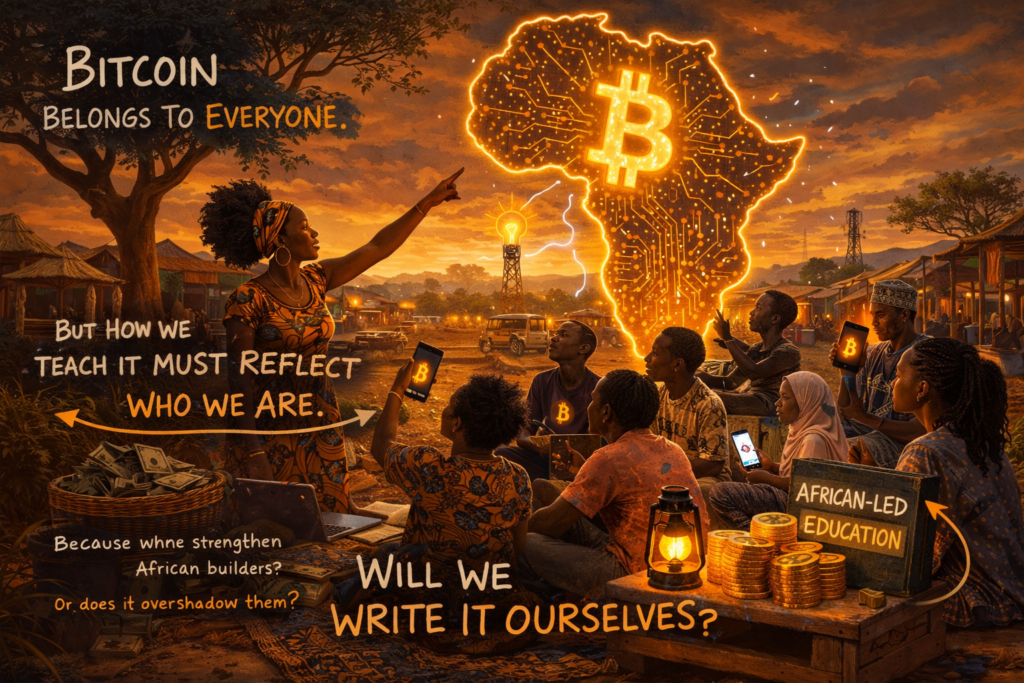
Does this strengthen African builders?
Or does it unintentionally overshadow them?
Bitcoin belongs to everyone.
But how we teach it must reflect who we are.
If we do not actively center African-led education now, we risk building a version of “Bitcoin for Africans” shaped more by distant priorities than by the lived realities of markets, townships, villages, campuses, and informal economies across this continent.
Sovereignty is not something we download.
It is something we define.
And if Bitcoin is truly a tool for freedom, then Africa must teach it in her own voice — with cultural depth, historical awareness, practical relevance, humility, and unapologetic pride.
The narrative is still being written.
The question is simple:
Will we write it ourselves?