Most Africans Are Not Using Bitcoin the Way You Think
From the outside, Africa is often seen as a continent constantly trying to catch up. Catch up with technology. Catch up with development. Catch up with the global economy. When global conversations about innovation happen, Africa is usually discussed as a future market, not a present one.
That same mindset shapes how many people think about Bitcoin adoption in Africa. When people outside the continent hear about Africans using Bitcoin, they often imagine young people trading on apps, chasing quick profits, or speculating on price movements.
But that picture is largely wrong.
Across the continent, many Africans are using Bitcoin for far more practical reasons. Not to get rich, but to survive inflation, move money across borders, and protect what little value they have.
For millions of people, the problem is not access to sophisticated investment products or high yield opportunities. The real problem is much more basic. How do you save money in an environment where your local currency keeps losing value? How do you send money to another country without paying huge fees? How do you receive payments from abroad when you do not have access to global banking infrastructure?
These are everyday questions for Africans, and they shape how Bitcoin is actually used on the ground.
In countries like Nigeria, Ghana, Kenya, and Zimbabwe, inflation is not an abstract economic concept. It is something people feel directly in their daily lives. The same amount of money buys less food, less fuel, less rent, and less opportunity every year. Saving in local currency often feels like running on a treadmill that keeps speeding up. You work, you save, and yet your purchasing power quietly disappears.
Traditional alternatives are also limited. Dollar accounts are restricted or difficult to access. Foreign exchange controls make it hard to move money freely. Real estate is out of reach for most young people. Stock markets are either inaccessible or poorly trusted. For many, the only realistic option is to hold cash and hope for the best.
This is where Bitcoin enters the picture, not as a speculative asset, but as a tool for financial self defense.
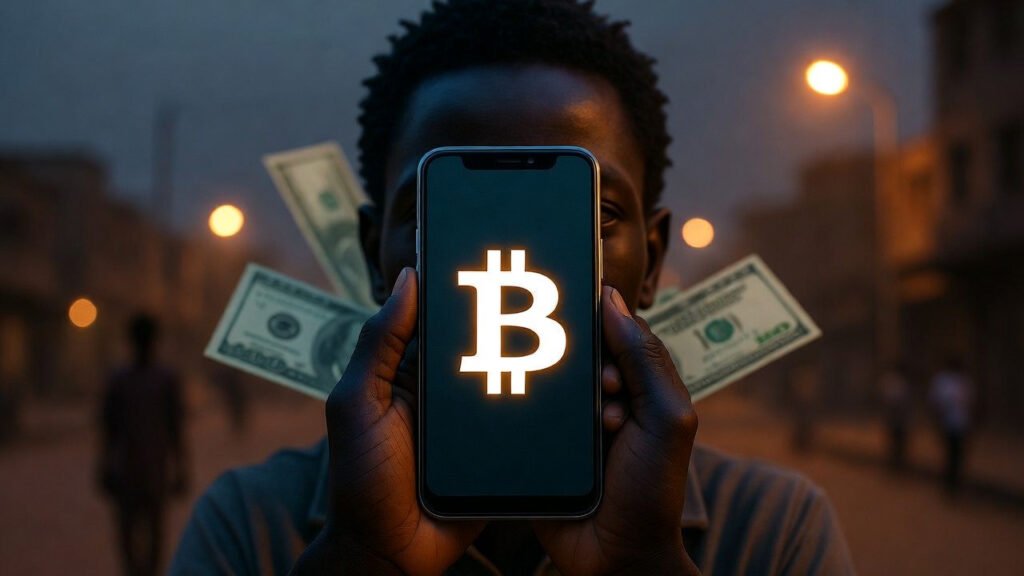
Bitcoin gives Africans something they rarely have access to. A way to store value in an asset that is global, scarce, and not directly tied to the policies of any local government or central bank. With just a smartphone and an internet connection, someone in Lagos or Nairobi can hold the same asset as someone in London or New York, without asking for permission from a bank.
Bitcoin in Africa is not a wealth creation tool. It is a wealth preservation tool.
This shift in usage is also reflected in broader data. Africa consistently ranks among the highest regions in the world for peer to peer Bitcoin usage, according to multiple industry reports, especially in countries facing currency instability and capital controls.
For freelancers and remote workers, Bitcoin is often a payment rail before it is an investment. Designers, developers, writers, and educators across Africa use Bitcoin to receive payments from international clients who cannot easily pay into African bank accounts. Instead of waiting days for wire transfers or losing money to intermediaries, they receive value directly and instantly.
A Nigerian freelancer I spoke to recently told me he stopped saving in naira entirely. After watching his earnings lose value month after month, he started converting a portion of every payment into Bitcoin. Not because he believed it would make him rich, but because it was the only way he felt he could preserve the value of his work over time.
For families and diaspora communities, Bitcoin is increasingly used for remittances. Sending money across borders in Africa is still expensive and slow. In some corridors, fees can reach double digits. Bitcoin allows people to send value directly to relatives back home without relying on traditional money transfer services.
For merchants and small businesses, especially in border towns and online markets, Bitcoin offers a way to accept payments from anyone, anywhere. No chargebacks. No complex onboarding. No restrictions based on nationality or location.
In many of these cases, people are not thinking about charts, price predictions, or market cycles. They are thinking about stability, access, and control.
This difference in mindset became especially visible during the EndSARS protests in Nigeria in 2020. When traditional financial channels were restricted and some activist groups had their bank accounts frozen, many protesters turned to Bitcoin as a way to continue receiving donations and funding support. Not as a political statement, but as a practical workaround. Bitcoin worked when other systems failed.
That moment revealed something important. Bitcoin in Africa is not just about economics. It is about resilience.
This is why the Bitcoin narrative in Africa is fundamentally different from what exists in more developed economies.
In Silicon Valley, Bitcoin is often framed as an investment or a hedge in a diversified portfolio. In Africa, Bitcoin is closer to infrastructure. It is a piece of financial plumbing that simply works when other systems do not.
It is not replacing luxury banking services. It is replacing broken ones.
For many Africans, Bitcoin is not an investment. It is an exit strategy from broken money.
That does not mean there are no challenges. Bitcoin is still volatile, and that volatility can be scary for people who are already financially vulnerable. Education around self custody is still low, which exposes users to scams and bad actors. Internet access and power reliability remain real barriers in many regions.
But despite these limitations, adoption continues to grow, not because of hype, but because of necessity.
Africa has a long history of leapfrogging technology. The continent skipped landlines and went straight to mobile phones. It skipped physical banking infrastructure and moved to mobile money. Now, it may skip traditional savings systems and move directly to open, digital, global money.
Not because it is fashionable.
But because, for many Africans, it is the first time saving actually makes sense.
In the coming years, it will not be surprising to see a generation of Africans who never opened a traditional savings account, but who know how to self custody Bitcoin, use Lightning, and transact globally. Not because they are tech obsessed, but because they are practical.
That is the part most people outside Africa still do not see.
Bitcoin here is not about the future of finance.
It is about the present reality of survival.