How Bitsavers Eduhub Is Challenging Financial Exclusion
What if Africa’s biggest barrier to financial freedom isn’t access to money, but access to the knowledge needed to understand it?
Imagine a university student in Nairobi receiving a monthly allowance. Transport becomes more expensive, food consumes a larger portion of their budget, and whatever little remains is expected to stretch until the next month.
They hear about Bitcoin. Someone describes it as digital gold. Another calls it a speculative gamble. Someone else promises overnight riches.
But nobody explains how it works, what makes it different, how to secure it, or why understanding money matters in the first place.
This is where an important conversation about Bitcoin education in Africa begins.
Is Financial Exclusion Also an Information Problem?
Africa’s financial inclusion conversation often revolves around access to banking, mobile money and credit. Yet another barrier deserves equal attention: financial literacy.
Millions of young Africans are entering an increasingly digital economy without adequate exposure to alternative financial systems, personal financial management or the technologies reshaping global money.
Bitcoin presents an opportunity to explore a different monetary system. However, opportunity without understanding can quickly become vulnerability.
Price speculation, misleading investment promises, scams and poor wallet security can turn curiosity into costly mistakes.
The problem isn’t necessarily that Africans aren’t interested in Bitcoin. It is that interest frequently arrives before education.
You cannot meaningfully participate in a financial revolution you barely understand.
Bitsavers Eduhub: Making Bitcoin Education Practical.
This is the educational gap that Bitsavers Eduhub seeks to address.
Based in Kenya, Bitsavers Eduhub is a youth-focused initiative committed to equipping people with the knowledge and practical tools to pursue greater financial independence through Bitcoin.
Rather than reducing Bitcoin to price movements and market speculation, its educational approach explores the fundamentals of Bitcoin, saving strategies, dollar-cost averaging (DCA), and self-custody.
These are important distinctions.
Understanding Bitcoin’s monetary principles helps learners look beyond daily price fluctuations. Learning about self-custody introduces the responsibility of controlling one’s own private keys. Exploring DCA provides a framework for understanding consistent saving rather than making emotionally driven market decisions.
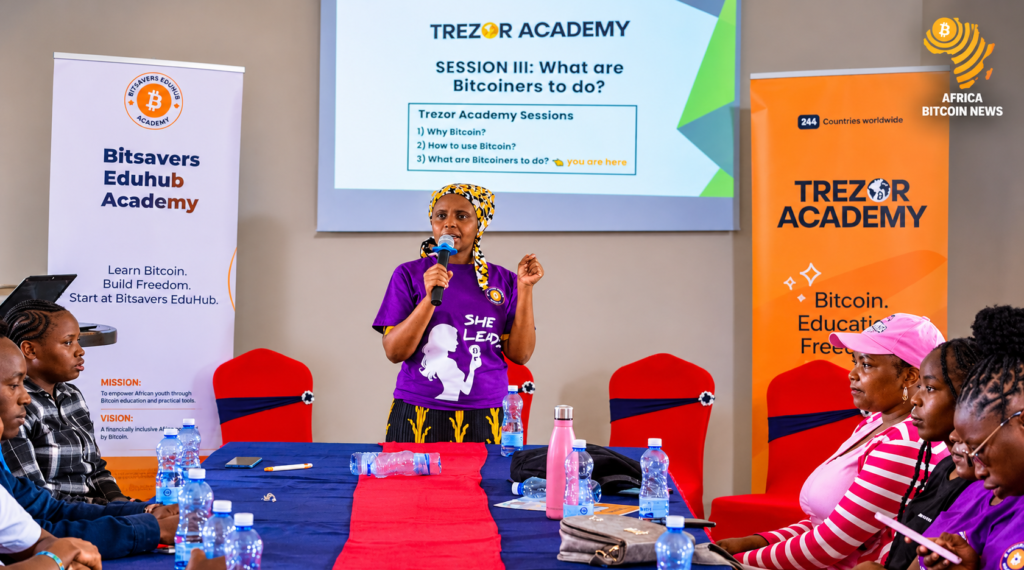
Through cohort-based learning, mentorship, peer engagement and campus outreach, Bitsavers is taking these conversations beyond online Bitcoin communities and into spaces where young Africans can question, experiment and learn.
Its wider educational activities also explore Lightning Network payments, merchant onboarding and the development of Bitcoin-powered circular economies.
The objective is not simply to create more Bitcoin holders. It is to cultivate more informed Bitcoin participants.
Beyond Owning Bitcoin: Understanding Financial Sovereignty.
Perhaps the most important lesson Bitsavers Eduhub brings to the table is that financial independence begins with understanding responsibility.
“Bitsavers EduHub is dedicated to educating individuals, students, and entrepreneurs on Bitcoin adoption, payments, and financial sovereignty“
Self-custody, for instance, is empowering, but it also demands discipline. Losing access to private keys can mean losing access to funds. Bitcoin’s price volatility also means that it should never be presented as a guaranteed protection against financial hardship.
Education must therefore include both possibilities and risks.
For young Africans navigating inflation, unemployment and limited economic opportunities, understanding how Bitcoin works can expand their financial vocabulary and introduce new ways of thinking about savings, ownership and exchange.
More importantly, community-based education creates opportunities for knowledge to travel.
A student who understands Bitcoin can introduce a friend. A graduate can educate a family member. A merchant who learns how Lightning payments work can explore accepting Bitcoin from customers.
That is how education can move from individual awareness to grassroots adoption.
Who Gets to Understand the Future of Money?
Africa has one of the world’s youngest populations. Its next generation will participate in shaping the future of technology, commerce and finance.
But will that generation merely consume financial innovations developed elsewhere or understand the systems well enough to participate in building them?
Bitsavers Eduhub represents one answer to this challenge: start with education, build confidence through practical learning, and allow informed participation to follow.
Bitcoin is not a magical solution to Africa’s economic challenges. It cannot independently eliminate unemployment, reverse inflation or solve structural inequality.
But denying people access to the knowledge required to evaluate emerging financial technologies is another form of exclusion.
Perhaps the real measure of Bitcoin adoption should not be how many wallets Africans open, but how many people understand what they are doing when they open them.
Because financial freedom without financial literacy is simply another form of dependence.
Are We Teaching Africa to Use Bitcoin or Simply Telling Africa to Buy It?
If Bitcoin is about individual sovereignty, shouldn’t understanding it be the first step towards experiencing it?
Explore Bitsavers Eduhub, engage with its educational initiatives, and challenge yourself to learn before you leap.
If you already understand Bitcoin, ask yourself: Who is one person you could help understand it today?
Knowledge is the first transaction. Freedom is what we build with it.
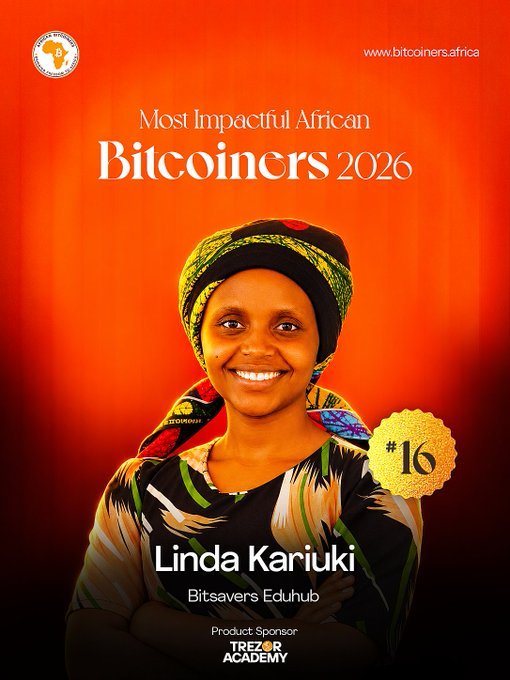
From classrooms and campus meetups to practical Bitcoin use, Linda Kariuki, the Founder of Bitsavers Eduhub is helping create pathways for more young Kenyans to understand, use and participate in the Bitcoin economy through Bitsavers Eduhub in collaboration with Trezor Academy
As a local host and organiser of Trezor Academy Kenya, Linda has helped build a consistent education pipeline, graduating more than 120 students across five cohorts.
In October 2026, Cohort 8 brought together another 35 participants from Kenyatta University, JKUAT, and KCA University.
Through Bitsavers Eduhub, she has also trained 100+ learners across three cohorts, covering Bitcoin, dollar-cost averaging, and financial inclusion. Beyond structured programmes, Linda has organised campus Bitcoin meetups, engaging around 150 participants, and helped build a Bitcoin circular economy around the JKUAT community. Through practical tools such as Bitika and Tando, she is helping students move from learning about Bitcoin to using it.
Her work also extends to women and youth-focused education, including volunteering as an educator with AfriBit Kibera and supporting Bitcoin education within university communities.
Thank you, Linda, for making Bitcoin education accessible to young Africans and selflessly driving Bitcoin Adoption in Africa.
Get the Weekly Brief
Essential African Bitcoin news, curated for builders. No spam.
"*" indicates required fields